

AI in Cross-Team Workflow Alignment
AI is reshaping how teams work together by addressing common collaboration challenges like miscommunication, data silos, and time wasted on repetitive tasks. Businesses lose up to 10% of revenue due to disconnected teams, with employees spending 100 minutes daily switching between apps. AI tools reduce these inefficiencies by automating workflows, improving communication clarity, and consolidating information.
Key Takeaways:
- AI-powered workflows are projected to grow from 3% to 25% by the end of 2025.
- Workers using AI report a 72% productivity boost, while manual tasks drop by 40%.
- Multi-agent AI systems cut task handoff errors by 40–60% and speed up responses by 12 hours.
- Companies like CVS Health and Broadcom have cut support resolution times by automating processes.
AI doesn't just make collaboration easier - it transforms how teams share information, manage tasks, and focus on high-value work. By automating repetitive actions and providing a unified view of data, AI eliminates delays and helps teams align faster and more effectively.
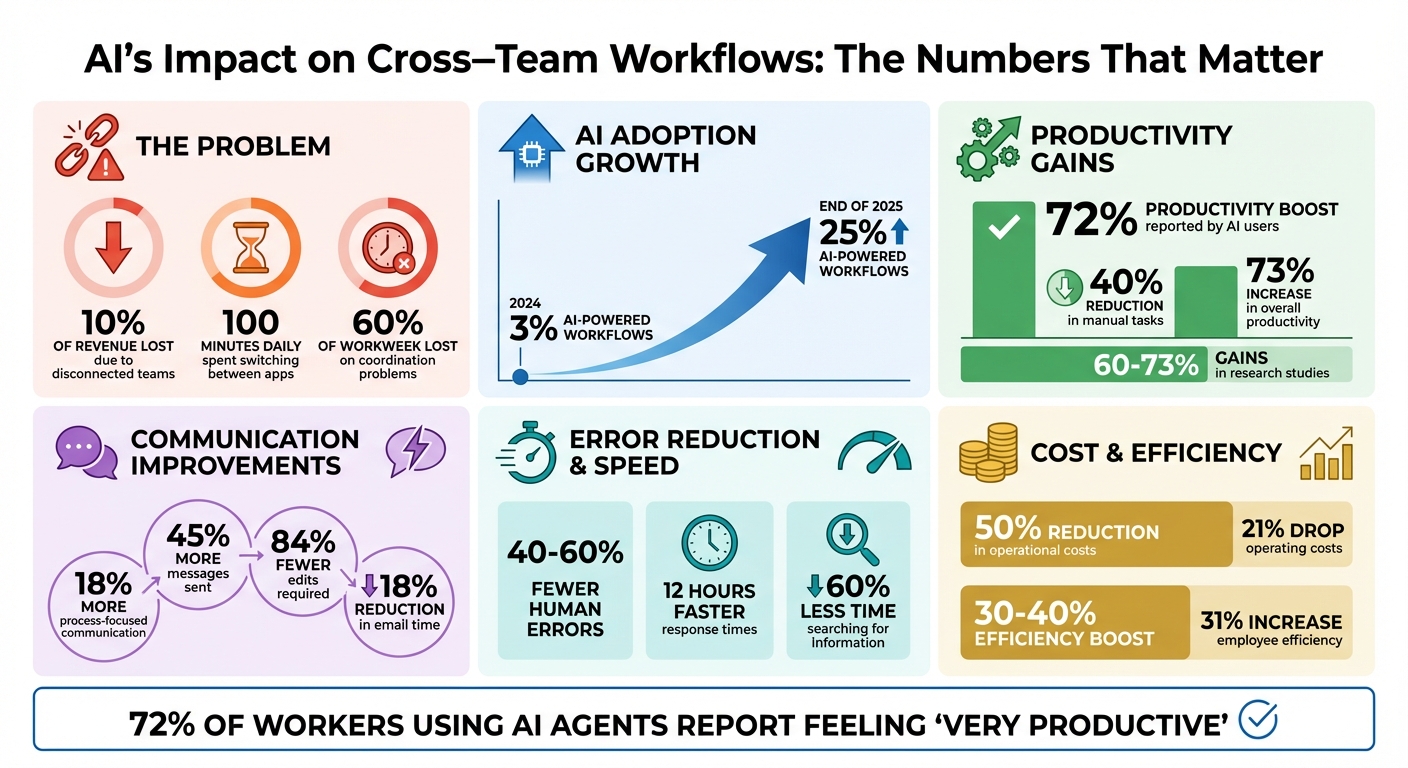
AI Impact on Cross-Team Workflow Efficiency: Key Statistics and Benefits
How AI Improves Cross-Team Communication
Reducing Miscommunication and Improving Message Clarity
AI is transforming the way teams interact and share information. Studies reveal that human-AI collaborations involve 18% more process- and content-focused communication compared to traditional team setups. In contrast, human-only teams allocate 29% more time to social and emotional exchanges. This shift allows teams to prioritize critical tasks like planning, prioritizing, and solving problems instead of spending excessive time on rapport-building.
An MIT experiment using MindMeld highlighted AI's role in enhancing communication efficiency. Human-AI teams sent 45% more messages but required 84% fewer edits, leading to a 23% increase in time spent on generating content and a 20% drop in text editing efforts. This streamlined approach significantly reduced the back-and-forth clarification cycles that often slow teams down.
"AI's involvement in collaborative settings can drive productivity and performance by enabling participants to focus more on the content, possibly by reducing the social coordination costs of collaboration."
– Harang Ju, Researcher, MIT
Real-world applications back up these findings. A field experiment at Procter & Gamble demonstrated how AI synthesizes diverse viewpoints to create solutions that balance technical and commercial priorities. This eliminates unnecessary inter-departmental communication loops, freeing teams to concentrate on meaningful tasks. The result? A smoother alignment of workflows across different teams.
Streamlining Information Flow and Knowledge Access
AI doesn't just clarify communication - it also simplifies how teams access and manage information. Disorganized data can slow teams down, but AI addresses this by consolidating scattered information into a unified, easy-to-navigate view.
Organizations adopting agentic AI have reported a 31% boost in employee efficiency. Tools like Inbox Agents exemplify this improvement by integrating multiple messaging platforms into one interface. These platforms use AI to provide summaries and generate smart replies, cutting down on the need to switch between tools for context or crafting responses.
"You go to a single conversational interface in Slack, and you can interact with humans and AI. Agents are doing the work, and we've dreamt of that for decades. Now we're finally seeing it."
– Aaron Levie, CEO, Box
The rise of autonomous agents marks a significant shift from basic chatbots. These agents go beyond answering questions - they analyze data, make decisions, and perform tasks within existing workflows. Whether it’s updating systems, tracking project progress, or ensuring everyone on the team has access to the same information, this agentic layer strengthens collaboration and keeps workflows seamlessly aligned across teams.
sbb-itb-fd3217b
AI's Effect on Workflow Coordination and Task Automation
Reducing Coordination Overhead and Handoff Errors
Manual handoffs often create frustrating bottlenecks that drain productivity. Studies reveal that disconnected teams can lose up to 60% of their workweek on coordination problems - things like chasing updates, searching for files, or routing tasks between departments. AI steps in to smooth out these inefficiencies by automating the administrative work that bogs teams down with AI-powered inbox management.
Organizations leveraging AI-powered workflow automation have reported 40–60% fewer human errors, thanks to reduced reliance on manual handoffs. Beyond improving accuracy, AI-driven automation can also slash operational costs by as much as 50%, all while boosting efficiency by 30–40%. For example, instead of relying on emails or meetings, AI can automatically trigger the next step in a process - like assigning an onboarding task to the operations team as soon as a deal is finalized in the CRM.
Multi-agent AI systems take this a step further. They autonomously assign tasks, share information across departments, and even recover from errors. These systems mimic human delegation but without the usual delays. Teams using AI-native communication tools respond to cross-functional requests 12 hours faster than those sticking to traditional methods. Additionally, AI-powered search tools cut the time spent hunting for information by up to 60%, giving employees instant access to the context they need.
"When everyone can see the entire process and understands how their work affects others, you eliminate the most common source of business inefficiency."
– Dr. Michael Porter, Harvard Business School
These improvements aren't just theoretical - they translate into measurable results, as shown in the examples below.
Real-World Examples of AI in Cross-Functional Alignment
Businesses across industries are seeing real benefits from AI-driven workflow coordination. In Q1 2025, CVS Health introduced Moveworks' AI assistant, cutting live agent chats by 50% by automating routine IT and HR support tasks. Broadcom saw even greater success in Q2 2025, achieving an 88% autonomous resolution rate for internal service tickets through AI-managed cross-departmental workflows.
AI's impact extends to document-heavy processes as well. Thermo Fisher Scientific used UiPath to automate invoice processing, reducing the time required to handle 824,000 annual documents by 70%. Similarly, Morningstar reclaimed 14,976 hours annually by implementing an AI-enabled workflow pipeline for its research team, saving hundreds of thousands of dollars in time value.
Customer support teams are also reaping the rewards. RPG Group used Pipefy to train an AI system on internal HR data, enabling it to resolve 92% of employee inquiries within minutes and cutting ticket resolution times from 24 hours to just 4 hours. Meanwhile, Palo Alto Networks saved an impressive 351,000 hours of productivity in 2024 by deploying Moveworks to handle enterprise-wide support issues.
These examples illustrate how AI doesn't just speed up isolated tasks - it transforms how teams collaborate by reducing delays and errors, allowing employees to focus on higher-value, strategic work instead of getting bogged down in administrative tasks.
Employee Experience and Governance in AI-Supported Workflows
How AI Changes Team Roles and Collaboration Patterns
AI is reshaping how teams work together. By reducing direct text editing by 71% and increasing productivity by 73%, it allows employees to shift their focus from routine tasks to strategic planning. Instead of spending time on social coordination, like rapport-building or real-time inbox monitoring, teams leveraging AI prioritize content creation and high-level decision-making.
The impact goes beyond just efficiency. In an experiment conducted by Procter & Gamble with 776 professionals, AI-enabled teams created well-rounded, cross-functional proposals that equaled - or even outperformed - those generated by entirely human teams. Remarkably, AI empowered individuals to achieve results comparable to entire teams working without AI.
"Work in the future will be a partnership between people, agents, and robots - all powered by AI." – McKinsey Global Institute
This evolving partnership is changing the skills that matter most in the workplace. Human roles are shifting from task execution to "orchestration", which involves asking the right questions, interpreting AI-generated results, and overseeing AI systems. The demand for AI fluency has surged - US job postings now list it seven times more frequently than before. Additionally, organizations are rethinking their structures: 45% of leaders foresee fewer middle management layers as AI takes over coordination tasks.
To adapt, teams are creating dual career paths. One focuses on "generalist orchestrators", who manage human-AI collaborations, while the other supports "AI-augmented specialists", who combine deep expertise with AI tools. These changes are setting the stage for governance models that ensure AI is used responsibly and effectively.
Governance and Responsible AI Use in Workflows
As AI takes on more responsibility, governance becomes a top priority. 58% of leading organizations anticipate major changes to decision-making rights and governance structures due to the rise of AI-driven systems. To address these challenges, companies are dynamically adjusting AI decision rights based on the risks and complexity of specific workflows.
Many organizations are adopting a phased approach, gradually moving from observation to full autonomy. For example, a retail bank implemented this strategy in 2025 for automating credit-risk memos. Analysts shifted to strategic oversight while AI agents pulled data from over ten sources. The results were impressive: 30% faster credit turnaround times and a potential 20% to 60% boost in productivity.
Regular evaluations of AI systems are critical. These reviews focus on accuracy, adaptability, and bias, ensuring retraining occurs when needed. The most effective AI transformations follow the 10/20/70 rule: 10% of the effort goes into algorithms, 20% into technology infrastructure, and 70% into people and process adjustments.
Transparency is equally important. AI tools should link their outputs to original sources using metadata, enabling team members to verify the information behind decisions. When AI drafts documents or extracts data, it should provide confidence scores, helping supervisors identify which sections require closer manual review. This careful balance of automation and human oversight ensures that AI enhances teamwork while maintaining accountability and ethical standards.
AI for team collaboration: drive greater impact on innovation and productivity
Conclusion
AI is transforming how teams collaborate, with research showing productivity gains of 60–73% and an 18% reduction in email time. Companies that adopt agentic AI report a 31% increase in employee efficiency and a 21% drop in operating costs. These findings highlight the need for more than just incremental updates - organizations must rethink their workflows entirely.
The real game-changer isn't just automating tasks but reimagining processes from the ground up. In fact, high-performing organizations are three times more likely to overhaul their workflows when implementing AI. Studies also reveal that AI-driven workflow redesigns speed up document completion and improve communication across teams. This marks a major shift in how cross-functional teams collaborate and coordinate.
Tools like Inbox Agents take this a step further by consolidating messaging channels with features like AI-powered summaries, smart replies, and personalized responses. This unified approach ensures everyone operates from a single source of truth. It's no surprise, then, that 72% of workers using AI agents report feeling "very productive".
Success often starts small, with pilot groups testing the waters, human oversight for critical decisions, and a focus on one measurable KPI to demonstrate quick returns. As Michael Peeler, Head of GTM Analytics and Engineering at IBM, puts it:
"The most important thing to do is to start experimenting with it now".
Organizations that dive into AI-enabled workflows early are setting themselves up not just for operational improvements but for a stronger position in collaboration and innovation. This strategic move delivers efficiency gains while paving the way for long-term competitive advantages.
FAQs
How does AI help prevent miscommunication in cross-team workflows?
AI plays a crucial role in cutting through the noise of cross-team communication, turning scattered conversations into clear and actionable insights. By analyzing messages for tone, urgency, and context, it ensures that critical updates reach the right people and priority tasks are flagged for the team. This approach helps minimize the chances of missed updates, duplicate responses, and confusion over responsibilities.
AI-powered tools also make communication more efficient by reducing unnecessary back-and-forth and summarizing ongoing discussions. For example, platforms like Inbox Agents bring email, chat, and ticketing systems together into a single interface. These tools provide concise summaries and context-aware suggestions, ensuring everyone stays informed and aligned, no matter the department.
What are the main advantages of using AI systems to improve workflow alignment and automation?
AI systems, particularly those using multi-agent setups, are transforming workflow automation by assigning specific tasks - like data processing, message management, and decision-making - to a network of collaborative AI agents. These agents work in sync, forming a flexible system that can scale effortlessly across teams and departments.
Here are some standout advantages:
- Boosted efficiency and productivity: AI takes over repetitive tasks, allowing employees to concentrate on more creative and strategic responsibilities.
- Enhanced team communication: AI tools simplify messaging, summarize discussions, and help reduce misunderstandings within teams.
- Cost-effectiveness and scalability: By optimizing workflows, businesses can lower operational expenses while driving revenue growth.
Take Inbox Agents, for example. This platform consolidates messaging channels into one interface and offers AI-driven features like automated conversation summaries, smart replies, and personalized outreach. The result? Smoother collaboration and more time for employees to focus on high-value work.
How is AI transforming team roles and responsibilities?
AI is reshaping the way teams operate by handling repetitive tasks like drafting standard responses, sorting spam, and managing outreach efforts. By taking these time-consuming duties off employees' plates, AI lets team members focus on what truly matters - strategic planning, creative problem-solving, and fostering meaningful relationships.
The impact of AI on productivity is backed by data. In one experiment involving human-AI collaboration to create over 11,000 ads, AI helped boost messaging volume by 137% while cutting routine editing time by 20%. This shift allowed employees to spend 23% more time on core content creation, which led to improved quality in their work. Corporate surveys echo these findings, showing that AI tools function as "digital teammates", enabling workers to oversee AI-generated outputs instead of being bogged down by manual tasks.
For businesses that rely heavily on messaging platforms, tools like Inbox Agents highlight this transformation. These platforms consolidate multiple inboxes into a single interface and provide AI-driven features like automated summaries and smart replies. By reducing the burden of inbox management, such tools give teams the freedom to focus on strategic priorities, personalized customer engagement, and driving impactful business outcomes.