


AI in Customer Journey Mapping: Key Benefits
AI is reshaping how businesses understand and engage with customers. It replaces outdated, manual methods of customer journey mapping with real-time, data-driven insights and predictions. Here’s why it matters:
- Real-Time Insights: AI continuously updates customer journey maps based on live data, unlike static, outdated traditional methods.
- Predictive Analytics: It forecasts customer behavior, helping businesses prevent churn and boost retention.
- Personalization at Scale: AI enables tailored experiences for each customer, improving satisfaction and loyalty.
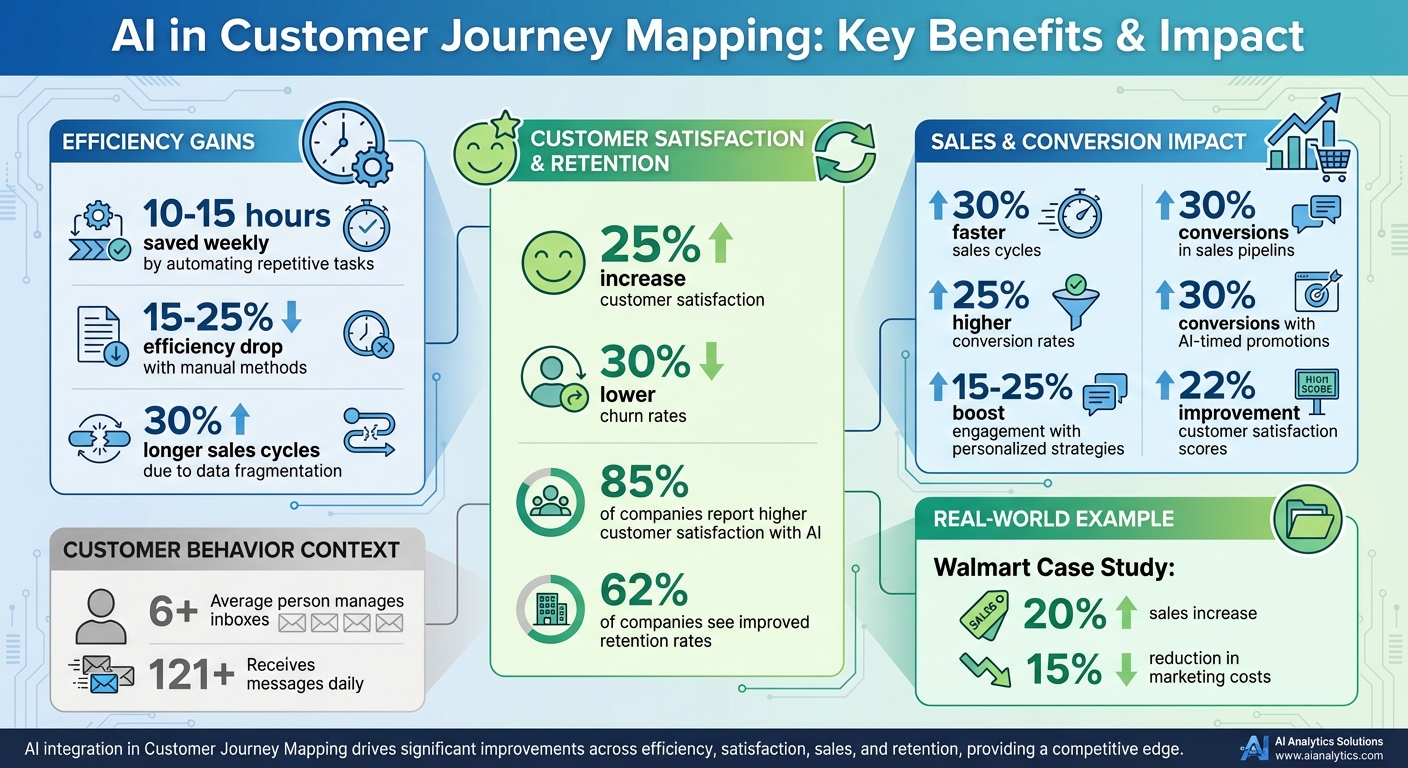
- Efficiency Gains: Automating repetitive tasks saves teams 10–15 hours weekly, allowing them to focus on more strategic work.
- Measurable Impact: Companies using AI report a 25% increase in customer satisfaction, 30% lower churn rates, and faster sales cycles.
For example, Walmart used AI to analyze customer data, achieving a 20% sales increase and cutting marketing costs by 15%. Similarly, Inbox Agents centralizes messaging across platforms, providing a unified view of customer interactions and smarter engagement tools.
AI transforms customer journey mapping into a dynamic system that evolves with customer behavior, delivering better experiences and driving revenue growth.
AI Customer Journey Mapping: Key Statistics and Benefits
A Deeper Dive Into AI-Powered Journey Mapping
Problems with Traditional Customer Journey Mapping
Traditional customer journey mapping often falls short when it comes to truly understanding customers. A major issue lies in how data from various channels - like email, SMS, social media, and messaging apps - remains disconnected. Picture this: a customer browses products on your website, gets an email promotion, and later interacts with your brand on Instagram. Traditional mapping methods struggle to link these touchpoints. This fragmentation can stretch sales cycles by as much as 30%. On top of that, with the average person juggling six or more inboxes and receiving over 121 messages daily, manually tracking these interactions becomes nearly impossible. The result? Incomplete and ineffective journey maps.
The process of manually piecing together customer journeys is another significant hurdle. Teams often spend 10–15 hours each week gathering and organizing data, only to find that the maps they create are outdated by the time they’re ready for analysis. Instead of being actionable tools, these maps end up as static visuals. Without automation, businesses face a 15–25% drop in efficiency when trying to glean insights, leaving them perpetually playing catch-up as customer behavior evolves in real time.
The most damaging flaw, however, is the lack of personalization. Traditional methods rely on generic messaging derived from aggregated data. For instance, sending every customer the same post-purchase email, regardless of their browsing history or preferences, fails to resonate. This one-size-fits-all approach can slash engagement and conversion rates by 15–25% compared to more tailored strategies. It’s a missed opportunity to create meaningful connections with customers and drive loyalty.
How AI Improves Customer Journey Mapping
AI has revolutionized the way businesses understand and enhance the customer journey. By unifying scattered data, predicting behaviors, and automating personalized interactions, AI shifts customer journey mapping from static diagrams to dynamic, actionable tools. It doesn’t just collect data - it connects the dots, offering a real-time, evolving view of each customer’s experience. Let’s break down how AI achieves this through data integration, predictive insights, and automation.
Combined Real-Time Data
One of AI’s biggest strengths is its ability to consolidate data from multiple channels into a single, cohesive view. Whether it’s emails, social media interactions, website activity, or phone calls, AI pulls all these touchpoints into a unified dashboard. By leveraging machine learning and natural language processing, AI integrates fragmented data sources and eliminates the guesswork caused by siloed systems. This continuous, real-time flow of insights allows teams to understand customer behavior as it happens, rather than relying on outdated or incomplete snapshots.
Predictive and Prescriptive Analytics
AI doesn’t just observe - it anticipates. By analyzing historical trends and real-time signals, it predicts customer actions, like identifying when someone might stop engaging. For example, if AI detects signs of disengagement - such as unopened emails or abandoned shopping carts - it can suggest specific actions, like sending a personalized discount or a timely follow-up message. One e-commerce company working with SuperAGI reported a 30% increase in conversions by using AI to strategically time promotions. This proactive approach helps businesses not only retain customers but also deepen their engagement.
Automation and Timely Engagement
Speed and personalization are essential in today’s customer experience, and AI excels at both. It automates responses based on customer behavior, ensuring no opportunity is missed. For instance, if a potential buyer spends time on your pricing page, AI can instantly send a tailored follow-up email. If a loyal customer goes quiet, AI can trigger a check-in message without waiting for human intervention. Companies using AI for sales automation have reported 30% faster sales cycles, 25% higher conversion rates, and a 22% improvement in customer satisfaction. On top of that, sales teams save 10–15 hours per week on repetitive tasks, allowing them to focus on more complex, relationship-driven interactions. The result? A customer experience that feels both efficient and genuinely attentive.
sbb-itb-fd3217b
Key Benefits of AI in Customer Journey Mapping
AI isn't just changing customer journey mapping - it’s revolutionizing how businesses understand and connect with their customers. Let’s break down the key ways AI delivers value, going far beyond just saving time.
Deeper Customer Insights
AI can sift through massive amounts of customer data from various touchpoints to uncover patterns and behaviors that traditional methods often overlook. By using machine learning, it identifies hidden preferences and pain points, transforming raw data into actionable strategies. This means businesses can make smarter, faster decisions to fine-tune every interaction along the customer journey.
Real-Time Adjustments
Traditional journey mapping offers static snapshots, but AI takes it a step further with constant monitoring of customer behavior. This real-time capability allows businesses to address issues as they arise, rather than relying on delayed, retrospective analysis. For example, if a customer shows signs of frustration - like abandoning their cart or exiting a page - AI can trigger immediate interventions to re-engage them.
Personalized Experiences at Scale
AI makes personalization more than just a buzzword. By analyzing individual customer behaviors and preferences, it tailors interactions to feel relevant and timely. Instead of generic messaging, customers receive content that speaks directly to their needs at every stage of their journey, creating a more meaningful connection.
Boosted Retention and Revenue
Predictive analytics powered by AI can flag early warning signs of churn, such as reduced engagement or abandoned carts. By addressing these signals proactively, businesses can intervene before losing a customer. Studies show that 85% of companies report higher customer satisfaction, and 62% see improved retention rates when using AI for journey mapping . These stronger relationships often lead to higher revenue.
Streamlined Team Efficiency
AI takes over repetitive tasks like data collection, analysis, and routine responses, freeing up teams to focus on what really matters - building relationships and tackling complex customer challenges. With the heavy lifting handled by technology, teams can invest their energy into more strategic, customer-focused work.
These advantages pave the way for more dynamic customer engagement, including real-time messaging journeys powered by unified platforms.
Real-Time Messaging Journeys with Inbox Agents
Inbox Agents takes the power of AI and applies it to real-time messaging, creating sharper and more effective customer engagement.
Unified Messaging for a Complete Customer View
Switching between multiple platforms for SMS, email, and social media often leaves teams scrambling to piece together a customer’s journey. Inbox Agents eliminates this hassle by consolidating all messaging platforms - like Gmail, Outlook, LinkedIn, Instagram, WhatsApp, and Messenger - into one centralized workspace. For each customer, messages, timestamps, and agent actions from all channels are combined into a single thread. This way, a support agent can see exactly where the conversation started, whether it was an email, a social media inquiry, or a text message follow-up. This unified view helps teams spot issues like delayed responses or repeated questions and makes it easier to track which interaction led to a purchase or prevented churn.
AI Tools to Refine Customer Journeys
AI takes the guesswork out of understanding customer interactions. Inbox Agents uses AI to turn complex message data into actionable insights. For example, automated inbox summaries condense multi-channel conversations into quick overviews of key issues and actions, saving teams from sifting through every individual message. Features like smart replies and personalized responses adapt to customer behavior using natural language processing. If a customer hesitates over pricing, the system might suggest a discount. If strong buying intent is detected, it could schedule a follow-up automatically. Studies show that such AI-driven personalization can boost customer satisfaction by 25% and improve conversion rates by 15–25%. All of these tools work together to make messaging smarter and more efficient.
Seamless Integration and Real-Time Updates
Inbox Agents doesn’t just enhance messaging - it connects seamlessly with your CRM to ensure all insights are actionable. Conversations are automatically logged, keeping contact records, deal stages, and support tickets up to date in real time. For example, if a deal moves to “proposal sent” in your CRM, Inbox Agents instantly updates its labels and priorities. This two-way sync ensures that messaging flows and AI suggestions always match the latest stage of the customer journey. Teams can react immediately when customers show frustration or a strong interest in buying. Users report saving significant time by automating repetitive tasks while still delivering timely, personalized responses across all messaging platforms.
Conclusion
AI has reshaped customer journey mapping into a dynamic system that evolves alongside customer behavior. Businesses can now monitor activity across multiple channels, anticipate customer needs, and deliver personalized experiences on a large scale. The results speak for themselves: companies leveraging AI in their journey mapping report a 25% boost in customer satisfaction and a 30% drop in churn rates. Sales teams, too, are seeing tangible benefits, with deal cycles shortening by up to 30% and conversion rates climbing by 15–25%.
One of AI's standout advantages is its ability to combine speed and personalization without requiring larger teams. Automation takes over repetitive tasks, freeing up your team to focus on strategy and more complex challenges. Meanwhile, real-time analytics identify pain points before they escalate into customer loss.
To enhance these benefits, tools like Inbox Agents simplify customer communication even further. For businesses juggling conversations across email, social media, SMS, and messaging apps, this AI-powered platform brings everything together in one interface. With features like smart replies, automated summaries, and personalized responses, every interaction becomes more efficient and meaningful. By incorporating the full conversation history, Inbox Agents ensures that customer engagement is timely, relevant, and informed - putting the real-time personalization and data insights discussed earlier into action.
If you're ready to integrate AI into your customer journey strategy, start small. Audit your existing data, test an AI tool with a specific segment, and set measurable goals like improving response times or increasing conversion rates. Track your progress over 30–90 days, and involve a cross-functional team to fine-tune your approach as new insights emerge. This ensures your AI-driven strategies stay aligned with both customer needs and your business objectives.
AI doesn’t just improve journey mapping - it transforms it into a learning system that gets smarter with every interaction. Businesses that embrace this shift will provide better experiences, keep more customers, and unlock steady revenue growth. Those who hesitate risk falling behind competitors who are quicker, more personalized, and continuously improving.
FAQs
How does AI enhance personalization in customer journey mapping?
AI pushes customer journey mapping to new heights by diving deep into individual communication habits, preferences, and behaviors. It fine-tunes interactions to match each customer's specific tone, language, and relationship dynamics, making every exchange feel personal and relevant.
With these real-time insights, businesses can build stronger connections, boost engagement, and provide experiences that genuinely resonate with each customer.
What are the biggest challenges with traditional customer journey mapping?
Traditional customer journey mapping faces several challenges. One of the biggest hurdles is the lack of real-time insights, which makes it difficult to keep up with customers' evolving needs. On top of that, it often depends on manual data collection, leaving room for errors or outdated information. To complicate matters further, tracking dynamic customer behaviors across various channels is no easy task, often leading to blind spots in understanding the complete customer experience.
What’s the best way for businesses to start using AI in their customer journey strategies?
To integrate AI into customer journey strategies, businesses can utilize tools like Inbox Agents. These tools bring all messaging platforms together in one interface, making it easier to manage conversations. Plus, they offer AI-powered features like automated inbox summaries, smart replies, and personalized responses.
With AI, businesses can monitor customer interactions in real time, automate routine tasks, and create tailored experiences that align with each customer's preferences. This approach not only boosts engagement but also uncovers new revenue opportunities and simplifies communication, creating a smoother and more effective customer journey.