


How AI Scores Buyer Intent in Messaging Platforms
AI helps businesses identify potential customers by analyzing messaging data like emails, social media chats, and business communications. It assigns a score (0–100) to measure how likely someone is to make a purchase. This system saves time by focusing on high-priority leads, using powerful language models like GPT-3 and BERT to detect signals such as urgency, questions about pricing, or repeated inquiries.
Key Points:
- AI analyzes text, tone, and behaviors to predict buyer intent.
- Scores combine factors like urgency (40%), topic relevance (30%), sentiment (20%), and recent activity (10%).
- Multi-channel integration (e.g., Slack, WhatsApp, Gmail) ensures no lead is missed.
- Real-time updates help sales teams act faster and prioritize leads effectively.
Businesses using AI for buyer intent scoring report:
- 11.6× efficiency boost for sales teams.
- 25% higher conversion rates and shorter sales cycles.
- Insights show that 88% of buyers don’t visit pricing pages, highlighting the importance of conversational signals.
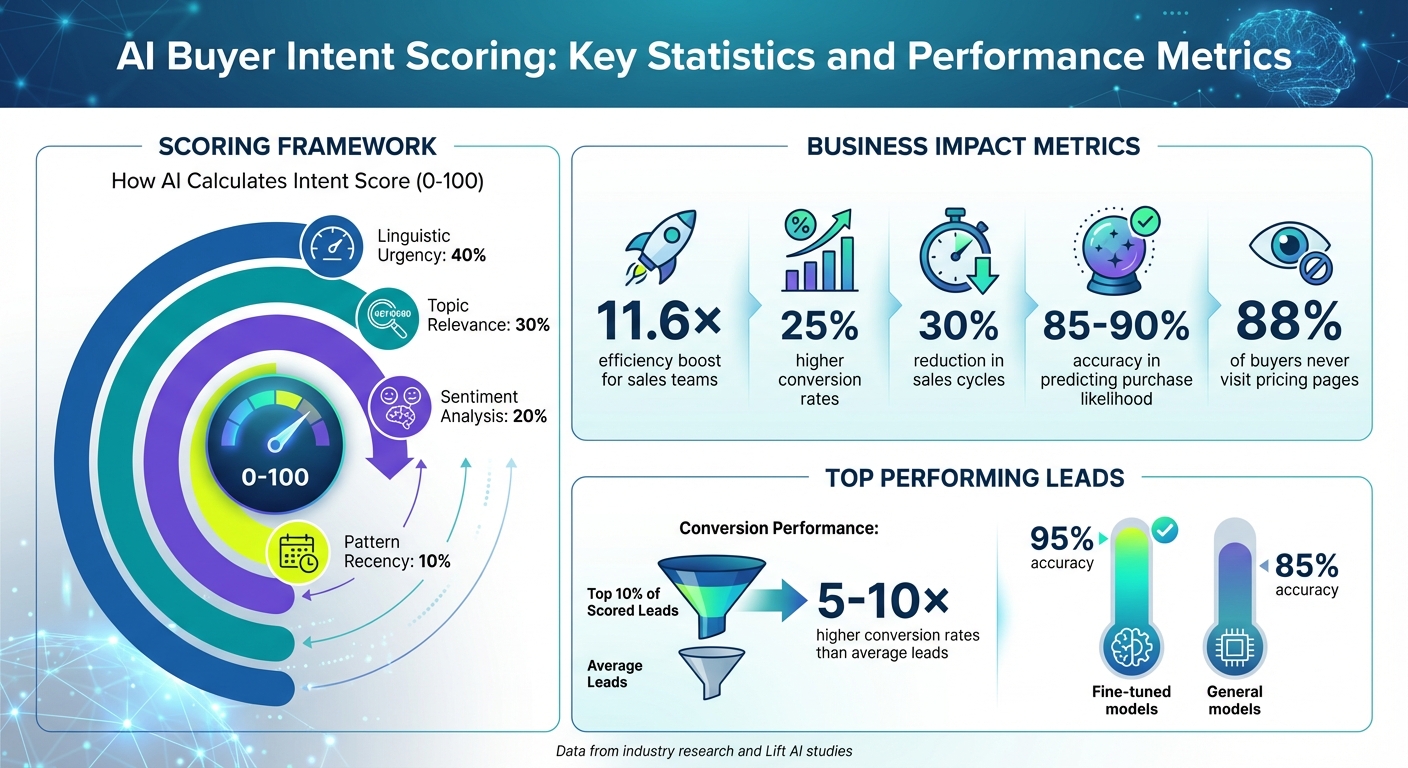
AI Buyer Intent Scoring: Key Statistics and Performance Metrics
Latané Conant & Anne Hollander • Decoding Buyer Intent with 6AI 3
Signals AI Uses to Detect Buyer Intent
AI uses a variety of signals to evaluate buyer intent, refining its scoring framework to provide a clearer picture of a prospect's readiness to purchase. These signals generally fall into three categories: behavioral signals, linguistic cues, and interaction patterns. Each offers valuable insights into how close a prospect may be to making a buying decision.
Behavioral Signals
Behavioral signals are all about actions that reveal a prospect’s level of engagement. For instance, a prospect who sends multiple messages in a single day - rather than just checking in weekly - is likely showing heightened interest. Similarly, rapid responses, like replying within five minutes, suggest urgency and active consideration. Another key indicator? The number of questions asked. A prospect asking detailed questions about implementation or logistics is often signaling deeper interest. Advanced AI systems analyze these micro-behaviors in real time, helping to identify and prioritize engaged prospects.
Linguistic Cues
Linguistic cues focus on the words and tone prospects use in their messages. Sentiment analysis plays a big role here, assessing whether the emotional tone is positive, neutral, or negative. Enthusiastic or excited language often correlates with higher purchase intent, and AI models can predict buying likelihood with 85–90% accuracy by identifying these emotional shifts. Certain phrases - like "pricing", "discounts", "demo", or "when can we start" - serve as clear indicators that a prospect is moving into the advanced stages of consideration. Additionally, analyzing the overall tone - whether it’s formal, urgent, or consultative - adds another layer of insight into intent scoring.
Interaction Patterns
Interaction patterns go beyond isolated actions or specific words, offering a broader view of a prospect’s intent. For example, requesting a demo signals active evaluation, while mentioning competitors may indicate that the prospect is weighing options. Repeated questions about specific features, implementation timelines, or ROI calculations suggest sustained interest. Modern AI models bring these signals together, cross-referencing behavioral, linguistic, and interaction data to create a more complete picture. By analyzing hundreds of micro-signals simultaneously, these systems avoid over-reliance on any single metric, ensuring more accurate and reliable prioritization.
How Pre-Trained Language Models Score Intent
Pre-trained language models like BERT and GPT-3 have reshaped how AI identifies buyer intent within messaging platforms. By analyzing the structure of conversations and gauging sentiment, these models can differentiate between casual inquiries and urgent, high-priority messages. This detailed understanding sets the stage for accurate intent scoring.
Natural Language Understanding in Messaging
These models rely on transformer architectures to break down text into tokens, create embeddings, and apply attention mechanisms to understand word relationships. For example, a message mentioning "user count" may indicate a deeper evaluation phase. BERT is particularly effective at interpreting short conversational snippets by analyzing text in both directions, while GPT-3 and similar models excel at tracking intent across multi-turn conversations. They recognize topics through entity detection - picking up on terms like "pricing", "demo", or "implementation" - and assess intent levels by analyzing patterns in phrasing. A message like "need this ASAP" paired with positive sentiment is flagged as high-intent, whereas vaguer queries are categorized as lower priority.
How Scoring Mechanisms Work
Using these analytical tools, AI assigns a measurable intent score. This process involves a regression or classification layer that evaluates four key factors: linguistic urgency (40%), topic relevance (30%), sentiment (20%), and pattern recency (10%). The result is a score ranging from 0 to 100, where 100 reflects the highest likelihood of conversion. For instance, Lift AI processes hundreds of micro-signals in real time to produce these scores, helping businesses identify their most promising leads.
Today’s buyer-intent models achieve an impressive 85–90% accuracy in predicting purchase likelihood by learning from historical conversion data. Fine-tuning further enhances performance - models trained on domain-specific datasets, such as sales chat logs labeled by outcomes, can improve accuracy from a general 85% to over 95% for intent-related tasks. This customization allows the AI to adapt to platform-specific nuances, whether it’s the concise nature of WhatsApp messages or the formal tone of emails. In unified messaging systems, intent scores are updated in real time as new messages arrive, enabling platforms to prioritize high-intent conversations immediately. For example, Inbox Agents uses these scoring techniques to consolidate messages from multiple channels, ensuring critical communications are addressed without delay.
Research Findings on Buyer Intent Analysis
Recent studies shed light on how pre-trained models interpret buyer intent, emphasizing the importance of combining signal weighting and real-time scoring for more accurate predictions.
Signal Weighting in AI Models
Both academic and industry research highlight that integrating behavioral data from multiple sources with content-based signals significantly outperforms relying on single-signal methods. For example, analyzing micro-behaviors - like message frequency or response time - alongside content cues, such as inquiries about pricing, leads to better accuracy compared to evaluating these elements in isolation.
Engagement metrics, while offering broader recall, tend to have lower precision. On the other hand, content-driven interactions provide higher precision but occur less frequently. A quick reply might indicate baseline interest, but intent scores rise dramatically when specific linguistic markers are detected. Phrases like "What's the total cost per month in USD for 10 users?" or "We're deciding this quarter" are strong indicators of advanced buying stages. This combined approach has been shown to drive significant results, with leads in the top 10% achieving conversion rates five to ten times higher than the average lead.
Interestingly, research from Lift AI, which analyzed billions of events and millions of conversions, found that 88% of buyers never visit the pricing page. This finding underscores the limitations of older tools that prioritize pricing-page visits as key intent signals. Instead, modern models must focus on capturing nuanced micro-behaviors and their sequences to better assess intent.
Using these insights, AI models refine their real-time evaluations by incorporating historical data.
Real-Time Scoring with Historical Data
While weighted signals improve precision, historical data plays a vital role in enhancing real-time scoring. By studying historical messaging patterns, AI can identify trajectories from initial contact to conversion, learning to predict outcomes more effectively. When pre-trained models are fine-tuned with large datasets containing message text, timestamps, communication channels, and outcomes, they can estimate purchase probabilities in real time. These scores are updated continuously as conversations progress.
Platforms that retrain their models with recent U.S. messaging data report significant improvements. For instance, Lift AI claims that its real-time buyer-intent scoring system can boost sales efficiency by up to 11.6× when sales teams prioritize high-intent prospects. In unified inbox systems, historical cross-platform data - including email threads, SMS, live chat logs, and marketplace messages - helps prevent double-counting and ensures that responses from the same buyer are correctly attributed. This is essential for maintaining accurate and stable live scores.
A two-stage process is often used to balance responsiveness and stability. The first stage involves a fast streaming model that updates scores in real time based on the latest message content and metadata. The second stage uses a batch model to periodically recalculate long-term propensity, incorporating factors like past deals, website activity, and engagement history across platforms. This hybrid method allows for sub-second updates while avoiding abrupt score fluctuations caused by isolated interactions.
This architecture is crucial for unified messaging platforms. For example, tools like Inbox Agents combine real-time conversation-level intent scores with aggregated account-level insights. This setup enables sales teams to quickly identify and prioritize high-value opportunities, ensuring efficient and targeted outreach efforts.
sbb-itb-fd3217b
Challenges and Best Practices for AI Intent Scoring
Implementing AI-driven buyer intent scoring in messaging platforms comes with its share of challenges. The complexity of modern communication tools, combined with the demand for real-time precision, creates obstacles that require thoughtful and effective solutions.
Data Unification Across Platforms
One of the biggest challenges is pulling together data from a variety of messaging channels into a single, cohesive dataset. Sales teams interact with prospects across platforms like email, SMS, LinkedIn, Instagram, WhatsApp, Discord, and Slack - each with its own data structure and unique identifiers. Connecting users and conversations across these platforms is no small feat, and incomplete data can weaken the reliability of intent scores.
Adding to the complexity are privacy regulations like GDPR and CCPA, which dictate how conversation logs and behavioral data can be stored and shared. Companies must ensure they have proper consent mechanisms, limit data collection to what’s absolutely necessary, and implement strict access controls - all while retaining enough historical context to generate accurate scores. Identity resolution, which involves linking a buyer’s interactions across different email addresses, phone numbers, and social media profiles, is particularly tricky. Poor resolution can lead to issues like double-counting signals or fragmenting a buyer’s journey. But when done right, it not only meets privacy requirements but also sharpens the accuracy of intent scoring.
To tackle this, organizations often rely on robust API integrations for both first- and third-party data. For example, Inbox Agents consolidates data across various channels, enabling precise and unified analysis. Once data is unified, the next step is ensuring the AI models stay current with evolving buyer behaviors.
Continuous Model Training and Feedback
AI models need to adapt regularly as buyer behaviors shift, new communication platforms emerge, and product language evolves. Without ongoing updates, models can experience drift, reducing their accuracy over time. A key challenge here is obtaining high-quality labeled data for retraining, especially when it involves linking messaging histories to outcomes like closed deals.
Creating feedback loops is critical for fine-tuning these models. For instance, when a high-intent score results in a successful conversion, the AI learns to recognize similar patterns. On the flip side, when a flagged conversation turns out to be a support ticket or a misclassified interaction, that feedback helps reduce future errors. Lift AI, for example, incorporates micro-behavior feedback from millions of sales transactions, leading to an impressive 11.6× boost in sales efficiency. Allowing sales teams to label conversations in real time further enhances the model’s accuracy. Regularly monitoring precision and recall metrics is essential to quickly identify and address any drift in the model's performance.
Real-Time Prioritization in Unified Inboxes
After unifying data and fine-tuning models, the next challenge is managing high messaging volumes in real time. Even with unified data and advanced AI models, sales teams can easily become overwhelmed by the sheer number of messages, risking missed opportunities. Traditional tools that rely on basic signals, like page views, often fall short when it comes to analyzing the subtle micro-behaviors that drive intent.
Unified inbox solutions address this by aggregating signals into one streamlined view. AI can then score and rank conversations based on behavioral and linguistic cues. For instance, Inbox Agents employs AI-powered "smart triage" to filter out spam and highlight high-priority leads. Features like its Dollarbox, which identifies messages with revenue potential, and automated daily briefings that summarize key conversations, help sales teams focus on what matters most. Remarkably, these systems often achieve high accuracy within just one to two weeks of consistent use.
To get the best results, AI-driven sorting is paired with human oversight. This ensures that high-intent conversations trigger appropriate responses - whether through automated replies, follow-ups, or routing - while leaving room for strategic decision-making. This hybrid approach allows organizations to act on opportunities as they arise without compromising the nuanced judgment needed for complex sales scenarios.
Future Directions in AI-Powered Buyer Intent Scoring
AI-powered buyer intent scoring is stepping into a new era, moving beyond text-only analysis to embrace multi-modal data. By combining text, voice notes, audio calls, images, and behavioral metadata, these systems aim to provide a more complete understanding of buyer interest. This shift toward cross-channel intelligence enhances the ability to detect meaningful signals that text alone might miss.
Multi-Modal Analysis
Next-generation solutions are expanding on traditional text-based models by integrating additional forms of data. Messaging platforms now frequently support voice notes, video clips, and media sharing, enabling future intent scoring models to analyze these formats alongside text. This approach captures subtleties that words alone can’t convey. For example, audio sentiment analysis can detect urgency or hesitation in a prospect’s tone during a call or voice message, while shared visuals - like product screenshots or pricing sheets - can indicate heightened interest.
By analyzing speech patterns, speaking rates, and emotional markers from audio, and cross-referencing them with text-based cues, multi-modal models create a more nuanced understanding of buyer intent. Imagine a scenario where a prospect sends a voice note asking about pricing right after viewing a product demo. The combination of these signals carries far more weight than either would on its own, enabling sales teams to zero in on the most promising leads.
Platforms like Inbox Agents are already paving the way by offering instant voice transcription for channels like email, LinkedIn, Instagram, Discord, WhatsApp, and Messenger. These tools convert spoken messages into text in real time, allowing AI to analyze both the content and context of audio alongside written communications. This richer dataset makes it easier to identify "hot opportunities" and prioritize messages with clear revenue potential, outperforming traditional text-only models.
Adaptive Scoring for Unified Messaging
Incorporating multi-modal data is just one piece of the puzzle. Adaptive scoring ensures that insights remain accurate and relevant across different communication platforms. Each platform has its own communication style - a quick, casual message on WhatsApp is vastly different from a formal email, but both can signal strong buyer intent. Adaptive AI models adjust their scoring methods to reflect these platform-specific nuances rather than applying a one-size-fits-all approach.
These models use continuous learning to fine-tune features for each channel. For example, they might interpret email open rates and reply times differently from WhatsApp read receipts or LinkedIn InMail acceptance rates. All these signals are then merged at the account level, creating a unified intent score that reflects the buyer’s journey across email, SMS, and social media.
Inbox Agents exemplifies this approach by consolidating communications from multiple platforms into a single intelligent interface. Its AI learns the unique communication styles, tone, and relationship dynamics of each user across channels. The platform’s Dollarbox feature specifically tracks messages with revenue potential, adjusting its scoring based on how each platform is used. Within a week or two of regular use, the system refines its accuracy through user feedback and priority adjustments. This ensures that whether a prospect reaches out via LinkedIn or WhatsApp, the AI can quickly identify and prioritize conversations that matter most.
Conclusion
AI-powered intent scoring brings together behavioral, linguistic, and interaction signals into one actionable score. By using pre-trained language models, it captures subtle cues - like urgency, pricing inquiries, or language used by decision-makers - that simple keyword triggers often overlook. These models assign probabilistic scores, enabling teams to zero in on conversations most likely to drive revenue [6,13].
The productivity benefits are undeniable. Focusing on high-intent prospects can increase sales team efficiency by as much as 11.6×. Companies leveraging intent data report a 25% boost in conversion rates and a 30% reduction in sales cycles [4,7]. These improvements are powered by real-time prioritization in unified inboxes, where high-intent messages automatically surface - whether they come through email, WhatsApp, LinkedIn, or SMS [2,13]. Tools like Inbox Agents highlight this approach by consolidating multi-channel conversations and using AI to spotlight top-priority leads in just a few weeks. This dynamic scoring system is proving to be a game-changer.
As discussed earlier, continuous model training and unified data are key. Models that incorporate feedback from successful and failed deals, merge signals across platforms, and adapt to shifting buyer behaviors consistently outperform static lead scoring systems [6,13]. While challenges like data fragmentation and model drift persist, strategies such as robust integration, ongoing evaluation, and human oversight help address these issues.
Looking ahead, multi-modal analysis will combine text with voice transcripts, attachments, and visual content to create even deeper intent profiles. Adaptive scoring will further refine models to fit each business’s unique context [2,8]. Starting with straightforward use cases to prove ROI before scaling automation is a practical path forward [2,13].
The takeaway is straightforward: AI-driven intent scoring transforms disorganized, high-volume messaging into an efficient, revenue-focused workflow. It enables fast, precise responses at a scale previously unattainable [2,4].
FAQs
How does AI evaluate and prioritize leads in messaging platforms?
AI sifts through messages to evaluate and rank leads by examining both the content and context of the communication. It pays close attention to key factors like urgency, potential revenue, and time-sensitive details, as well as patterns in how senders behave and engage.
With this data, the system can automatically prioritize leads, ensuring that the most critical or promising opportunities get immediate attention. This allows businesses to focus their energy on what truly matters, streamlining efforts and boosting productivity.
How does AI use language cues to evaluate buyer intent?
AI uses linguistic cues like tone, sentiment, and context to make sense of messages and evaluate buyer intent. By studying subtle patterns in language, it can pick up on signals that indicate interest, curiosity, or even a readiness to act.
This kind of analysis gives businesses deeper insights into customer behavior, allowing them to engage more effectively and deliver personalized communication that aligns with individual needs.
How can businesses protect customer data when using AI to analyze buyer intent?
Businesses looking to use AI for intent analysis while safeguarding customer data can take several critical steps. Start with strong encryption to secure sensitive information during storage and transmission. It’s equally important to comply with data protection laws such as GDPR and CCPA, ensuring customer privacy is respected.
Another effective measure is anonymizing data, which removes identifiable details, reducing the risk of exposure. Limiting data access strictly to authorized personnel further strengthens security.
To stay ahead of potential threats, conduct regular audits of AI systems. These reviews help ensure compliance with privacy standards and uncover any vulnerabilities. By focusing on these practices, businesses can protect customer data while maintaining their trust.