

AI Segmentation for Outreach: Ultimate Guide
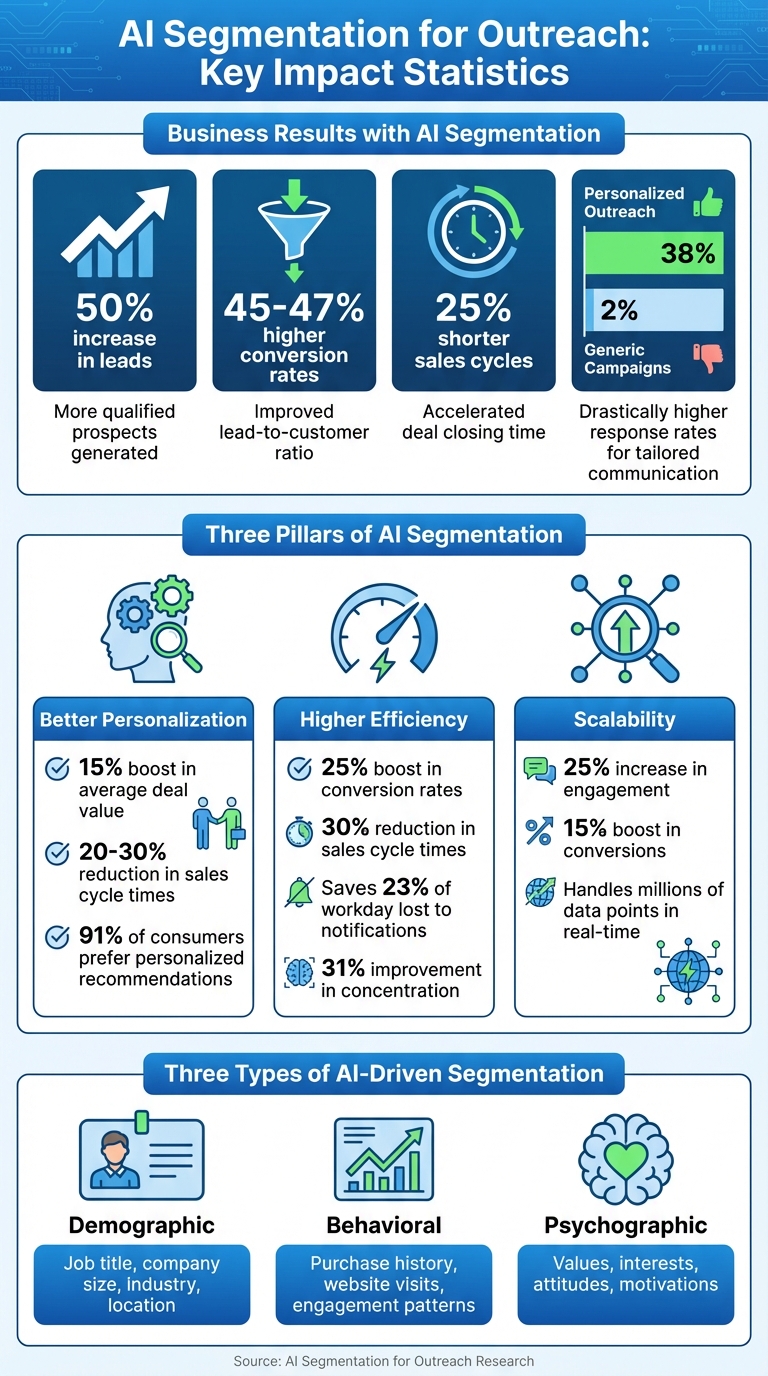
AI segmentation transforms outreach by dividing audiences into precise groups using machine learning. It analyzes demographics, behaviors, and psychographics to create real-time, targeted campaigns that improve engagement and conversions. Businesses using AI segmentation report:
- 50% more leads and conversion rates up by 45–47%.
- 25% shorter sales cycles and 38% response rates for personalized outreach.
- Tools like Inbox Agents streamline communication across platforms like email and LinkedIn, prioritizing high-value interactions.
Key benefits include:
- Personalized messaging tailored to each audience group.
- Efficient data processing, saving time and improving focus.
- Scalability, handling large datasets and dynamic updates.
AI segmentation combines demographic, behavioral, and psychographic insights to deliver relevant, well-timed messages. It’s reshaping outreach strategies, making campaigns more precise and impactful.
AI Segmentation Impact: Key Statistics and Benefits for Outreach Campaigns
Unlock Your Audience: Master AI-Powered Smart Segmentation 🚀
Benefits of AI in Audience Segmentation
AI is reshaping how businesses approach audience segmentation, offering unmatched levels of personalization, efficiency, and the ability to handle large-scale operations. Here's a closer look at how it transforms outreach campaigns.
Better Personalization
AI dives deeper than traditional demographic categories, analyzing individual preferences and behaviors to create messaging that truly connects. Instead of broad strokes, it identifies patterns like optimal email open times or browsing habits to deliver tailored content. For instance, Lenovo and Juniper Networks used AI-driven segmentation to automate personalized campaigns across emails and landing pages. The result? Millions saved and increased conversion rates. Another example comes from a fitness brand that used psychographic insights to target eco-conscious customers with messages about sustainable gear, leading to a 15% boost in average deal value and cutting sales cycle times by 20–30%. AI can even trigger outreach based on real-time behavioral cues, ensuring the right message reaches the right person at the perfect moment.
Higher Efficiency
Gone are the days of spending weeks manually sorting through customer data. AI streamlines this process, pulling information from CRM systems, websites, and social media, and refining it automatically. This efficiency helps professionals reclaim focus, as constant notifications can eat up 23% of their workday and reduce concentration by 31%. Tools like Inbox Agents take it a step further, consolidating communications from platforms like email, LinkedIn, and Slack into one interface. Messages are then categorized into folders like Revenue Opportunities or Investor Updates, allowing teams to prioritize what matters most. Companies such as HubSpot have seen a 25% boost in conversion rates and a 30% reduction in sales cycle times thanks to this approach.
Scalability for Large Data Sets
AI shines when it comes to handling massive amounts of data. Machine learning techniques, like clustering and predictive modeling, uncover patterns across millions of data points, creating dynamic segments that update in real time. For example, companies like EventX use AI to analyze behavioral, firmographic, and technographic data simultaneously, identifying micro-categories traditional methods often miss. This capability ensures businesses can maintain personalization, even as their contact lists grow from hundreds to hundreds of thousands. SuperAGI offers a great example, achieving a 25% increase in engagement and a 15% boost in conversions through personalized content delivery. Tools like Inbox Agents further demonstrate AI's scalability by managing hundreds of messages daily across multiple platforms, ensuring every response reflects the prospect's full communication history and position in the buyer's journey.
Types of AI-Driven Audience Segmentation
AI is transforming how businesses understand and reach their audiences by leveraging three key segmentation methods: demographic, behavioral, and psychographic. Each method offers unique insights that, when combined, create a clearer picture of your target audience.
Demographic Segmentation
This method categorizes people based on key attributes like job title, company size, industry, income, location, and education. AI simplifies this process by pulling data from CRM systems, enrichment tools, and public sources, then updating and standardizing it in real time. For example, in B2B marketing, you can target specific roles - like VPs of Marketing - or companies that meet certain criteria, such as revenue brackets. Tools like EventX's Lead Finder can even identify high-quality leads and segment event attendees by age or occupation for tailored invitations.
When you combine demographic data with behavioral insights, your targeting becomes razor-sharp. Imagine narrowing your focus to "Directors of IT at mid-market SaaS companies who visited your pricing page in the last seven days." Campaigns built on this level of detail are far more relevant than those based solely on broad demographic categories.
Behavioral Segmentation
Behavioral segmentation zeroes in on actions - such as purchase history, website visits, email engagement, content downloads, feature usage, or even cart abandonment. AI thrives in this space, identifying patterns across vast datasets that would overwhelm manual analysis. According to Invoca, 91% of consumers prefer brands that offer personalized recommendations and relevant offers.
Platforms like Outreach.io leverage real-time behavioral signals to prioritize leads and fine-tune outreach efforts. For instance, instead of sending generic emails, you can craft targeted sequences triggered by specific behaviors, like revisiting your pricing page multiple times. Personalized outreach like this often delivers response rates as high as 38%, compared to just 2% for generic campaigns. AI can also categorize users into segments such as "highly engaged" or "inactive but ready for re-engagement", ensuring outreach happens at the perfect moment.
Psychographic Segmentation
Psychographic segmentation digs deeper into what makes people tick - analyzing their values, interests, attitudes, and motivations. AI uncovers these insights by examining social media activity, content preferences, survey data, and even the language used in communications. This approach allows you to connect on a more emotional level, going beyond demographics and behaviors.
For example, AI might identify groups like "early adopters who thrive on innovation", "budget-conscious efficiency seekers", or "decision-makers passionate about sustainability." Messaging can then be tailored to appeal to each group’s priorities, whether that’s emphasizing cutting-edge features, ROI, or environmental benefits. Tools like M1-Project's ICP Generator can sift through social data to reveal these deeper traits, enabling outreach that resonates on a personal level.
Bringing It All Together
By integrating demographic, behavioral, and psychographic data, AI creates dynamic, ever-evolving profiles of your audience. These profiles update in real time as new information comes in, allowing for highly targeted and automated outreach. For instance, platforms like Inbox Agents use these insights to tag conversations, suggest tailored responses, and coordinate outreach across multiple channels like email, SMS, and LinkedIn.
The result? Communication that feels personal and timely, every time. Combining these segmentation methods ensures your marketing efforts are not only precise but also deeply relevant to your audience’s needs and motivations.
How to Implement AI Segmentation in Outreach Campaigns
Set Clear Outreach Goals
Start by defining specific and measurable goals for your outreach campaigns that align with your business objectives. Instead of vague aims like "increase engagement", set precise benchmarks, such as boosting email open rates by 20%, increasing conversions by 15%, or improving click-through rates from 2% to 5%. These specific targets not only guide your AI system but also provide a clear way to measure the success of your segmentation efforts.
Collect and Organize Your Data
AI segmentation thrives on clean, accurate data. Gather information from all available sources, such as your CRM (like HubSpot), website analytics, purchase history, social media interactions, and email engagement. Tools like Google Analytics or integrated platforms can help consolidate this data into one place. Once collected, clean the data by removing duplicates, standardizing formats (e.g., MM/DD/YYYY), and validating its accuracy. Poor data quality can reduce the effectiveness of campaigns by as much as 30%. Platforms like Inbox Agents simplify this process by merging communications from email, LinkedIn, Instagram, Slack, and WhatsApp into a single, intelligent inbox, giving your AI a complete picture of interactions. With clean and unified data, you can start applying AI-driven segmentation techniques.
Use AI Tools for Dynamic Segmentation
Now it’s time to put your organized data to work. Use AI tools like machine learning clustering and predictive modeling to create dynamic audience segments. These tools group individuals based on behaviors, such as how often they make purchases or engage with your content. They can also predict future actions, helping you identify high-value leads or frequent engagers. This real-time segmentation allows you to tailor your outreach to specific behaviors, ensuring your messages resonate with each audience group.
Automate Your Outreach Campaigns
Once your segments are in place, let AI take over the task of crafting and delivering personalized messages at scale. AI analyzes each segment to tailor content - for example, highlighting sustainability features for environmentally conscious users or focusing on ROI for budget-driven decision-makers. Tools like Inbox Agents can automate outreach across multiple channels, using smart replies and personalized messaging to save time and effort. This approach not only boosts response rates but also reduces the manual workload for your team.
Monitor Performance and Optimize
After automating your campaigns, keep a close eye on performance metrics. Track key indicators like engagement rates, conversion rates, ROI, bounce rates, and response rates for each segment. Aim for response benchmarks in the 25–35% range. Use AI analytics to conduct A/B testing on different segments and refine your strategies based on what performs best. Over time, the AI will learn from these results, improving its segmentation and personalization capabilities. Most AI systems achieve high accuracy within 1–2 weeks of consistent use and feedback, so regular monitoring and adjustments are essential.
sbb-itb-fd3217b
AI Tools and Techniques for Audience Segmentation
When it comes to audience segmentation, advanced AI tools can take your strategies to a whole new level, offering a level of precision and efficiency that’s hard to achieve manually.
Machine Learning Clustering
Machine learning clustering relies on algorithms like k-means and hierarchical clustering to group audiences based on shared traits - without needing rigid pre-set rules. These algorithms sift through data points like visit frequency, purchase habits, engagement levels, and content preferences to uncover natural groupings within your audience.
For instance, a B2B SaaS company might use clustering to categorize leads by how deeply they use the product and the volume of support tickets they’ve submitted. This could result in groups like “power users” (ideal for upsell opportunities), “stuck evaluators” (who need educational resources), and “at-risk accounts” (requiring proactive attention). On the other hand, an e-commerce brand could segment customers by factors such as average order value, browsing behavior, or responsiveness to discounts, enabling highly focused email campaigns for “loyal high-value buyers” versus “bargain shoppers.” What’s more, as new behavioral data comes in, these clusters are continuously refined, making your segments increasingly accurate over time.
Once clusters are established, predictive techniques can further fine-tune your approach by anticipating customer actions.
Predictive Personalization
Predictive personalization takes segmentation a step further by using AI models to forecast future customer behaviors rather than solely analyzing past actions. These models generate actionable scores - like a customer’s likelihood to make a purchase, cancel their subscription, or engage with your content - so you can prioritize and customize your outreach before they even act.
For example, a retail brand might use propensity-to-buy scores to zero in on the top 20% of customers most likely to make a purchase, driving up ROI compared to generic campaigns. Meanwhile, a subscription-based company could use churn risk scores to identify accounts that are likely to disengage and enroll them in a customer success program with targeted incentives or educational content. At the same time, accounts showing strong engagement could receive expansion offers. Over time, these models improve as they process more data, making your personalization efforts sharper and more effective.
With these refined segments in place, tools like Inbox Agents can streamline your outreach, ensuring every message hits the mark.
Inbox Agents for Outreach Management
Inbox Agents simplifies outreach by bringing together multiple communication platforms - email, LinkedIn, Instagram, WhatsApp, Slack, Discord, and more - into one intelligent dashboard. This unified view is crucial because clustering and predictive models are most effective when they analyze behavior across channels, not in isolated silos.
Using AI, Inbox Agents identifies messages with high “revenue potential” and organizes them into priority categories. Its smart triage system filters out low-value content like spam, letting you focus on leads that matter. Additionally, it offers smart replies and personalized responses, drawing on conversation history and predefined business rules to craft contextually relevant messages that stay true to your brand’s tone. For outbound campaigns, you can sync segmentation data - such as “loyal high-value buyer” or “churn_score = 0.82” - to automate tailored sequences with specific cadences, offers, and messaging. Within just a couple of weeks, the AI adapts to your unique terminology and relationship patterns, making it a powerful tool for small and mid-size teams seeking enterprise-level automation without the complexity of building custom solutions.
Best Practices and Common Mistakes in AI Segmentation
To make the most of the AI segmentation framework, it’s crucial to focus on three key principles: clean data, proper segmentation, and continuous refinement. Ignoring any of these can lead to segments that waste both time and money.
Prioritize Data Quality
The success of AI-driven segmentation hinges on the quality of your data. Inaccurate or outdated data - such as duplicate records or irrelevant contacts - can lead to poor targeting and ineffective campaigns. For instance, one company saw response rates plummet to just 2% when promoting eco-friendly products to users with no interest in sustainability. However, after cleaning their data and incorporating behavioral signals, response rates soared to 38%.
To get started, centralize your data from all available sources - CRM systems, website analytics, email platforms, support tickets, and social media interactions. This creates a comprehensive view for your AI to work with. Regular data hygiene practices, like deduplication, standardization, and periodic validation, are essential. Tools such as Inbox Agents can help automate these processes, saving time and ensuring accuracy.
Avoid Over-Segmentation
Once you’ve cleaned your data, the next step is to find the right level of segmentation. Over-segmenting your audience can lead to fragmented groups that are difficult to manage and test effectively. For example, when one team consolidated overly narrow segments into broader psychographic groups like "health-conscious eco-lovers", their ROI improved significantly.
A good starting point is to create 4–8 well-defined segments based on meaningful business criteria, such as customer lifecycle stage, engagement level, or predicted value. Use AI clustering tools to identify potential groupings, but don’t rely solely on automation. Have your team review the segments, merge similar ones, and eliminate those that don’t provide actionable insights.
Continuously Refine Your Strategies
Customer behaviors change over time, making static segments obsolete. To stay relevant, set measurable KPIs for each segment - like reply rates for cold outreach, demo bookings for warm leads, or renewal rates for existing customers - and monitor these metrics regularly. A/B testing different subject lines, send times, and offers can help uncover what resonates most with each group, and these insights can then be fed back into your AI models.
Dynamic segmentation is crucial for keeping your strategy up to date. Allow your segments to update automatically based on changes in engagement, triggering the right outreach sequences at the right time. Review your segments monthly to retire those that underperform and refine key signals. Platforms like Inbox Agents can streamline this process by analyzing interactions across all channels, adapting to your unique terminology and patterns within 1–2 weeks. They also prioritize messages with the highest revenue potential, ensuring your efforts focus on what delivers results. This ongoing optimization is essential for maintaining the personalization and efficiency achieved through AI-driven strategies.
Conclusion
AI-driven segmentation has turned outreach from a broad, one-size-fits-all process into a highly targeted strategy. By leveraging behavioral, demographic, and psychographic data on a large scale, businesses have seen conversion rates climb by as much as 47% and lead volume grow by 50%. These numbers highlight the clear advantage of personalized outreach - it separates wasted spending from meaningful revenue generation.
The real secret to success is treating AI segmentation as an ongoing process, not a one-and-done effort. Start by setting clear goals, ensuring your data is unified, and creating dynamic segments that evolve with customer behavior. Connect these segments to automated workflows so that each group receives tailored messages without constant manual intervention. From there, keep testing, refining, and optimizing - because customer preferences shift, and static segments quickly lose their relevance. A unified communication platform becomes essential to handle these moving parts effectively.
Coordinating segmented outreach across multiple channels like email, LinkedIn, Instagram, and Slack can get complicated fast. That’s where tools like Inbox Agents make a difference. By consolidating all messaging platforms into one intelligent interface, Inbox Agents simplifies your AI segmentation strategy. Its AI-powered features - such as automated inbox summaries, smart replies, negotiation tools, and personalized responses - ensure that every segment gets the right message at the right time, without the chaos of juggling multiple apps and endless notifications.
Ultimately, AI segmentation is more than just working efficiently - it’s about delivering measurable results. Whether your goal is to boost engagement, improve ROI, or scale your outreach without dramatically increasing your team size, AI segmentation offers a strong foundation. The real question isn’t whether to adopt it, but how quickly you can implement it to stay ahead in today’s fast-changing world.
FAQs
How can AI-driven audience segmentation boost outreach campaign results?
AI-powered audience segmentation takes outreach campaigns to the next level by pinpointing specific groups most likely to engage. By examining data patterns and user behaviors, AI helps craft messages that align perfectly with each segment's preferences and needs.
This kind of personalization fosters stronger connections, boosts response rates, and drives better conversion outcomes. It also simplifies the entire process, making campaigns more efficient and effective while cutting down on time and resource demands.
What’s the difference between demographic, behavioral, and psychographic segmentation?
Demographic segmentation zeroes in on measurable characteristics like age, gender, income level, and education - the basic building blocks of understanding your audience. Behavioral segmentation, on the other hand, examines actions and habits, such as purchase history, brand loyalty, or how customers interact with your product. Then there’s psychographic segmentation, which digs into the deeper layers: personality traits, values, interests, and lifestyles. This approach helps you uncover what truly drives your audience's decisions.
Each of these segmentation methods offers distinct insights, giving you the tools to craft outreach strategies that connect in a more meaningful way.
What steps can businesses take to maintain high-quality data for AI-powered audience segmentation?
To keep data in top shape for AI-driven audience segmentation, businesses should stick to a few essential practices:
- Keep data clean and current by removing duplicates, fixing errors, and updating outdated details.
- Double-check data accuracy by comparing it with trusted sources and ensuring it aligns across all systems.
- Streamline data entry processes to reduce inconsistencies and boost reliability.
- Continuously track data quality to make sure it stays relevant and complete over time.
Focusing on these steps helps businesses get sharper and more actionable audience insights from their AI tools.