

AI Trends in Messaging: What to Expect in 2025
AI messaging is transforming how businesses communicate in 2025. Here's what you need to know:
- 95% of customer interactions now involve AI, making it the backbone of customer communication.
- The conversational AI market is valued at $14.29 billion, growing at 23.7% annually.
- Customers demand AI-driven personalization, with 70% expecting tailored interactions and 64% noting improved emotional responses.
- Tools like Inbox Agents unify messaging channels (email, SMS, WhatsApp, etc.), reducing inefficiencies and ensuring consistent communication.
- AI features include automated inbox summaries, smart replies, spam filtering, and prioritization of revenue-generating messages.
- Real-time AI capabilities adjust tone and content based on sentiment, improving customer satisfaction and response quality.
The shift to AI-powered messaging is driven by the need for faster, more personalized, and efficient communication. By consolidating tools and leveraging AI, businesses can handle growing message volumes while maintaining high service standards.
Key takeaway: Start by centralizing your messaging channels and implementing AI tools like smart replies and summaries. Gradually expand to advanced workflows as your team adapts.
How AI Will Transform Communications | 2025 Trends Report
1. Inbox Agents
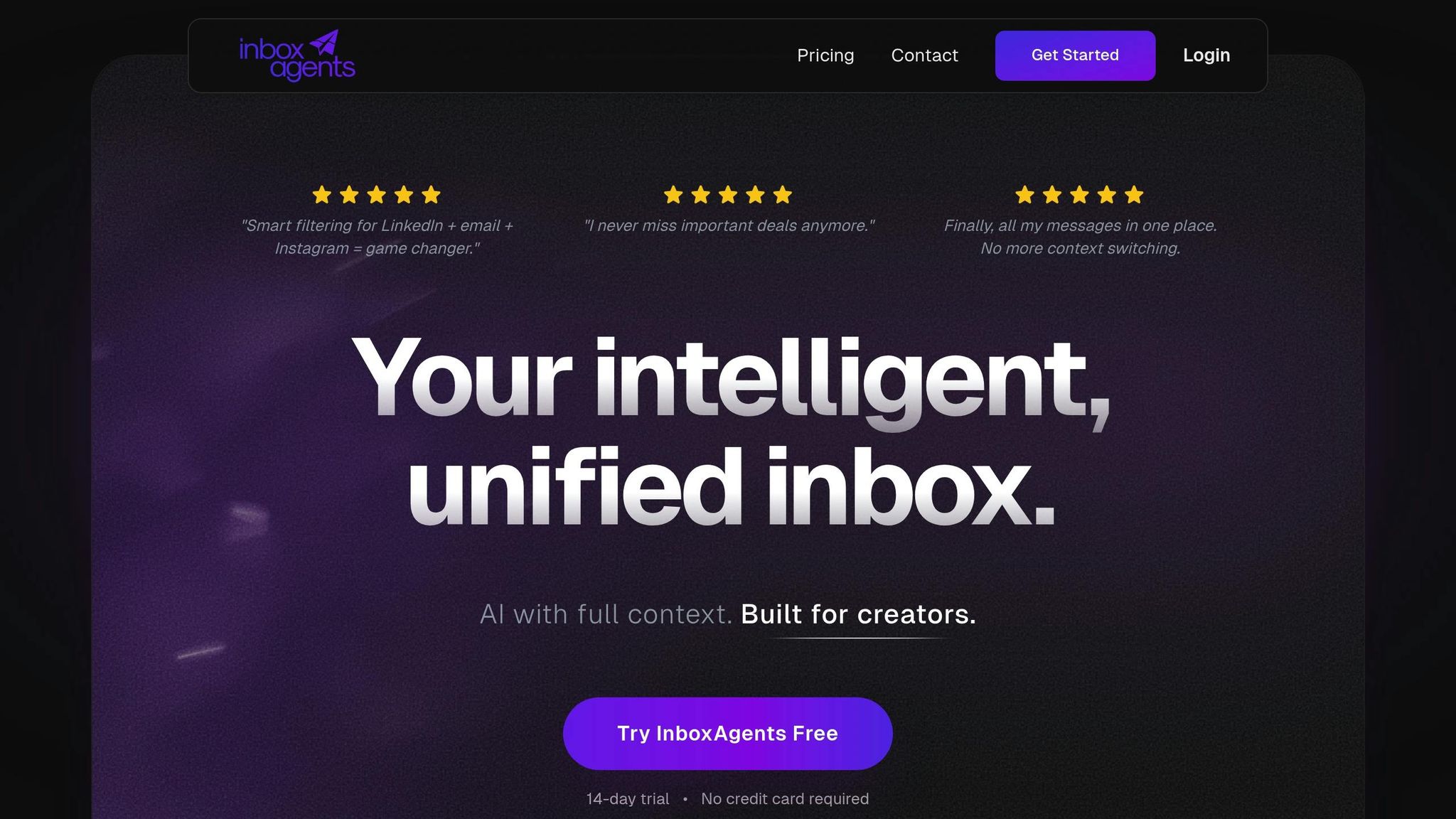
By 2025, U.S. businesses increasingly depend on integrated AI platforms to handle messaging across multiple channels. Inbox Agents addresses this need by merging all messaging channels into a single interface, while offering AI-driven tools that adjust in real time to customer demands and business contexts.
Unified Inbox Management
Modern business communication can feel scattered, with teams juggling multiple channels. Consider this: 64% of digital interactions happen via email, 47% through website and app chats, 36% on social media, and 28% through text messages. This fragmentation creates inefficiencies, making a centralized system crucial for seamless communication.
Inbox Agents brings everything - email, SMS, WhatsApp, Facebook Messenger, and in-app chat - into one streamlined interface. This eliminates the hassle of switching between tools, cutting down on wasted time and improving response rates, especially in high-pressure settings like ecommerce or customer service. The platform also keeps a complete conversation history across channels. For instance, if a customer starts a chat on WhatsApp and follows up via email, your team can see the entire thread without asking them to repeat details. Plus, it integrates with CRMs, ticketing systems, and marketing tools, giving AI agents access to customer purchase records, support tickets, or lifecycle data. This setup ensures every interaction is informed and efficient.
AI-Powered Features
Inbox Agents is packed with AI tools designed for the 2025 workplace, where digital workers are becoming the norm. Key features include:
- Automated inbox summaries: Quickly condense long threads or handoffs into clear, actionable overviews.
- Smart reply suggestions: Generate responses that align with your company’s tone and policies.
- Spam and abuse filtering: Flag suspicious messages in real time using advanced detection models.
The platform also handles automated outreach, triggering follow-ups for events like abandoned carts, renewal reminders, or appointment confirmations - no manual effort required. For more complex situations, such as handling complaints or negotiations, the system can suggest offers that comply with company policies, supporting human agents without overriding their judgment. A standout feature, "Dollarbox", prioritizes revenue-generating messages, ensuring sales opportunities don’t get lost under routine inquiries.
Real-Time Adaptation
What sets Inbox Agents apart is its ability to adjust on the fly. Using contextual data, it personalizes responses in real time, continuously learning from ongoing conversations. The AI refines its tone, word choice, and approach based on customer history and detected sentiment.
For example, if the system picks up on frustration or recognizes a high-value customer, it can automatically escalate the issue to a human agent or shift to a more empathetic tone. This reflects a broader shift in AI technology toward proactive systems that act based on context rather than simply responding to commands.
While the AI takes care of much of the heavy lifting, it still keeps humans in the loop for sensitive actions like negotiating terms or confirming meetings. This balance ensures efficiency without sacrificing oversight in critical situations.
Scalability for U.S. Businesses
Inbox Agents is built to grow alongside businesses, effortlessly handling the fluctuating demands of U.S. markets. With the conversational AI market projected to hit $14.29 billion by 2025, growing at 23.7% annually, it’s clear that more companies are adopting AI tools across departments.
The platform scales smoothly, whether businesses face seasonal spikes, promotional campaigns, or steady customer growth. Its role-based access supports large, distributed teams, and its efficient AI models maintain low latency - even during peak usage. Companies can start small, perhaps piloting the platform with web chat, and then expand to SMS or social channels as they see results in response times and customer satisfaction.
For businesses navigating regulations, Inbox Agents is designed with TCPA and CAN-SPAM compliance in mind. It includes clear opt-out options for outbound messages and tracks essential metrics like average handle time, first-contact resolution, and cost per interaction. This data helps teams make informed decisions about staffing and forecasting, ensuring they’re always ready to adapt.
sbb-itb-fd3217b
Pros and Cons
When it comes to messaging platforms, there’s always a balance between benefits and challenges. Inbox Agents is no different. By weighing its strengths and limitations, U.S. businesses can decide if it’s the right fit for their communication needs in 2025. Below is a breakdown of its key advantages and drawbacks across several operational areas.
| Aspect | Pros | Cons |
|---|---|---|
| Unified Inbox Management | Brings together email, SMS, WhatsApp, Facebook Messenger, and in-app chat into a single interface, reducing handling time by 20–30%. Maintains seamless conversation continuity across platforms. | Integrating with older CRM or ERP systems can be tricky, often requiring extra middleware. It may lack built-in connections to popular U.S. tools like Salesforce, Zendesk, or Shopify, which could mean additional customizations. |
| AI-Powered Features | Smart replies and automated summaries lighten the load of routine inquiries by 30–40%. Spam filtering saves 20–25% of time spent on junk messages, allowing teams to focus on real customer issues. Automated outreach has led to a 20% boost in qualified leads for similar platforms. | Relying too much on AI-generated responses can result in generic or off-brand replies. Regular checks on AI performance are needed to ensure accurate responses and maintain customer satisfaction. |
| Real-Time Adaptation | Uses AI to analyze incoming messages and adjust tone based on customer sentiment and history, reducing escalations by up to 25%. The "Dollarbox" feature prioritizes revenue-generating messages, ensuring sales opportunities don’t get overlooked. | Lacks full support for advanced multimodal AI features, such as analyzing images or voice messages, which are becoming standard in 2025. Additional tools may be needed to fill this gap. |
| Scalability | Efficiently handles varying message volumes, whether for small teams or enterprises managing thousands of messages daily. Supports distributed teams with low-latency AI during busy periods. | Consolidating cross-channel message data increases the need for strong encryption and compliance with U.S. regulations like the CCPA. Protecting sensitive customer data requires extra attention to privacy measures. |
| Implementation | Allows businesses to start small - like with web chat - and expand over time as they see improvements in response times and customer satisfaction. | Training agents to effectively use AI suggestions can take time. Setting up workflows for cases where AI can’t handle conversations also requires careful planning. |
Inbox Agents clearly aligns with the growing adoption of AI in business communication, with 70–72% of companies already using AI and 88% of teams engaging with it weekly by 2025. However, businesses should assess whether the platform can keep pace with emerging technologies or if additional integrations will be necessary as AI capabilities evolve.
For companies navigating these trade-offs, a gradual approach can be effective. Starting with straightforward tools like automated summaries or spam filtering, then scaling to more complex workflows such as negotiation handling, provides a manageable path. Monitoring key metrics - like first-contact resolution, average handle time, and customer satisfaction - will help ensure the platform delivers measurable results while keeping human oversight in place for sensitive tasks. These strategies reinforce Inbox Agents’ relevance in the rapidly evolving world of business messaging.
Conclusion
By 2025, AI messaging is set to redefine how U.S. businesses handle communication and workflows. The trajectory is clear: autonomous AI agents capable of independently initiating conversations and completing tasks, unified omnichannel inboxes that integrate platforms like email, SMS, WhatsApp, social media, and in-app chat, and real-time personalization that tailors messages to customer behavior.
For U.S. businesses, the operational benefits of unified inbox management are game-changing. Relying on fragmented tools leads to delays, missed communications, and inconsistent responses. A single AI-driven interface eliminates these inefficiencies, cutting response times, lowering labor costs through automated triage and summaries, and ensuring consistent messaging across all platforms. Real-time AI capabilities further refine tone and content dynamically, based on sentiment, context, and intent, helping businesses seize high-value opportunities without delay.
Inbox Agents exemplifies this shift by consolidating all messaging channels into a single intelligent workspace. Its features include AI-powered inbox summaries, smart replies, negotiation handling, automated outreach, and abuse filtering. The platform’s standout "Dollarbox" feature ensures revenue-driving messages stay prioritized, while its personalized response engine maintains your brand’s voice across all interactions. These tools not only adapt to shifting communication trends in real time but also allow businesses to meet customer needs seamlessly across multiple channels. For teams focused on metrics like first-response time, cost per conversation, and customer satisfaction, this unified approach delivers measurable productivity improvements and cost savings - without requiring a proportional increase in staff as message volume grows. It enhances current efficiency while setting the stage for future advancements.
Looking ahead, AI messaging will evolve into fully autonomous, multimodal agents capable of managing text, voice, and visual interactions. These advancements will build on the AI-first, unified platforms already transforming communication. Businesses that adopt these platforms today will be better equipped to integrate future innovations - whether through advanced RCS support, deeper CRM integrations, or fully automated workflows - while meeting the growing demand for instant, context-aware service on any device.
To get started, focus on consolidating your messaging channels into a unified inbox. Activate AI summaries and smart replies to handle high-volume conversations and achieve quick returns. As your team gains confidence, expand into proactive messaging strategies. Track key metrics like response time, resolution time, customer satisfaction, and cost per conversation to measure success and guide further investments. With 88% of teams already using AI weekly and 97% of business leaders planning to increase AI spending, the challenge isn’t deciding whether to adopt AI - it’s implementing it quickly and effectively.
FAQs
How can businesses adopt AI-powered messaging tools like Inbox Agents to improve customer interactions by 2025?
Businesses can improve customer communication by using AI-driven messaging tools like Inbox Agents, which bring together all messaging platforms into one simple, centralized interface. Inbox Agents comes packed with features like automated inbox summaries, smart replies, negotiation management, and personalized responses designed to meet specific business requirements.
These tools also include automated outreach capabilities and effective filters to manage spam and abuse, making communication smoother and more efficient. By adopting AI-powered solutions now, businesses can save time, enhance the quality of customer service, and position themselves to provide standout experiences as we approach 2025.
What challenges might businesses face when integrating Inbox Agents with their current CRM or ERP systems, and how can they address them?
Integrating Inbox Agents with your existing CRM or ERP systems can occasionally bring up challenges like compatibility issues, tricky data migration, or the need for extra training for your team. But don’t worry - these hurdles can be tackled with the right strategy.
Start by evaluating how well your current systems align with Inbox Agents. Working closely with the Inbox Agents support team can help you spot potential roadblocks early on and come up with solutions tailored to your needs. To keep things running smoothly, plan a structured data migration process and organize training sessions for your employees. This way, you can ensure a seamless transition and make the most out of what the platform has to offer.
How do Inbox Agents' real-time adaptation and personalization features enhance customer satisfaction and response quality?
Inbox Agents offers AI-powered tools like automated inbox summaries, smart replies, and custom responses to simplify communication. These features adjust in real time to match customer needs, delivering a more tailored experience and enhancing satisfaction.
By handling repetitive tasks and offering intelligent recommendations, Inbox Agents helps businesses concentrate on meaningful interactions, improving both the quality and speed of their responses.