

How AI Analyzes Sentiment for Better Replies
AI sentiment analysis helps businesses and professionals manage communication more effectively by understanding the emotional tone of messages. It uses natural language processing (NLP) and machine learning to classify messages as positive, negative, or neutral, and even detects subtleties like sarcasm or urgency. This enables faster, more accurate replies that match the sender's tone and intent, improving customer satisfaction and reducing miscommunication.
Key takeaways:
- Purpose: Identifies emotions and intent in messages to craft appropriate responses.
- Process: Collects and cleans data, classifies sentiment, and generates replies based on tone and urgency.
- Challenges: Sarcasm, ambiguous language, and cultural differences can complicate analysis.
- Benefits: Speeds up responses, prioritizes urgent issues, and personalizes communication to build trust.
Tools like Inbox Agents apply sentiment scoring across platforms, offering smart reply suggestions and real-time prioritization for better inbox management. This technology allows businesses to handle large volumes of messages while maintaining meaningful interactions.
Customer sentiment analysis AI explained
What Is Sentiment Analysis in AI
Sentiment analysis is the process of using natural language processing (NLP) and machine learning to identify emotions, tone, and intent within text. Instead of just analyzing words, this technology categorizes messages as positive, negative, or neutral. It can even go deeper, detecting specific emotions like frustration, happiness, or anger. By analyzing context, patterns, and subtle language cues, sentiment analysis helps uncover the true meaning behind a message.
Here’s how it works: the system gathers text from sources like emails, chats, or social media. It then uses NLP to evaluate tone, keywords, and context, while machine learning models identify emotional patterns. For instance, a phrase like "The item arrived" would typically be seen as neutral. In contrast, "Great product!" reflects positivity, and "Terrible service" clearly signals negativity.
Advanced AI systems, especially those powered by large language models, excel at recognizing conversational subtleties and varied communication styles. Some systems even achieve up to 96% accuracy in aspect-based sentiment prediction, allowing platforms to respond effectively - whether it’s addressing customer complaints or acknowledging praise. This capability is built on three key components:
Core Elements of Sentiment Analysis
AI-driven sentiment analysis is built around three main elements:
- Polarity Detection: Determines whether a message is positive, negative, or neutral by examining learned patterns.
- Emotion Recognition: Pinpoints specific emotions like joy, anger, or excitement by analyzing context.
- Intent Identification: Identifies the purpose of a message - whether it’s a complaint, a question, or a compliment - so the system can craft an appropriate response.
By combining these elements, AI systems gain a thorough understanding of communication, enabling them to generate responses that align with the sender's emotional tone and intent.
Common Challenges in Sentiment Detection
Even with advancements, AI still struggles with certain aspects of sentiment detection. Sarcasm, for example, often trips up systems. A sentence like "Great job, as always" might sound positive but could actually be critical. While older rule-based systems frequently misinterpret such nuances, modern AI models are improving by learning from context.
Ambiguity in language presents another hurdle. Sentences with dual meanings or complex structures can confuse even the most advanced models. Additionally, cultural differences make sentiment detection more challenging. What might be considered blunt or negative in one culture could simply be seen as honest in another. To address this, effective multilingual support requires training on diverse datasets to reduce biases and misinterpretations.
Despite these challenges, the shift from basic, rule-based methods to sophisticated AI-powered systems has significantly improved sentiment detection at scale. Understanding these obstacles helps us appreciate how AI adapts to craft responses that genuinely reflect the sentiment it identifies.
How AI Analyzes Sentiment to Create Better Replies
How AI Analyzes Sentiment in 3 Steps: From Data Collection to Personalized Replies
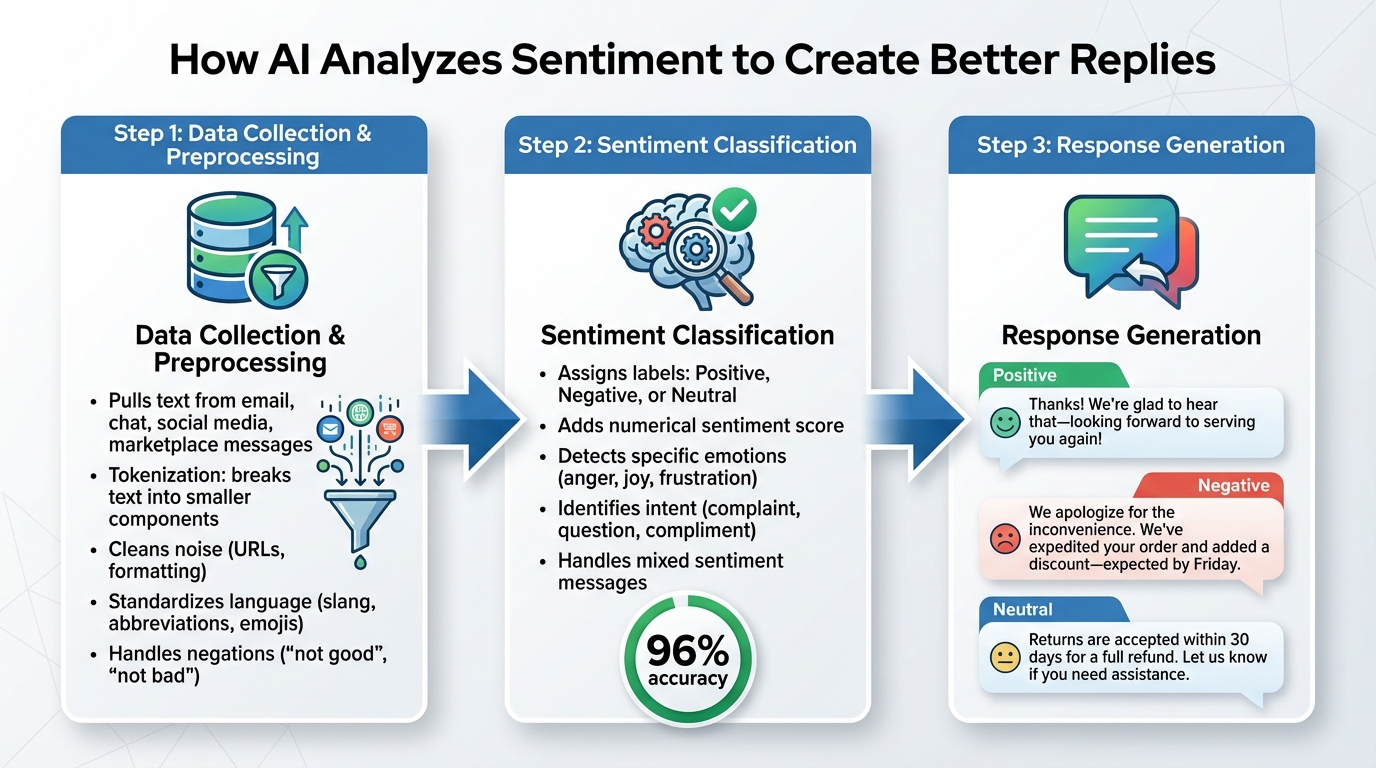
Once AI grasps the essentials of sentiment, it follows a systematic process to turn that understanding into responses that feel thoughtful and relevant. This process unfolds in three key steps, with each stage building on the last to ensure replies capture both the emotional tone and context of incoming messages.
Step 1: Collecting and Preparing Message Data
The process starts with gathering data. AI pulls text from various communication channels - email, chat, social media, and marketplace messages - often integrating everything into one central system. For platforms like Inbox Agents, this real-time integration enables sentiment analysis across all channels, ensuring messages are evaluated within the broader context of your interactions.
Once the data is collected, it goes through preprocessing to prepare it for analysis. This involves breaking the text into smaller components (tokenization), cleaning up noise like URLs, and standardizing the language. Informal U.S. English, including slang, abbreviations, and emojis, is adjusted for accurate interpretation. Even tricky phrases like "not good" or "this is not bad" are handled properly to reflect their true sentiment. By the time this step is complete, the text is ready for detailed analysis.
Step 2: Classifying Sentiment
With clean data in hand, AI assigns each message a sentiment label - positive, negative, or neutral - along with a numerical score. Advanced models such as BERT, trained on large datasets, excel at this task. Research by Thematic revealed an impressive 96% accuracy in sentiment analysis, with AI agreeing with human coders more consistently than humans agree with each other.
But it doesn’t stop at basic sentiment. These systems can also detect specific emotions like anger, joy, or frustration and identify the intent behind the message, whether it’s a complaint, a question, or a compliment. For instance, a message like "Love the fast delivery!" would be tagged as positive with a joyful tone, while "Your product broke after one use - fix this!" would be labeled negative with an angry, complaint-driven sentiment. AI can even handle mixed sentiment, recognizing when a message contains both praise and criticism. This level of detail allows platforms to prioritize urgent issues, route messages to the right team, and prepare thoughtful response strategies.
Step 3: Creating Responses Based on Sentiment
The final step ties sentiment analysis to response generation. AI crafts replies that match the tone and urgency of the incoming message. For positive messages, responses are warm and appreciative:
"Thanks! We're glad to hear that - looking forward to serving you again!"
For negative messages, the tone shifts to empathetic and solution-focused:
"We apologize for the inconvenience. We've expedited your order and added a discount - expected by Friday."
Neutral messages receive straightforward, factual replies:
"Returns are accepted within 30 days for a full refund. Please review the returns policy [here]. Let us know if you need further assistance."
Platforms like Inbox Agents take this a step further by analyzing your unique communication style - your tone, word choices, and even the dynamics of your relationships. This ensures automated replies align with your brand and feel authentic. The AI also considers the sender's relationship with you and the specific context of your business, offering tailored reply suggestions. Users maintain control through customizable settings, allowing you to adjust automation for different message types, senders, or platforms. This balance of sentiment-driven personalization and human oversight ensures replies are efficient, thoughtful, and true to your brand.
sbb-itb-fd3217b
Benefits of AI Sentiment Analysis for Inbox Management
AI-driven sentiment analysis doesn’t just make inbox management smarter - it transforms the way businesses handle customer interactions, leading to faster responses and happier customers.
Faster and More Accurate Responses
By leveraging advanced sentiment detection, AI takes the guesswork out of message handling. Instead of manually sorting through emails or messages, AI assigns an emotional and urgency score to each incoming item. This means angry or high-priority messages are instantly flagged and sent to senior representatives, while straightforward, positive, or neutral queries can be handled by automated replies. The result? Responses in seconds, not minutes.
AI also excels at understanding the subtleties of human communication, like sarcasm or nuanced tone - something traditional keyword-based methods often miss. By combining sentiment analysis with tools that detect topic and intent, businesses can ensure responses are not only timely but also relevant to the customer’s emotional state and specific issue. This reduces the chances of miscommunication or unnecessary follow-ups. A study by Thematic revealed that AI sentiment systems accurately predicted sentiment 96% of the time, often outperforming human annotators in consistency.
Better Customer Experience
When replies are tailored to match a customer’s emotional tone, the experience feels personal and thoughtful. For instance, negative messages prompt empathetic, detailed responses and, when necessary, escalations to higher support levels. On the other hand, positive interactions open the door for loyalty rewards or upsell opportunities. This personalized communication fosters trust and improves the overall quality of support, often reducing complaints and boosting satisfaction.
Identifying negative sentiment early allows teams to address issues before they escalate. Real-time emotional scoring also enables quality monitoring across all interactions, something manual reviews simply can’t achieve at scale. This level of personalization and attention to detail ensures that customers feel heard and valued, no matter the platform or channel.
How Inbox Agents Uses Sentiment Analysis
Inbox Agents simplifies communication management by applying real-time sentiment scoring across all messages. With a quick glance, users can identify which threads are positive, neutral, or negative, making it easier to prioritize urgent issues. The platform also generates automated summaries of critical conversations and suggests smart replies tailored to the customer’s emotional state.
Inbox Agents goes beyond basic inbox management by supporting tasks like negotiation handling and personalized follow-ups, using historical sentiment patterns and predefined business rules. Combined with robust spam and abuse filtering, the platform helps teams handle large volumes of messages efficiently while ensuring responses remain emotionally appropriate and aligned with the brand’s voice. This approach not only improves efficiency but also ensures customers consistently receive thoughtful and meaningful interactions.
Conclusion
AI sentiment analysis has transitioned from a niche concept to a powerful tool for businesses and professionals managing large volumes of communication. Thanks to advancements in natural language processing and machine learning, these systems can now interpret emotional tones - whether positive, negative, neutral, or more subtle nuances - at speeds and scales far beyond what manual efforts could achieve. The growth of the global text analytics market underscores the increasing reliance on these tools.
Support teams, sales professionals, and account managers, often juggling hundreds of messages daily, gain significant advantages from sentiment-aware AI. These tools enable quicker triage, smarter prioritization, and more thoughtful responses. For example, AI can route frustrated customers to experienced agents, suggest calming language for tense interactions, or highlight upsell opportunities in positive conversations. This combination of speed and empathy helps businesses maintain genuine connections with their customers while improving overall efficiency.
The process is straightforward yet effective: AI systems collect message data, analyze the sentiment based on context and tone, and then take action - whether through routing, automation, or escalation. Platforms like Inbox Agents apply these techniques across various channels, such as email, social media, and chat. They evaluate every conversation in real time, offering smart, sentiment-based replies that align with the customer's emotional state. Features like abuse filtering and personalized follow-ups further enhance communication, making it both scalable and human-like.
Modern AI tools excel at handling complexities like sarcasm, mixed emotions, and cultural differences - areas where older systems often struggled. This capability allows businesses to automate routine interactions while reserving human expertise for more sensitive or high-stakes scenarios.
For professionals in the U.S. looking to adopt sentiment-aware AI, the steps are clear: integrate sentiment scoring into your existing inbox or CRM, establish routing rules for urgent or negative messages, and track sentiment trends to guide your decisions. Real-time sentiment scoring, as demonstrated by tools like Inbox Agents, not only boosts operational efficiency but also strengthens customer relationships by ensuring every interaction respects the emotional context. By adopting sentiment-driven AI, businesses can streamline communication and build stronger customer trust.
FAQs
How does AI identify sarcasm in messages?
AI leverages advanced natural language processing (NLP) to pick up on sarcasm by examining the context, tone, and linguistic patterns within a message. It identifies subtle hints, like contradictions between what’s literally said and the implied meaning, to grasp emotionally layered or sarcastic remarks.
By improving its ability to interpret sarcasm, AI can deliver responses that feel more considerate and attuned to the situation, even in tricky or nuanced conversations. This capability is particularly helpful for managing complex communication scenarios.
How does AI sentiment analysis enhance customer communication?
AI-powered sentiment analysis allows businesses to grasp the emotions behind customer messages - be it positive, negative, or neutral. By analyzing tone and context, it helps craft responses that feel more tailored and considerate, boosting customer satisfaction and fostering better engagement.
On top of that, AI simplifies communication by offering contextually appropriate replies. This not only saves time but also ensures a professional tone, making it especially valuable for businesses managing large volumes of customer interactions efficiently.
How does AI use sentiment analysis to improve responses?
AI uses sentiment analysis to grasp the tone and intent behind messages - whether they're positive, negative, or neutral. By recognizing the emotional context, AI can create responses that feel both precise and empathetic, matching the sender's mood and expectations.
This approach helps cut down on misunderstandings and speeds up response times by reducing the need for manual input. The outcome? A smoother, quicker communication experience that's thoughtfully aligned with the flow of the conversation.