


Conversation Analytics for Buyer Intent
Want to know who's ready to buy, cancel, or needs help? Conversation analytics can tell you. This AI-powered technology scans customer interactions - emails, calls, chats, and social media - to identify buying signals. By analyzing both what people say and how they say it, businesses can prioritize leads, improve sales forecasts, and even prevent churn.
Key Takeaways:
- What it does: Transforms unstructured data from conversations into actionable insights.
- Why it matters: Companies using intent data are 8.5x more likely to achieve over 20% revenue growth.
- How it works: AI tools like NLP analyze explicit signals (e.g., demo requests) and implicit cues (e.g., tone changes).
- Real-world impact: Faster sales cycles, improved retention, and smarter lead prioritization.
AI platforms like Inbox Agents simplify this process by centralizing data, scoring intent in real time, and automating follow-ups. Whether it's spotting a high-value lead or addressing a frustrated customer, acting on these insights can boost revenue and customer satisfaction.
What is Conversation Intelligence? AI Speech Analysis for Sales, Support & Product Teams
Buyer Intent Signals in Conversations
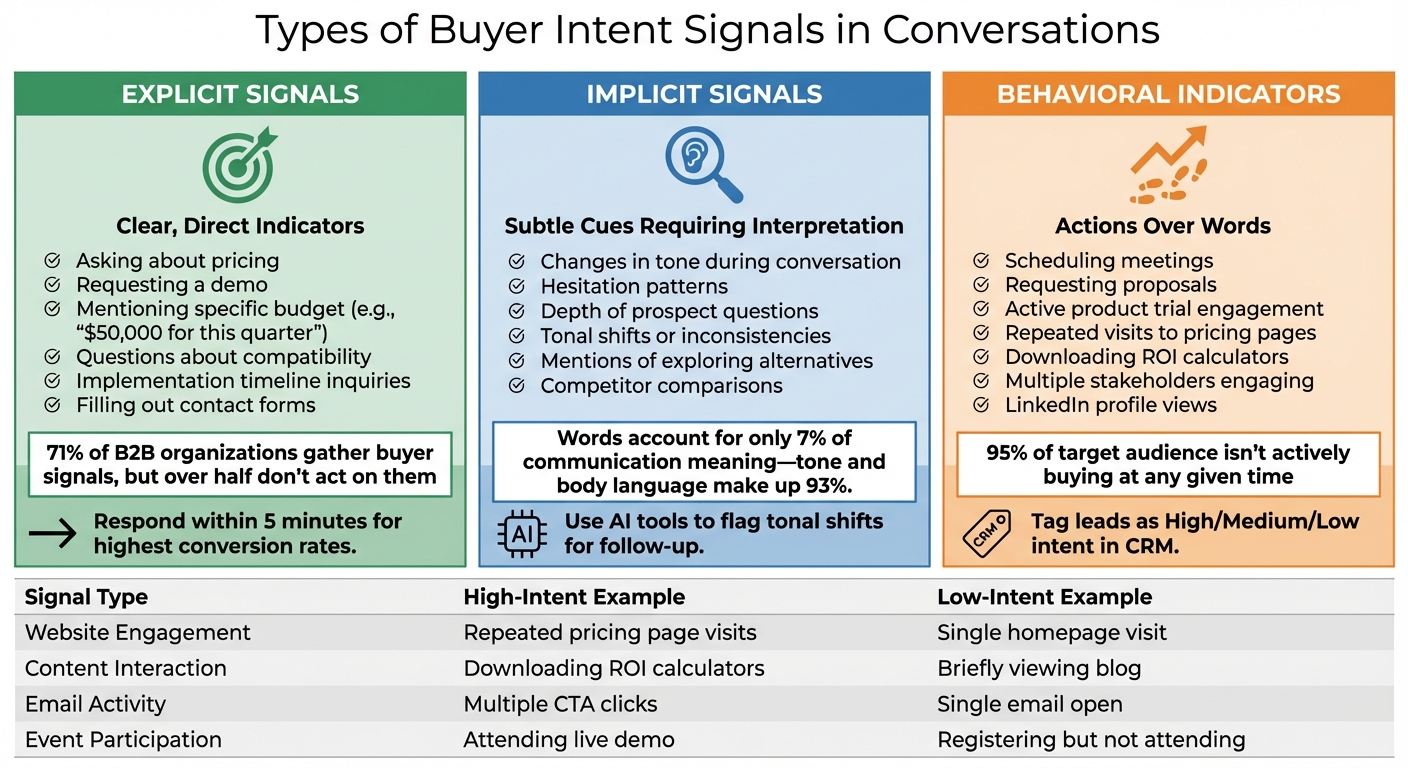
Buyer Intent Signal Types: Explicit, Implicit, and Behavioral Indicators
Buyer signals can take many forms - they might be direct and obvious or subtle and behavioral. Knowing how to distinguish between explicit, implicit, and behavioral signals allows you to focus on the right conversations at the right moments.
Explicit Signals
Explicit signals are the clearest indicators of interest. These include actions like asking about pricing, requesting a demo, or mentioning a specific budget (e.g., “We’ve set aside $50,000 for this quarter”). Other examples include questions about compatibility with existing tools, implementation timelines, or filling out a contact form.
Here’s the kicker: 71% of B2B organizations gather buyer signals, but over half don’t act on them. That’s a huge missed opportunity, especially since conversion rates skyrocket when sales reps respond within the first five minutes. In 2024, 60% of sales reps missed their quotas, and 44% of deals fell through - often because teams didn’t respond quickly enough to these explicit signals.
"Explicit signals are clear, intentional actions such as filling out a contact form, requesting a demo, or directly stating interest."
- Jenny Romanchuk, Artisan
"Intent data needs to be actioned the same day to make the most use of it. Intent loses a lot of value a week later and is almost worthless a few weeks later."
- Tido Carriero, CEO of Koala
To stay ahead, set up real-time alerts in your CRM or Slack for high-value actions like visits to your pricing page or demo requests. This ensures your team can respond promptly - ideally within the hour.
While explicit signals are straightforward, implicit signals require a bit more interpretation.
Implicit Signals
Implicit signals are subtle and require reading between the lines. These might include changes in tone, hesitation, or the depth of a prospect’s questions. Interestingly, research shows that words account for only 7% of communication meaning - tone and body language make up the rest. Advanced AI tools now analyze virtual “body language” during video calls, picking up on emotions like confusion, excitement, or skepticism.
"The real issue isn't in hearing what buyers are saying on call. But in tracking what they're NOT saying."
AI-powered tools can flag tonal shifts or inconsistencies for further follow-up. Natural Language Processing (NLP) and Topic Modeling break down not just the content of a conversation but how it’s delivered, identifying key phrases about pricing concerns, competitor comparisons, or contract terms.
"The intent signal just gives me a reason to research the account. It isn't THE reason to reach out."
- Jen Allen-Knuth, Founder of DemandJen
Implicit signals are your cue to dig deeper. For instance, if a prospect mentions they’re exploring alternatives, tailor your next interaction to highlight how your solution outshines competitors, using targeted case studies or testimonials.
But actions can be just as telling as words, which brings us to behavioral signals.
Behavioral Indicators
Behavioral signals reveal intent through what prospects do rather than what they say. High-intent behaviors include scheduling a meeting, requesting a proposal, or actively engaging with a product trial. Repeated visits to pricing or comparison pages are another strong indicator that a buying decision is near. Similarly, interacting with bottom-of-funnel content like ROI calculators or in-depth whitepapers signals serious consideration.
Social behaviors also provide clues. For example, when prospects accept your LinkedIn connection request, follow your company page, or frequently view your profile, they’re signaling early interest. If multiple stakeholders from the same company are engaging with your content, it’s often a sign of organizational intent.
Here’s the challenge: 95% of your target audience isn’t actively looking to buy at any given time. And even when they are, buyers spend only 5% of their purchase journey interacting with sales reps. That’s why tracking behavioral patterns is so crucial. Tools like Inbox Agents simplify this process by consolidating data from email, chat, SMS, and social media into one platform, making it easier to identify trends and act on them.
| Signal Type | High-Intent Example | Low-Intent Example |
|---|---|---|
| Website Engagement | Repeated visits to pricing or comparison pages | Single homepage visit |
| Content Interaction | Downloading ROI calculators or whitepapers | Briefly viewing a blog post |
| Email Activity | Multiple CTA clicks | Single email open |
| Event Participation | Attending a live demo or requesting a meeting | Registering for a webinar but not attending |
To maximize these insights, tag leads in your CRM as High, Medium, or Low intent based on their behavior. Then, follow up with personalized outreach. For example, if someone attended a webinar, reference it directly: “I noticed you joined our webinar on [topic] - do you have any questions?” Or, if they’ve been exploring your pricing page, say, “I saw you were checking out our pricing options - can I help clarify anything?” These small touches show you’re paying attention and can make all the difference.
Using Data for Conversation Analytics
Understanding buyer intent starts with collecting the right data and preparing it effectively. Without a complete dataset, you risk missing crucial buyer signals.
Sources of Conversation Data
Conversation data comes from more places than you might realize. Voice-based data includes phone calls, video meetings on platforms like Zoom or Microsoft Teams, and even interactions with voice assistants. These channels are rich with intent signals - tone, pace, and pauses often reveal more than words alone. In fact, nonverbal cues like tone account for 93% of communication, while words make up just 7%.
Text-based data includes email threads, live chat transcripts, chatbot logs, SMS messages, and conversations on messaging apps. These sources offer a detailed record of what prospects are asking, how they interact, and recurring topics of interest. Then there’s social media data - comments and direct messages provide raw, unfiltered feedback about how people view your brand.
Metadata and contextual data tie these sources together to create a full picture. This includes CRM records, purchase history, website activity, and campaign attribution. For example, linking an ad click to a visit on your pricing page and a follow-up demo request call can map the entire buyer journey while eliminating data silos. Behavioral metrics like talk-to-listen ratios (ideally 30/70, meaning you listen 70% of the time), response times, and frequently asked questions also provide valuable insights.
"There's still a huge disconnect in most businesses between what marketing knows about customers and the insights generated in the contact center. The ability to accurately identify customer needs and priorities - from their own words - and apply them across teams presents a huge opportunity."
- Nicole France, VP and Principal Analyst, Constellation Research
Businesses that act on insights are 8.5x more likely to achieve revenue growth exceeding 20%. Once you’ve identified your data sources, the next step is preparing it for analysis.
Preparing Data for Analysis
Raw data needs to be accurately transcribed, synchronized with timestamps, and mapped to ensure a clear view of the buyer’s journey. If your speech-to-text tool struggles with regional accents or noisy environments, key intent signals might be lost before analysis even begins.
For example, when a prospect clicks an ad, visits your pricing page, and then calls your sales team, syncing these events is vital to understanding their journey. In 2024, a major telecom company used conversation analytics to connect offline phone data with Google Ads Smart Bidding. By linking these touchpoints, they reduced their cost per acquisition by 82% over two years and saw an 18% increase in net revenue from paid search.
Data mapping plays a crucial role here, connecting conversations to specific campaigns, sales stages, or customer profiles. For instance, if a prospect mentions, "I saw your webinar on ROI optimization", your system should automatically link that conversation to the webinar campaign in your CRM. This improves forecasting accuracy and aligns teams.
Security is another priority. Automated PII redaction ensures compliance with data regulations, and top platforms maintain certifications like SOC 2 Type 2, ISO 27001, and PCI DSS to handle sensitive data safely.
Tracking sentiment throughout conversations is equally important. If a prospect starts off enthusiastic but becomes hesitant when discussing implementation timelines, that’s a clear signal of where follow-up efforts should focus. Properly prepared data is the foundation for scoring buyer intent reliably.
Inbox Agents simplifies these critical preparation tasks, making it easier to integrate data into your workflow.
How Inbox Agents Simplifies Data Management
Managing data effectively is essential for accurate intent analysis. Most systems require juggling multiple platforms, but Inbox Agents consolidates all your channels into a single, searchable dataset.
The platform uses AI-powered summarization to highlight key action points automatically. Instead of combing through full transcripts, you get concise summaries that pinpoint buyer intent signals - whether someone asks about pricing, provides important details, or requests a proposal. This saves hours of manual work while ensuring no high-priority signal is missed.
Natural Language Processing (NLP) further streamlines the process by categorizing conversations by topic and intent. For example, a message about "integration with Salesforce" might be tagged as a technical inquiry, while a question about "implementation timelines" could be flagged as high purchase intent - all without manual tagging.
Inbox Agents also prioritizes security, automatically detecting and redacting sensitive information to comply with data protection laws. And because it integrates seamlessly with your CRM, analyzed intent data flows directly into your existing workflows, enabling your team to act on buyer signals in real time.
sbb-itb-fd3217b
Methods for Scoring Buyer Intent
Once your data is ready, you can use AI techniques to assign numerical scores that reflect buyer intent. Here’s a closer look at how to build and implement a scoring model.
AI Methods for Intent Analysis
AI tools transform raw data into actionable intent scores by analyzing customer interactions and behaviors.
Natural Language Processing (NLP) plays a pivotal role in intent analysis. It converts speech into text and examines conversations from phone calls, emails, and chats to uncover sales trends and customer preferences. NLP identifies key topics such as competitor mentions, pricing questions, or objections - clues that reveal where a buyer stands in their journey.
Sentiment analysis evaluates emotional shifts during conversations. For instance, it can spot a change from enthusiasm to hesitation when discussing timelines. These AI-driven algorithms assess emotions like happiness, frustration, or doubt in real time, offering insights into how the discussion is progressing.
Intent classification uses machine learning to tag specific behaviors or statements. For example, inquiries about pricing or contract terms are flagged as strong indicators of intent. By 2024, 40% of enterprise applications were expected to incorporate conversational AI, a leap from just 5% in 2020.
Predictive analytics looks at historical data to predict the likelihood of closing a deal. Sales teams using AI-driven call guidance have been shown to close 35% more deals compared to teams relying solely on traditional coaching methods.
Building a Buyer Intent Scoring Model
To create a scoring model that works, start by analyzing past successes. Look at the characteristics and behaviors of leads that converted quickly versus those that didn’t. This analysis helps identify which signals are most predictive of closed deals.
The backbone of any scoring model is signal weighting - assigning scores to actions based on their likelihood to predict conversion. For example, requesting a demo might add +20 points, while unsubscribing could subtract 20.
Here’s an example of how different behaviors might influence scores:
| Lead Behavior Category | Example Action | Suggested Score Impact |
|---|---|---|
| High Intent (Explicit) | Demo Request / Contact Form | +20 |
| Moderate Intent (Implicit) | Pricing Page Visit | +15 |
| Low Intent (Behavioral) | Content/Whitepaper Download | +5 |
| Negative Intent | Unsubscribe / Opt-out | -20 |
| Engagement Signal | Multiple Website Visits (3+) | +10 |
Data integration strengthens your model further by combining first-party data (like website activity, chat logs, and call recordings) with third-party insights. For example, tracking competitor research or reviews can offer valuable context. Companies that recently secured funding are 2.5 times more likely to invest in new solutions, making funding announcements a useful external signal.
Machine learning refines the model by analyzing which combinations of signals best predict conversions. For instance, a visit to a pricing page followed by a competitor mention during a call could indicate stronger intent than either action alone.
Using conversation intelligence can boost win rates from an industry average of 24% to between 31% and 38%. The key is to align scoring thresholds with your sales process so that high-scoring leads get immediate attention, while lower-scoring ones enter nurturing workflows.
Once your scoring model is in place, real-time monitoring becomes essential for acting quickly on high-intent signals.
Real-Time Scoring in AI-Powered Platforms
Real-time scoring transforms intent analysis into an active sales tool. Modern platforms analyze conversations as they happen, instantly calculating scores and triggering automated actions.
For example, Inbox Agents processes conversations across all messaging channels simultaneously. Its NLP engine identifies intent topics, keywords, and sentiment changes in real time, updating intent scores on the fly. If a prospect’s score exceeds a set threshold - such as 75 points - the system flags them as "high intent" and triggers specific workflows.
Auto-tagging removes the need for manual categorization. If a prospect mentions "integration with Salesforce", the system tags it as a technical inquiry. Similarly, asking about "implementation timelines" gets flagged as high purchase intent. These tags integrate directly into your CRM, ensuring your sales team has full context without extra data entry.
The platform also delivers actionable insights in real time. For instance, if sentiment analysis detects frustration, it can alert your team to step in or suggest specific objection-handling strategies. Real-time cue cards can reduce average handling time by about 18 seconds while improving overall outcomes.
"The customer actually responded on Friday of Labor Day weekend, when everybody was out of the office. But our AI Agent was there... by Friday, we had a $500,000 deal." - John Hansen, Sr. Director, Field Marketing
This ability to act on intent signals immediately - even outside regular business hours - ensures that valuable opportunities don’t slip through the cracks. Automated responses from Inbox Agents keep prospects engaged and maintain momentum throughout the sales cycle.
Finally, the system learns from outcomes over time. By syncing closed-won and closed-lost data back into the model, the platform gets better at predicting which conversation patterns lead to revenue, making future predictions even more accurate.
Applying Buyer Intent Insights to Daily Operations
Prioritizing Conversations Based on Intent
Using intent signals can do more than just rank leads - it can reshape how sales and support teams operate. By assigning leads into hot, warm, and cold tiers based on behaviors like frequent visits to pricing pages or downloading technical documents, teams can focus their energy where it matters most. This way, your top performers spend their time on prospects who are most likely to buy.
Real-time alerts make these insights actionable. For example, when a prospect's intent score hits a certain threshold, a notification can pop up in Slack or your CRM. This ensures you reach out when interest is at its peak. The numbers back this up: 91% of marketers use intent data to prioritize accounts, and 93% report higher conversion rates when they act on purchase-related signals.
Sales teams also benefit from intelligence briefs that summarize key details - what the prospect is researching, who’s involved in the decision-making, and even which competitors they’re considering [27, 30]. This saves hours of manual research and helps reps tailor their outreach. Not all activity signals the same level of interest, though. For instance, a junior staff member downloading a whitepaper isn’t as indicative of intent as a CTO reviewing implementation guides.
| Intent Signal Type | Example Behavior | Recommended Action |
|---|---|---|
| Active Intent | Visiting pricing pages, requesting demos | Immediate direct sales outreach |
| Passive Intent | Browsing competitor case studies, subscribing to newsletters | Nurture with targeted messaging |
| Awareness Intent | Searching "how-to" guides, reading blogs | Share educational or thought-leadership content |
| Churn Risk | Visiting "Alternatives" or "Comparison" pages | Customer Success check-in to address concerns |
This approach turns generic pitches into consultative outreach. Instead of cold calls, your team can address specific challenges or topics prospects have been researching, positioning themselves as trusted advisors [28, 30].
Improving Sales and Customer Success Workflows
Intent data doesn’t just prioritize leads - it reshapes the entire pipeline. Knowing which prospects are actively researching solutions allows you to fast-track high-potential leads straight to sales while funneling lower-intent leads into nurturing workflows. This segmentation helps boost conversion rates and ensures no valuable opportunities slip through the cracks.
Intent insights also make multithreading more effective. When multiple stakeholders from the same company engage with your content, you can craft tailored value propositions for each role - addressing IT’s concerns about integration while highlighting ROI for the CFO. Plus, companies that recently raised funding are 2.5 times more likely to invest in new solutions.
For existing customers, monitoring intent can help prevent churn. If a client starts researching competitors or visiting "Alternatives" pages, your Customer Success team can step in to resolve issues before they escalate [29, 30]. The likelihood of selling to an existing customer is 60–70%, compared to just 5–20% for new prospects.
Deal forecasting also improves when intent signals are combined with pipeline data. Instead of relying on gut feelings, managers can track engagement patterns and direct coaching efforts where they’ll have the most impact.
How Inbox Agents Automates Workflows
Once your team has streamlined prioritization and segmented pipelines, automation can take things a step further. Inbox Agents simplifies workflows by automatically routing high-intent conversations to the right team members. For example, if a prospect asks about pricing or requests a demo, the platform flags or transfers the interaction to a live rep immediately. This ensures prospects get human attention exactly when they’re ready to move forward.
The platform’s AI-powered summaries save reps from hours of note-taking. After each conversation, it generates concise summaries highlighting key points, sentiment changes, and action items. These are synced directly to your CRM, keeping records accurate without manual effort [17, 31]. On average, sales reps save 23 hours per month on documentation.
Other tools like smart replies and negotiation handling provide real-time support during conversations. If a prospect raises an objection or mentions a competitor, the system suggests relevant talking points and strategies on the spot [17, 31]. This makes navigating complex discussions smoother and more effective.
Automation also keeps momentum going after conversations. Based on intent signals, Inbox Agents can draft personalized follow-up emails referencing specific topics discussed. Reps can review, tweak, and send these messages while the buyer’s interest is still high [7, 31].
Additionally, features like spam filtering ensure your team engages only with legitimate prospects. Personalized responses, tailored to your business data, make every interaction relevant. By combining automation with real-time intent scoring, Inbox Agents turns raw data into actionable workflows, helping your team focus on high-value opportunities and close deals faster.
Conclusion: Using Conversation Analytics for Growth
Conversation analytics takes scattered interactions and transforms them into actionable insights, decoding both clear signals (like pricing questions or demo requests) and subtle cues (such as tone and sentiment). Businesses that rely on insights are 8.5 times more likely to experience revenue growth of over 20%, and data-driven companies are 23 times more likely to attract new customers compared to their competitors. This level of clarity fosters stronger alignment across teams.
The real game-changer is cross-functional alignment. By uniting sales, marketing, and product strategies around customer insights, businesses can amplify their overall impact. For instance, sales teams can fine-tune their pitches based on proven talk tracks, marketing teams can craft messages that reflect the language customers actually use, and product teams can prioritize features based on quantified feedback. This shared access to insights ensures every department works in sync, guided by the authentic voice of the customer.
AI-powered platforms like Inbox Agents make these insights actionable by automating tasks like transcription, summarization, and CRM updates, saving time and strengthening customer relationships. Features such as real-time intent scoring and automated workflow routing ensure that high-potential prospects receive attention exactly when they’re ready to buy. Take the example of Top Dog Law: in January 2025, this personal injury law firm implemented AI-driven conversation analytics and achieved a 20% boost in conversion rates while reducing feedback turnaround time by 75%.
Beyond automation, the shift from reactive to proactive engagement is key. Real-time intent scoring and keyword monitoring allow teams to address issues before they escalate. For example, tracking terms like "cancel" or "dissatisfied" helps Customer Success teams step in early, preventing churn - a 5% increase in retention can drive profitability up by as much as 95%. Meanwhile, sales reps armed with emotional intelligence data can engage with prospects more effectively, addressing their specific concerns and positioning themselves as trusted advisors rather than pushy salespeople.
Conversation analytics doesn’t just reveal what customers say - it uncovers why they say it. With the right tools and strategies, every interaction becomes a chance to learn, improve, and grow.
FAQs
How does conversation analytics help improve sales forecasts and reduce customer churn?
Conversation analytics leverages AI-driven tools, such as natural language processing (NLP), to examine chats, emails, and calls. These tools can uncover buyer intent, sentiment, and other crucial signals. By analyzing interactions for intent and tracking patterns like objections or shifts in emotional tone, businesses gain a clearer picture of which deals are moving forward and which may be at risk. This insight leads to more precise sales forecasting.
Additionally, the data can highlight early warning signs of customer churn, like reduced engagement or negative feedback. With timely alerts, businesses can step in with personalized outreach or retention strategies, addressing issues before they escalate. By transforming conversational data into actionable insights, companies can better allocate resources, secure more deals, and maintain strong customer relationships.
What’s the difference between explicit, implicit, and behavioral buyer intent signals?
Explicit buyer intent signals are those unmistakable actions or statements that show clear interest, like saying, “I’d like a demo” or completing a contact form. Implicit signals, however, are more nuanced and might include activities such as researching related topics, downloading guides, or inquiring about a product or service. Then there are behavioral signals - these are measurable actions that reflect engagement, like visiting a website, clicking on links, spending significant time on a page, or repeatedly performing certain actions.
By identifying and interpreting these signals, businesses can better gauge customer intent and adapt their strategies to connect with potential buyers at the right stage of their journey.
What is real-time intent scoring, and why is it valuable for sales teams?
Real-time intent scoring leverages AI and machine learning to evaluate live signals such as browsing activity, chat language, tone, and engagement behavior. From this data, it generates an intent score, indicating how likely a prospect is to make a purchase.
This process allows sales teams to zero in on top-priority leads, direct them to the most suitable channels, and boost conversion rates. With real-time insights at their fingertips, teams can engage prospects more effectively and accelerate the deal-closing process.