

How AI Detects Intent for Better Replies
AI intent detection helps businesses understand the purpose behind customer messages, enabling faster and more accurate responses. By analyzing language and context, AI can classify messages into intents like tracking orders, managing refunds, or answering product inquiries. This reduces frustration, improves efficiency, and boosts outcomes such as a 30% increase in email response rates and a 35% rise in deal closures.
Key insights:
- Customer Intent Types: Informational (e.g., "What’s your return policy?"), Transactional (e.g., "Upgrade my subscription"), and Navigational (e.g., "Where’s my billing history?").
- How It Works: AI uses Natural Language Processing (NLP) to clean and analyze text, then Machine Learning (ML) to classify intents with high accuracy.
- Real-World Impact: Companies like HyperJar reduced resolution times by 94%, while others improved negative interactions by 70%.
- Tools in Action: Platforms like Inbox Agents centralize messaging and automate responses, saving time and improving productivity.
AI intent detection transforms customer interactions by interpreting needs quickly and accurately, ensuring smoother communication and better outcomes.
How Do Intent Recognition Mechanisms Actually Work?
What Is Customer Intent in Messaging
Customer intent refers to the specific goal or need a customer has when they reach out to a brand. It’s not just about what they say - it’s about uncovering the real purpose behind their message. For instance, when someone types, "Track my shipment", they’re expecting a fast, tailored update on their package status.
Understanding intent allows AI systems to go beyond simple keyword recognition. Instead, they interpret meaning, enabling smarter actions like routing inquiries, triggering workflows (e.g., generating shipping labels or resetting passwords), and crafting personalized responses. Interestingly, only 38% of support agents correctly identify intent on first contact. Yet, when intent detection is mastered, it can slash resolution times by 67%.
"Customer intent goes beyond what customers say - it's what they truly need."
- Mozhdeh Rastegar-Panah, Senior Director, Product Marketing, Zendesk
3 Main Types of Customer Intent
Most customer messages can be grouped into three main categories:
- Informational intent: These customers are looking for answers or help with troubleshooting. Examples include, "What is your return policy?" or "How do I reset my password?"
- Transactional intent: These messages involve customers wanting to take action, such as making a purchase, upgrading a subscription, booking an appointment, or changing an order.
- Navigational intent: Customers with this intent are trying to locate a specific page, feature, or section, like asking, "Where can I find my billing history?" or "How do I access account settings?"
Recognizing these categories is critical for delivering fast and accurate automated responses.
Why Intent Detection Matters
When AI systems accurately detect customer intent, they can provide personalized and efficient interactions. This capability transforms customer experiences from frustrating to seamless. For example, in 2025, the mobile banking app HyperJar automated its "replace bank card" process. What used to take 15 to 20 minutes with a human agent was reduced to under two minutes, cutting resolution times by an impressive 94%. Similarly, fashion retailer Motel Rocks uses AI to identify both intent and sentiment. According to Customer Service Manager Lucy Hussey, this approach has turned 70% of negative interactions into positive ones.
Effective intent recognition also boosts first-contact resolution rates by up to 30%. By pinpointing what a customer needs, AI can extract key details - like order numbers or account info - and resolve issues entirely on its own. This not only speeds up routine queries but also allows human agents to focus on more complex cases, ensuring a smoother overall experience.
How AI Detects Intent: Core Methods
AI uses two key technologies to figure out what customers want: Natural Language Processing (NLP) and Machine Learning (ML). NLP kicks things off by processing human language - cleaning up filler words, fixing typos, and breaking down sentences into understandable pieces. Once the text is polished, ML steps in to analyze it, comparing it to labeled training data to predict the most likely intent behind the message.
Natural Language Processing (NLP) and Machine Learning
NLP focuses on two main tasks: syntax analysis and semantic analysis. Syntax analysis identifies parts of speech and filters out unnecessary words, while semantic analysis uses context to differentiate between various meanings of the same word. After this processing, machine learning algorithms take over to classify the message. These algorithms may rely on rule-based pattern matching, traditional classifiers like Support Vector Machines (SVM) or Bayesian networks, or even deep learning models like neural networks.
When training these systems, customer messages are mapped to specific "intents" or goals. Over time, as the model is exposed to more examples, it learns to identify patterns that distinguish similar queries. For instance, increasing the training data from 500 to 5,000 examples per intent can significantly reduce error rates - from 15% down to just 2%. On average, these models reach around 98% accuracy, though a small margin of uncertainty may require human review.
To ensure accuracy, AI systems assign a confidence score to each detected intent. If this score falls below a set threshold - usually between 50% and 70% - the system may ask for clarification or escalate the query to a human agent. Once these core methods are in place, fine-tuning the model with industry-specific data becomes critical for handling niche scenarios effectively.
Training AI with Industry-Specific Data
Pre-trained AI models often start with a broad understanding of language, drawing from billions of general conversations. However, fine-tuning with domain-specific data is essential for understanding specialized terminology and meeting unique customer needs. Typically, an AI agent begins with 30 to 40 intents, but more advanced systems can manage 60 to 80 intents to handle complex support tasks.
Using real customer data - like transcripts that include slang, typos, and colloquial expressions - can significantly improve accuracy compared to relying on idealized, developer-written examples. It's also important to avoid intent overlap, where similar phrases are used to train different intents, as this can confuse the AI and lower its prediction accuracy. Businesses should focus on training for the top 20% of high-frequency queries, as these usually account for most customer interactions.
This specialized training lays the groundwork for more advanced intent analysis, ensuring the AI can handle real-world conversations with precision. Next, we'll explore how AI processes and extracts intent from incoming messages in greater detail.
The AI Intent Analysis Process
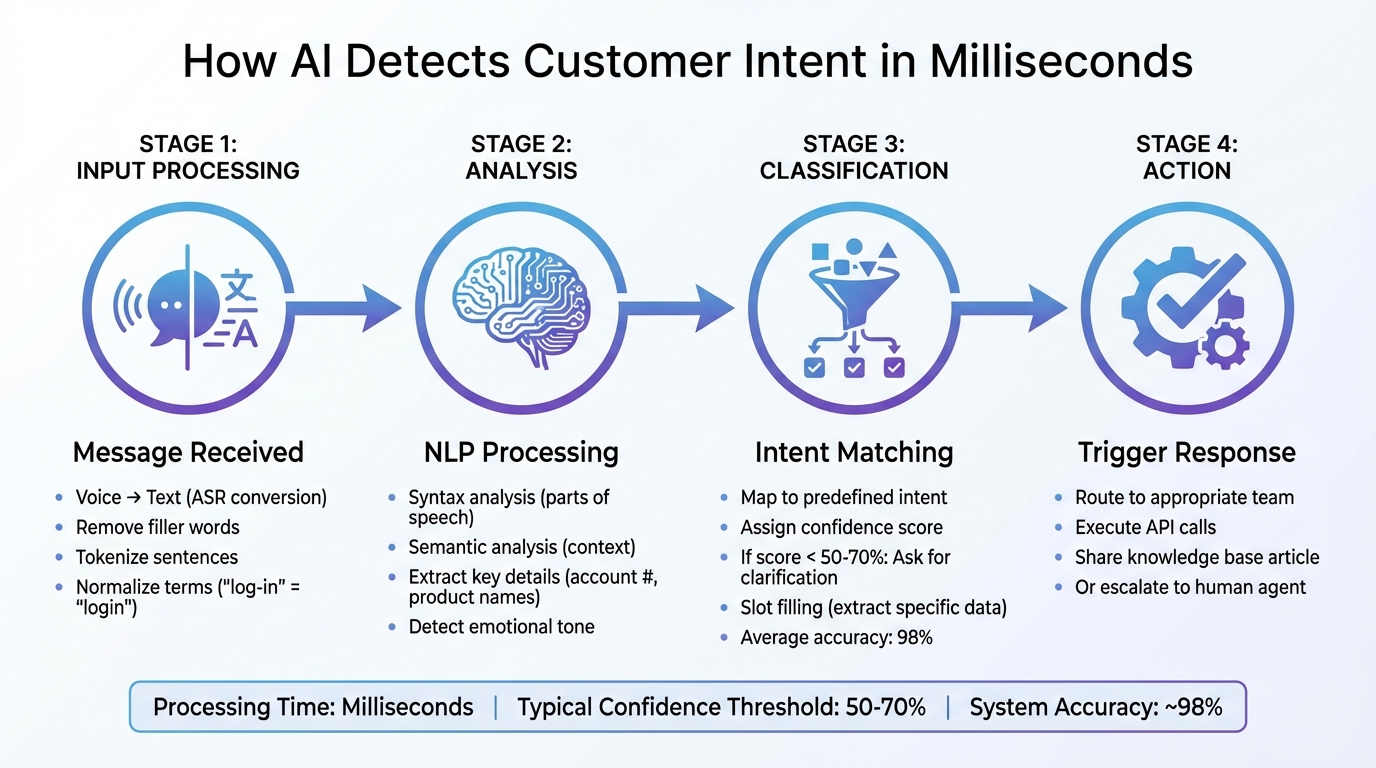
How AI Detects Customer Intent: 4-Stage Process from Message to Action
Once trained with industry data, AI systems process messages in just milliseconds, enabling real-time responses. This speed is essential for maintaining smooth interactions and meeting customer expectations for quick support. Let’s break down how raw message data is transformed into actionable intent.
Input Processing and Parsing
Using advanced NLP techniques, the AI begins by refining each incoming message. From the moment a message is received - whether through text or voice - the system gets to work. For voice inputs, Automatic Speech Recognition (ASR) converts spoken words into text. The text is then cleaned up by removing filler words, breaking sentences into tokens, and normalizing terms so that variations like "log-in" and "login" are treated the same.
Next, the system performs syntax and semantic analysis to pinpoint key details, such as account numbers or product names. At the same time, it evaluates the emotional tone of the message - detecting whether the customer is frustrated, urgent, or satisfied.
Intent Classification and Information Extraction
Once the message is preprocessed, the AI maps it to a predefined intent using techniques like pattern matching, classifiers, or neural networks. For instance, a message like "I can't get into my account" might be categorized under a Password Reset intent.
The system assigns a confidence score to each classification. If the score is too low (typically below 50–70%), the AI either asks for clarification or escalates the query to a human agent. To extract specific details, the AI uses slot filling. For example, in a request like "book a table for 2 at 4", it identifies "2" as the number of people and "4" as the time. Many modern systems use joint modeling, which identifies intent and fills slots simultaneously, reducing the chance of errors.
Handling Unclear Queries and Triggering Actions
When a query is vague or the confidence score is insufficient, the AI initiates a clarification loop. It might ask follow-up questions like, "Which course do you mean?" to gather the missing information. If no intent can be identified, the system activates a fallback response or forwards the query to a human agent for manual review. This feedback is then used to retrain the AI, improving its accuracy over time.
Once the intent and necessary details are confirmed, the system triggers the appropriate action - whether it’s routing the conversation to a live agent, executing an API call to retrieve account details, or sharing a relevant knowledge base article. By combining intent detection with sentiment analysis, the AI ensures responses are not only accurate but also context-sensitive, allowing businesses to prioritize issues like billing disputes over routine inquiries.
sbb-itb-fd3217b
How Inbox Agents Uses Intent Detection
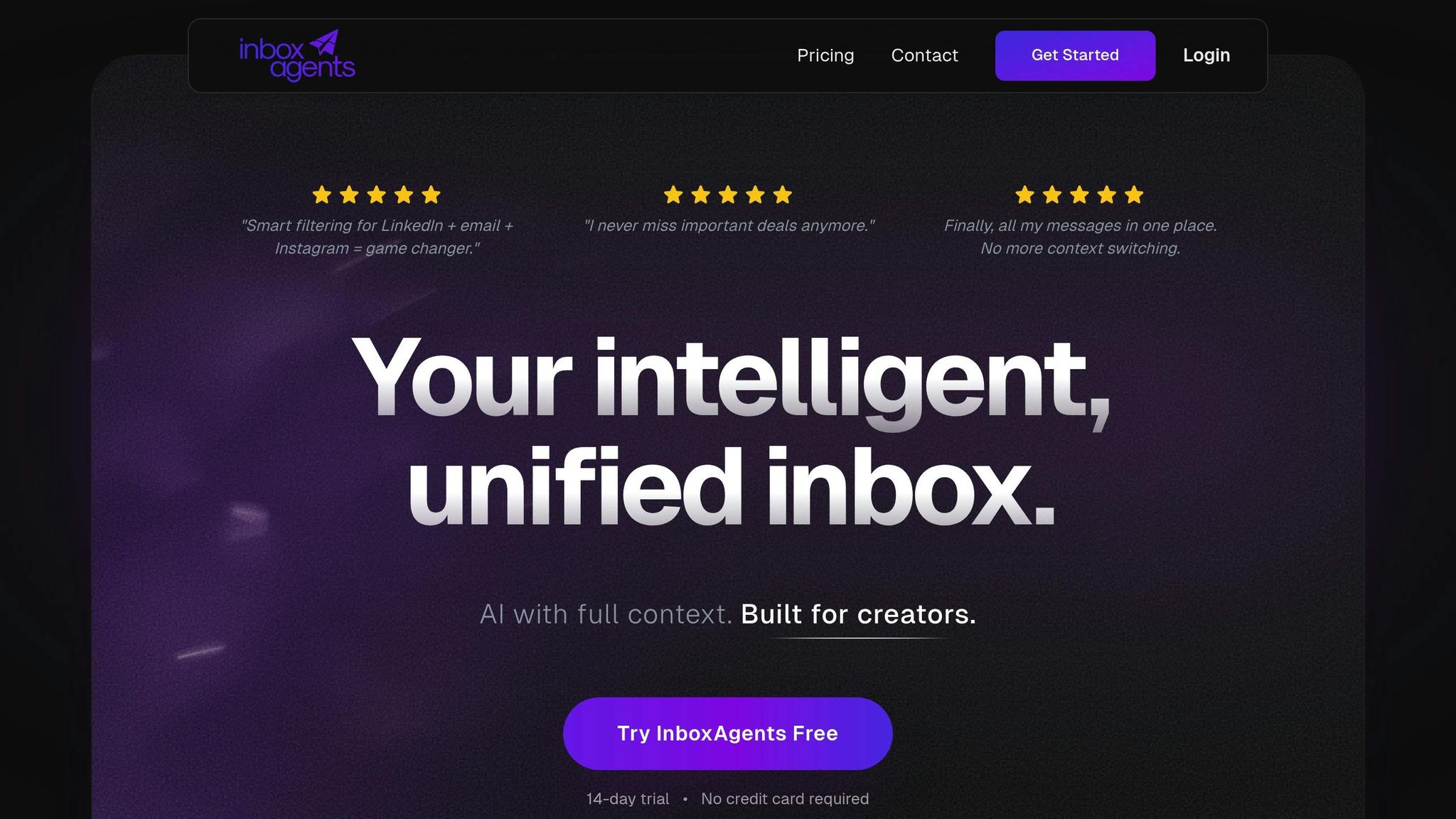
Inbox Agents takes AI intent detection to the next level, streamlining communication across platforms to save time and improve efficiency. By centralizing messaging into a single intelligent inbox, the platform not only consolidates multiple communication channels but also interprets the underlying intent of every incoming message. This eliminates the need to constantly switch between apps, cutting down wasted time by up to 23%. It’s not just about understanding what’s written - it’s about identifying what the sender truly needs.
One standout feature, Dollarbox, uses intent detection to identify and prioritize high-value messages. This means users no longer have to sift through an average of 121 daily messages manually. Instead, messages are automatically sorted into categories like Revenue Opportunities, Investor Updates, and Partnership Leads. As Grace Annalise, a Product Designer, puts it:
"Smart filtering for LinkedIn + email + Instagram = game changer".
Smart Replies and Personalization
Inbox Agents doesn’t stop at sorting messages - it also helps craft responses. By combining intent detection with tone and style matching, the platform generates AI-suggested replies that feel personal and natural. It learns your unique language, relationships, and business context to ensure responses align with your communication style. For example, when the system detects a scheduling request, it can propose meeting times based on your availability while maintaining your tone and voice.
This human-in-the-loop approach allows users to review and finalize replies, ensuring authenticity without sacrificing efficiency. The result? A personalized messaging experience that integrates seamlessly into your workflow.
Improved Productivity Through Unified Messaging
Inbox Agents is designed to help professionals reclaim their time. Its Daily Briefing feature delivers a morning summary of critical updates, making it possible to hit "Inbox Zero by 9 am". By unifying communications, the platform significantly reduces the time spent managing messages and the need to switch between apps.
Intent detection also enables users to customize automation levels. High-value contacts or topics can be flagged for manual review, while routine queries are handled by AI suggestions. This balance ensures that important relationships get the attention they deserve while day-to-day tasks are streamlined for maximum productivity.
Best Practices for Better AI Intent Detection
Creating an intent detection system that feels intuitive requires careful training, ongoing updates, and the integration of contextual cues. The difference between a system that irritates users and one that seems to understand them effortlessly lies in how well it’s developed and maintained. Let’s dive into some strategies that work.
Train AI Models with Contextual Data
Accurate intent detection starts with using real-world data. Training your AI on actual customer conversations is key. For example, fashion retailer Motel Rocks improved 70% of their negative interactions by leveraging real customer data to train their system.
Start by building an intent structure that reflects the most common types of support queries you receive. Focus on your high-frequency questions - these should have the most training examples. A good rule of thumb is to have at least 50 expressions per intent when launching, and scale up to 150–200 for intents that dominate your query volume. For instance, if 16% of your inquiries are about card replacements, this category should have significantly more examples compared to less common topics.
Keep your intent categories distinct to avoid overlap, and use slot filling to extract specific details. For example, the number “4” might mean 4:00 PM in one context but refer to four people in another. Fine-tuning your system with industry-specific language can also improve accuracy for niche scenarios. And don’t stop there - continuous learning ensures your model evolves and stays effective over time.
Use Continuous Learning and Feedback Loops
Intent detection isn’t a one-and-done process. The best systems are those that improve with every interaction. Regularly monitor your intent health by checking the average confidence score for each category. This will help you spot intents that need more training data or aren’t triggered often enough.
Set a confidence threshold - usually between 50% and 70% - for manual review. Messages in this range are especially valuable because the AI is close to understanding but not quite there. Analyze these cases to refine your training data and improve accuracy. Use tools like a confusion matrix to see where the system misclassifies similar intents, and adjust by either removing incorrect expressions or reassigning them to the right categories.
Perform regular content coverage analyses to identify gaps in your model. Look for frequent queries - those that make up at least 2% of your total volume - that don’t yet have a dedicated intent. Expanding your model to include these can help address new patterns as they emerge. Pair this with sentiment analysis to ensure your system responds not just accurately, but also empathetically.
Add Sentiment Analysis for Context-Aware Replies
Detecting a customer’s intent is only part of the story - you also need to understand how they feel. Sentiment analysis adds emotional context, helping your AI decide whether to automate a response or escalate the issue to a human. For instance, a frustrated customer requesting a cancellation needs a different approach than a satisfied customer making the same request.
Enable dynamic sentiment detection that updates with each new message, ensuring responses stay relevant as the conversation evolves. Use sentiment-based tagging to trigger specific workflows. For example, you can route upset VIP customers to senior agents or flag potential win-back opportunities when a cancellation request is paired with positive sentiment. By combining intent detection with sentiment analysis, your AI can deliver empathetic responses that turn potentially negative interactions into positive outcomes.
Conclusion
AI-powered intent detection is changing the way businesses approach customer interactions. Instead of relying on basic keyword matching, modern AI dives deeper - understanding the intent behind a customer's message. Whether someone is looking for help with an order, canceling a subscription, or ready to buy, AI can interpret their needs with remarkable precision. And these advancements aren’t just theoretical - they’re delivering real results.
For example, companies using AI-driven intent detection have seen 30% higher email response rates and a 35% boost in deal closures. Predictive lead scoring, another AI application, has been shown to cut sales cycle times by as much as 25%. Tools like Inbox Agents take it a step further by consolidating all customer messaging into one platform. Using intent detection, these tools ensure timely, personalized responses by automatically routing messages to the right teams and triggering the correct workflows - eliminating the delays caused by manual sorting.
When intent detection is paired with sentiment analysis, businesses can deliver even more context-aware responses. For instance, AI can distinguish between a frustrated customer requesting a cancellation and a satisfied customer making the same request. This nuanced understanding allows companies to turn potentially negative situations into positive outcomes, contributing to the 35% increase in deal closures.
As AI intent detection continues to improve through ongoing learning and feedback, platforms that integrate these capabilities into unified workflows will remain ahead of the curve. By adapting to customer needs in real time, businesses can ensure faster, smarter communication - building trust and driving measurable results.
FAQs
How does AI identify subtle differences in customer requests?
AI goes beyond just spotting keywords; it deciphers the deeper meaning and context behind customer requests. For example, it doesn’t just see "log-in" and "login" as two different phrases - it processes and standardizes text to understand they mean the same thing. By mapping messages into semantic representations, AI captures the intent behind the words, enabling it to differentiate between requests like "I need a refund because the product is defective" and "I want a refund for a wrong charge."
To sharpen its understanding, AI factors in additional cues such as user behavior (like recent actions or past interactions), tone, and confidence levels in its intent predictions. If the confidence score is low, the system can start by categorizing the request broadly and then refine it into more specific subcategories. What’s more, AI gets smarter over time, continuously learning and adapting to new patterns and subtleties.
Inbox Agents leverages this sophisticated intent detection to craft responses that are both precise and tailored to the customer’s needs. By blending text analysis with interaction history, it delivers replies that hit the mark - whether the request is about tracking an order, initiating a return, or exploring product recommendations.
How does sentiment analysis enhance AI intent detection?
Sentiment analysis brings an emotional depth to AI’s ability to detect intent. By determining whether a message carries a positive, neutral, or negative tone - or even pinpointing specific emotions like frustration or enthusiasm - it helps the AI grasp how the customer feels, not just what they want. For instance, a frustrated “I need help” might trigger an escalation to a live agent, while a cheerful “Thanks!” could be met with a friendly automated response.
By combining intent detection with sentiment analysis, AI delivers responses that are more in tune with the customer’s emotional state. Tools like Inbox Agents use this data to prioritize urgent messages, route conversations to the right channels, and craft replies that align with the customer’s mood. This approach leads to interactions that feel more personal, enhance customer satisfaction, and make communication processes more efficient.
How can businesses enhance the accuracy of AI intent detection?
To make AI intent detection more effective, start by using high-quality, well-labeled training data. Gather real customer messages from different communication channels and carefully tag each one with its corresponding intent. Then, clean up the text by removing unnecessary elements like filler words or inconsistent spellings. This way, the AI can concentrate on understanding the actual meaning behind the messages.
Another key step is to enhance the model with multi-channel behavioral data. By incorporating details like browsing history, tone of voice, and engagement patterns, you enable the AI to develop a more complete and accurate understanding of customer behavior. Additionally, creating a clear and structured intent taxonomy - grouping similar intents and keeping the categories manageable - can help reduce errors and boost the system's overall accuracy.
Lastly, implement a continuous learning process. Regularly review where the AI misclassifies intents, update the training data with corrected examples, and retrain the model to keep up with evolving customer needs. This ongoing refinement ensures the AI remains accurate and consistently delivers relevant responses.