

AI Feedback Loops vs. Static Response Systems
AI feedback loops and static response systems are two distinct approaches to designing communication tools. Feedback loops continuously improve by learning from interactions, while static systems rely on fixed rules and require manual updates. Here's what you need to know:
- AI Feedback Loops: Learn from user interactions, refine responses automatically, and handle complex, evolving scenarios.
- Static Response Systems: Follow pre-programmed rules, deliver predictable outcomes, and suit stable, repetitive tasks.
Quick Comparison
| Feature | AI Feedback Loops | Static Response Systems |
|---|---|---|
| Learning | Automated, based on user feedback | Manual updates by developers |
| Flexibility | Adjusts to new data and trends | Fixed, requires reprogramming |
| Use Case | Dynamic, evolving environments | Predictable, repetitive tasks |
| Maintenance | Lower over time after setup | High, due to frequent updates |
AI feedback loops shine in dynamic environments like customer support or fraud detection, where they improve efficiency and accuracy. Static systems are better for environments needing consistent, rule-based responses, like compliance workflows. Your choice depends on your needs - whether you prioritize adaptability or reliability.
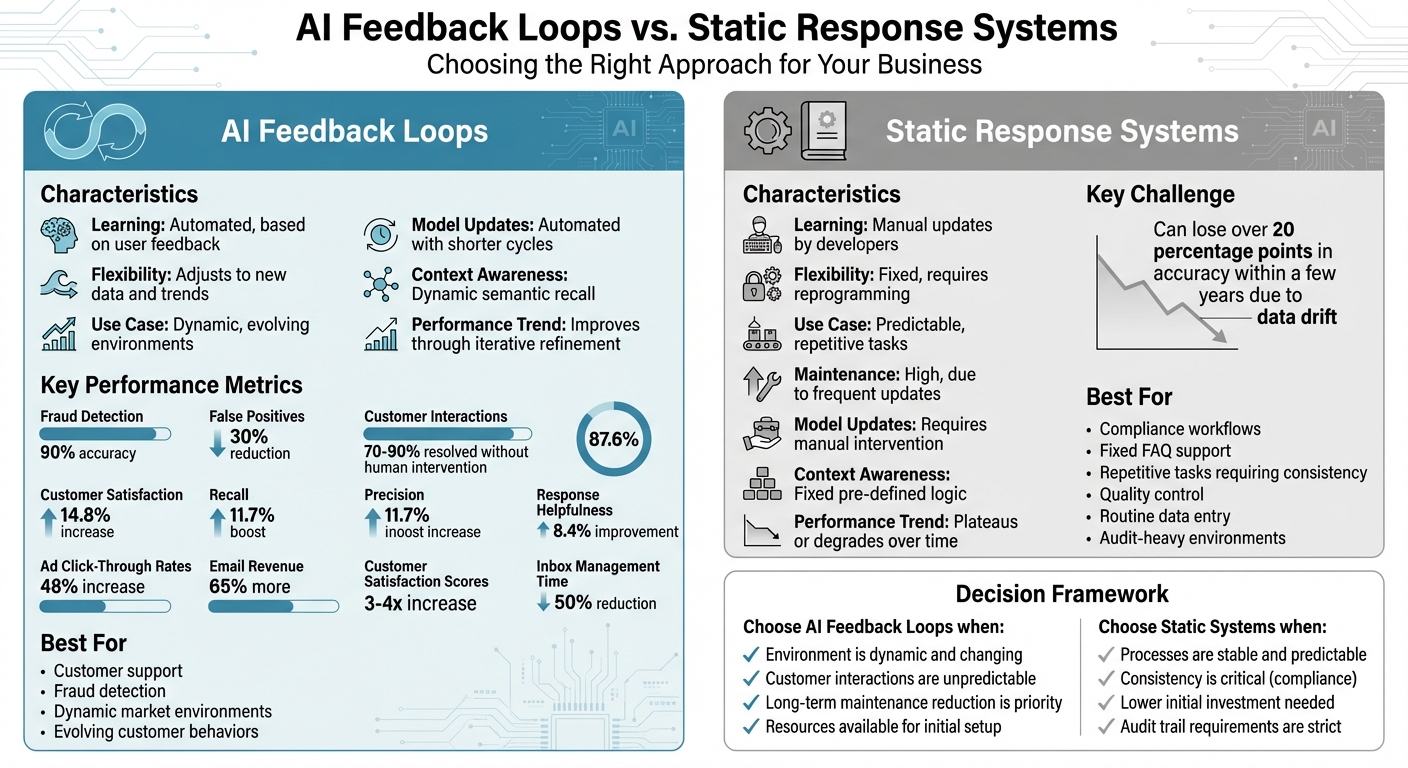
AI Feedback Loops vs Static Response Systems: Key Differences and Performance Metrics
Main Differences Between AI Feedback Loops and Static Response Systems
How Each System Works
The standout difference between these two systems lies in their ability to adapt. AI feedback loops thrive on a "data flywheel" approach. They process incoming inputs, generate responses, collect user feedback (like corrections or follow-up queries), and use that feedback to fine-tune future interactions. In contrast, static response systems stick to predefined rules for each interaction, with no mechanism for dynamic adjustment.
"AI products aren't static. They exist in the messy middle between automation and conversation - and that means they need to adapt to users in real time."
– Eric Heaton, Head of Engineering at Siberia
This fundamental difference in operation shapes how these systems handle learning and recognize context.
Learning and Context Awareness
AI feedback loops excel at learning from experience. They use techniques like backpropagation and closed-loop learning to identify and correct errors automatically. With the help of vector databases, they can compare new inputs to past data, enabling them to dynamically improve context recognition. On the other hand, static systems lack this capability. They depend on keyword matching and rigid logic, which can only evolve through manual updates by developers. For instance, recognizing variations in phrasing for the same issue often requires manual reprogramming. Studies reveal that static models can lose over 20 percentage points in accuracy within a few years due to data drift, even when paired with retrieval systems.
A real-world example highlights the potential of AI feedback loops. In October 2025, Airbnb introduced an Agent-in-the-Loop (AITL) framework for its U.S.-based customer support. Spearheaded by Cen (Mia) Zhao and a team of 10 researchers, the initiative incorporated real-time annotations into live operations. During a pilot involving 40 agents and 5,000 cases, the system slashed model retraining cycles from months to weeks. The results? A 14.8% increase in precision@8, an 11.7% boost in recall@75, and an 8.4% improvement in response helpfulness.
Comparison Table
| Feature | Static Response Systems | AI Feedback Loops |
|---|---|---|
| Learning Approach | Manual updates and rules-based | Continuous closed-loop learning |
| Model Updates | Requires manual intervention | Automated with shorter cycles |
| Context Awareness | Fixed pre-defined logic | Dynamic semantic recall |
| Data Handling | Static knowledge cut-off | Real-time user interaction integration |
| Resource Needs | Frequent manual maintenance | High initial setup; largely automated thereafter |
| Performance Trend | Plateaus or degrades over time | Improves through iterative refinement |
Benefits of Each System
Benefits of AI Feedback Loops
AI feedback loops thrive in dynamic environments where change is constant. They adapt in real time to shifting market trends, seasonal demands, and evolving customer behaviors - areas where traditional static systems often fall short. By leveraging iterative learning, these systems continually refine themselves, correcting errors and improving performance.
Take Airbnb as an example. In a pilot conducted in October 2025, their use of AI feedback loops shortened retraining cycles from months to just weeks. This shift led to measurable gains in precision, recall, and the overall helpfulness of responses.
The banking sector has also reaped the rewards of these systems. Fraud detection tools equipped with feedback loops now achieve an impressive 90% accuracy while cutting false positives by 30%. Similarly, customer service chatbots utilizing these loops resolve 70–90% of interactions without needing human intervention, all while maintaining an 87.6% customer satisfaction rate. Another critical advantage is how AI feedback loops address the issue of knowledge decay. Unlike static models that can lose over 20 percentage points of accuracy within a few years, feedback loops help maintain consistent performance.
While these systems excel in adaptability, static response systems remain a better fit for environments where predictability is key.
Strengths of Static Response Systems
Static response systems are best suited for scenarios where consistency and predictability outweigh the need for continuous learning. Their fixed logic ensures stable performance, making them a trusted choice for repetitive tasks where reliability is paramount. This reliability is particularly valuable in industries with strict audit requirements or compliance standards, where stakeholders demand systems that are easy to explain and validate.
"Some teams disable feedback loops entirely because static agents feel safer than risking systems that learn the wrong lessons." – Datagrid Team
Another major advantage of static systems is cost efficiency. Without the need for complex feedback pipelines or ongoing monitoring, these systems are simpler and quicker to deploy. Their predictable operation makes them ideal for tasks like quality control, routine data entry, and maintaining data integrity. For example, in business workflows involving CRMs, static systems help prevent a single erroneous entry from cascading into larger issues throughout the system.
Both approaches have their strengths, but their effectiveness depends on the specific needs and challenges of the environment in which they are deployed.
AI Feedback Loops in Inbox Agents

Smart Replies and Personalized Responses
Inbox Agents uses a draft-and-review system that gets smarter with every interaction you have. It doesn’t just stop at offering generic suggestions - it actively learns from how you edit and adjust its responses. For instance, if you frequently correct certain phrases or override specific suggestions, the AI picks up on those patterns and adapts accordingly. Even subtle actions, like moving an email to a different folder or tweaking a label, help fine-tune its filtering rules automatically, making the system more in sync with your workflow over time - all without requiring extra effort from you.
"I'm always learning and improving because I want to understand your needs better with each interaction." – Actor AI Assistant
For emails that carry more weight, Inbox Agents takes it up a notch by routing drafts for your review. Each override you make is logged with a reason code, which helps the system learn from your decisions. This process not only prevents errors in the future but also boosts the reliability of its suggestions.
This dynamic feedback loop is a prime example of how Inbox Agents uses AI to make email communication smoother and more efficient.
Continuous Learning in Unified Inbox Management
Inbox Agents doesn’t stop at refining individual email responses - it takes things further by applying continuous learning across all your communication platforms. Whether it’s email, LinkedIn, or another channel, the AI tracks your behavior, like which types of messages get quick replies, and adjusts its prioritization logic to match.
Its advanced memory system operates on multiple levels. It can handle urgent client requests in real time while still keeping track of long-term business context. If it encounters unclear intent, it prompts you for clarification and reroutes accordingly. Any corrections you make are fed back into the system, helping it avoid similar issues in the future.
This ongoing learning process also sharpens features like spam filtering, message categorization, and even negotiation handling. By grounding its decisions in real-time CRM data, Inbox Agents delivers smarter, more accurate results. Businesses using these intelligent feedback systems have reported 3-4x increases in customer satisfaction scores and cut inbox management time by up to 50%.
sbb-itb-fd3217b
Choosing the Right System for Your Needs
Evaluating Environment Stability and Data Complexity
The type of system you choose should depend heavily on how stable your operating environment is. Static systems are ideal when your business processes, customer inquiries, and product offerings remain fairly predictable. For instance, if you're running a help desk with a fixed set of FAQs or managing compliance workflows that demand consistency, a static system provides the control and reliability you need.
However, if your environment is more dynamic - think frequent updates to product features, shifting customer preferences, or seasonal spikes in demand - you'll need a system with feedback loops. Static models tend to falter when faced with constant change, often requiring frequent manual adjustments just to keep up. Eric Heaton, Head of Engineering at Siberia, highlights this challenge:
"Without a feedback mechanism in place, teams end up chasing quality through prompt tweaking or endless manual intervention… a treadmill that burns time and slows down iteration".
Data complexity is another critical factor. Static systems often struggle with more nuanced inputs, such as mismatched tones, incomplete information, or subjective interpretations. For example, if your customer interactions require distinguishing between factual errors and issues with communication style, feedback loops handle these complexities far more effectively. Take the case of banking institutions: those using feedback-enabled fraud detection systems have achieved 90% accuracy while reducing false positives by 30%.
Once you've assessed environmental stability and data complexity, it's time to weigh resource and cost factors in your decision.
Resource and Cost Considerations
Your budget and available technical resources will strongly influence your choice. Static systems are less expensive to set up initially, but they often lead to time-consuming manual updates and prompt adjustments down the line. On the other hand, systems with feedback loops require a more substantial upfront investment in infrastructure - such as vector databases and monitoring tools - but they significantly cut down on long-term maintenance.
Real-world results back this up: organizations that have implemented feedback loops report improved model accuracy and fewer retraining cycles, yielding impressive returns on their initial investment.
That said, feedback loops come with their own challenges. You'll need to put mechanisms in place - like validation gates and versioning - to ensure the AI learns the right lessons and avoids "memory corruption". If your team doesn't yet have the expertise or tools to manage this kind of monitoring, starting with a static system may be the wiser choice until you're ready to scale up.
AI Workshop – Session 1: Feedback Loops Explained ft. @VideoGeeksNet
Conclusion
Deciding between AI feedback loops and static response systems isn't about picking one over the other - it’s about aligning the right approach with your business needs. Static systems excel in delivering consistent, predictable results, making them perfect for environments like compliance-heavy workflows or fixed FAQ support. On the other hand, when customer interactions become unpredictable or market conditions change rapidly, feedback loops provide the adaptability needed to stay ahead.
The numbers speak for themselves: feedback-driven systems have achieved a 48% increase in ad click-through rates and 65% more email revenue. One example even demonstrated how shortening retraining cycles significantly boosted recall. These results highlight how businesses can transform their operations with systems that learn and adapt in real time.
Take Inbox Agents as an example. By harnessing AI feedback loops, the platform redefines how teams handle communication across various channels. With features like smart replies and personalized responses that improve with every interaction, Inbox Agents eliminates the exhausting cycle of manually tweaking prompts. Each conversation becomes a learning opportunity, allowing the system to better understand your business and refine its responses.
As Eric Heaton aptly put it, the key differentiator lies in how effectively systems gather, organize, and act on user feedback. Whether you’re managing customer support, driving sales outreach, or streamlining team communications, the ability to learn and evolve sets truly effective systems apart from those that simply perform routine tasks.
Looking forward, the future belongs to systems that grow alongside your business. While static systems still have their place, feedback loops pave the way for safer autonomy, reduced manual effort, and continuous improvement.
FAQs
How do AI feedback loops improve adaptability compared to static response systems?
AI feedback loops give systems the ability to learn and improve continuously by incorporating user interactions - like corrections, feedback, or successful outcomes - into their training process. This ongoing refinement helps the AI adapt to changes in language, customer preferences, and market trends. By learning from real-world use, these systems become more accurate, make fewer mistakes, and reduce the need for human intervention.
Static response systems, on the other hand, operate in a fixed manner. They generate the same output regardless of changing circumstances and can't adjust to new information or user input. To handle new scenarios, these systems often require manual updates, which can slow their ability to respond to evolving demands.
Inbox Agents takes advantage of AI feedback loops to keep features like automated inbox summaries, smart replies, and negotiation handling both relevant and personalized. This approach ensures responses stay current, avoiding the limitations of traditional rule-based systems.
What should I consider when choosing between AI feedback loops and static response systems?
When choosing between AI feedback loops and static response systems, it’s essential to consider factors like flexibility, potential risks, and available resources. Feedback loops enable systems to learn and improve by analyzing user interactions, making them an excellent fit for dynamic scenarios where user preferences or needs frequently shift. That said, they can introduce unpredictability and require robust safeguards to ensure consistent and reliable results.
Static systems, by contrast, deliver steady and predictable responses. This makes them easier to manage, audit, and maintain. They’re often the go-to option for situations where compliance, minimizing errors, or controlling costs takes precedence. While they are less demanding in terms of resources, static systems lack the ability to adapt and evolve as feedback-driven models do.
For tools like Inbox Agents, which provide AI-powered smart replies and tailored outreach, feedback loops can fine-tune responses over time, improving overall effectiveness. Ultimately, the decision boils down to finding the right balance between flexibility, safety, and budget to align with your business objectives.
Do AI feedback loops provide better long-term accuracy than static systems?
AI feedback loops are built to learn and improve by integrating user input over time. This process keeps AI systems accurate and up-to-date, steering clear of the limitations that come with static response systems.
By updating their models using real-world data and interactions, these feedback loops allow AI to adjust and grow. This ensures the system can keep up with shifting demands, making it a strong choice for environments that require flexibility and adaptability.