

How AI Generates Smart Replies for Messages
AI-powered smart replies simplify communication by suggesting quick, context-aware responses to messages. For example, when you're asked, "Are you free Friday?" the system might propose options like "Yes, I'm free!" or "Sorry, I can't." These replies are powered by natural language processing (NLP), machine learning, and generative AI, which analyze the message's tone, intent, and context to craft relevant responses in seconds.
Here’s why this matters:
- Saves time: Reduces manual effort in drafting replies, especially for repetitive tasks.
- Improves efficiency: Handles high message volumes without needing extra staff.
- Consistency: Maintains a uniform tone and professionalism across responses.
Key technologies include:
- NLP: Understands tone, sentiment, and context.
- Machine learning: Learns from past interactions to predict better replies.
- Generative AI: Creates custom responses using vast datasets and internal knowledge bases.
Smart replies evolve with use, learning from feedback to improve accuracy and personalization. Businesses can integrate these tools into platforms like Inbox Agents to manage emails, chats, and social media messages in one place, ensuring faster, more effective communication.
Create Email Replies in SECONDS using AI (Guide)
Core Technologies Behind Smart Replies
AI-powered smart replies are built on three key technologies: natural language processing (NLP), machine learning with predictive algorithms, and generative AI models. Each plays a specific role in understanding, interpreting, and crafting responses that feel natural and relevant. Let’s break down how these technologies work together to create context-aware responses.
Natural Language Processing (NLP)
NLP is the backbone of smart reply systems, enabling AI to make sense of human language. It processes messages by breaking text into smaller components (tokenizing), identifying parts of speech, and analyzing sentiment to detect whether the tone is positive, neutral, or negative. For instance, when someone sends a message like "How are you?", NLP recognizes it as a casual greeting and might suggest a friendly reply such as "Good, thanks!"
In professional settings, NLP can differentiate between a straightforward question and a complaint by analyzing the message's tone and context. It also tracks the flow of a conversation, ensuring references like "Can we reschedule that?" are understood based on prior exchanges. This contextual awareness ensures that responses remain relevant and appropriate.
Machine Learning and Predictive Algorithms
Taking cues from NLP, machine learning models analyze extensive datasets - such as emails, chat logs, and customer support interactions - to identify patterns and predict suitable replies. These models rank potential responses using techniques like pattern recognition and probability scoring. For example, in a scheduling conversation, the system can prioritize responses based on past user preferences or interactions.
A notable example is Google's Smart Reply feature for Gmail, which quickly gained traction. Shortly after its release, about 10% of all outgoing replies were generated using suggested responses. Feedback loops play a crucial role here - when users select, modify, or ignore suggestions, the system learns from these actions to continuously improve its predictions.
Generative AI Models
Generative AI models take things further by creating entirely new responses instead of selecting from pre-written options. These advanced models are trained on massive text datasets, enabling them to understand grammar, conversational patterns, and even specialized industry terms. For example, instead of a simple "Yes" or "No", a generative AI might craft a response like, "I'd love to join, but I have a conflict at 7:00 PM. Could we do 8:30 PM instead?"
Many modern systems enhance this capability with retrieval-augmented generation (RAG). This approach first searches internal knowledge bases, FAQs, or policy documents for context, ensuring the generated response is accurate and aligned with company standards. Reinforcement learning further fine-tunes these models, reducing errors and ensuring the output meets user expectations. This combination of precision and adaptability makes these models invaluable for professional communication.
How Smart Replies Are Generated
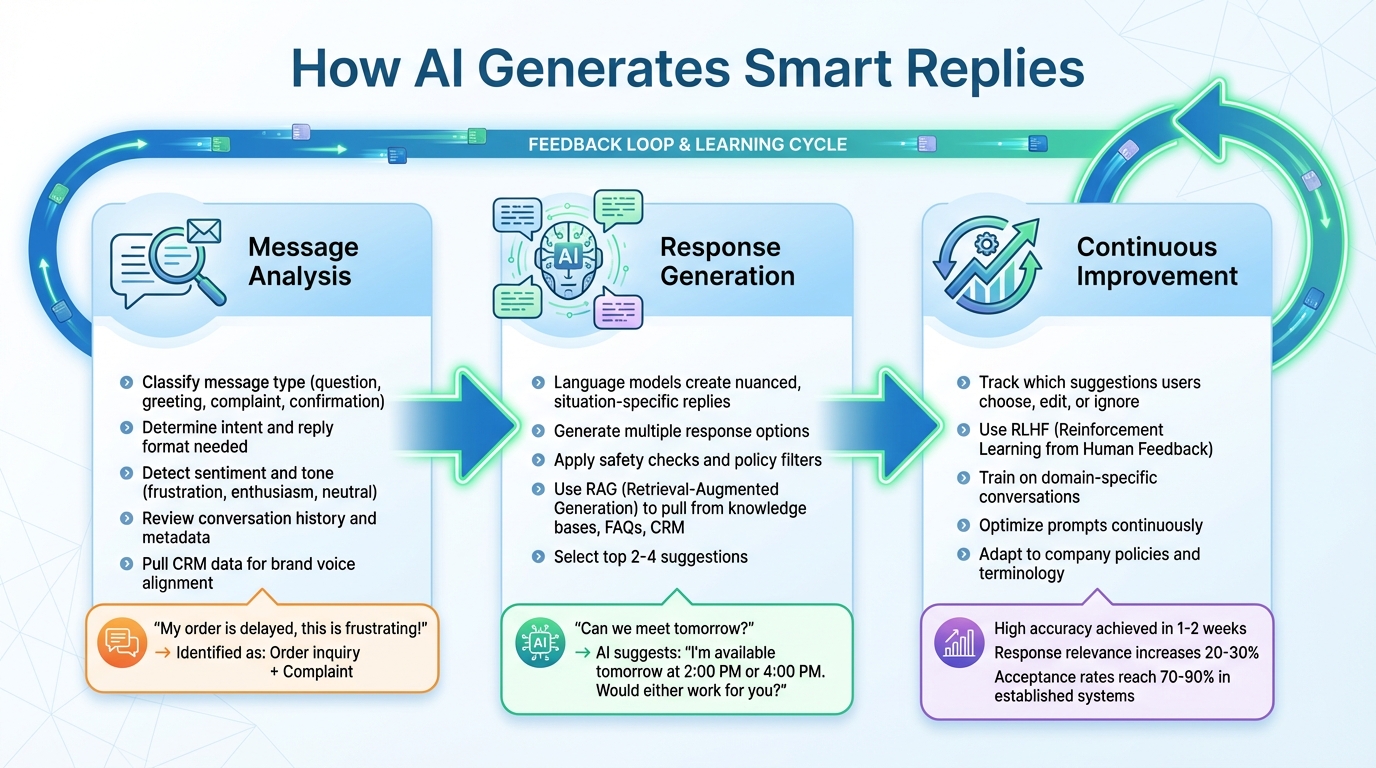
How AI Generates Smart Replies: 3-Step Process from Message Analysis to Continuous Learning
Now that we've explored the technologies behind smart replies, let’s break down how AI transforms an incoming message into a polished, ready-to-send response. This process happens in mere seconds and involves three key steps: analyzing the message, generating a response, and ongoing refinement.
Analyzing Input Messages
The process starts with natural language processing (NLP) and machine learning to classify the type of message. The AI examines the entire message to understand its nature - whether it’s a question, a greeting, a complaint, or a confirmation. For instance, if a customer writes, "My order is delayed, this is frustrating!", the system identifies it as an inquiry about order status paired with a complaint.
From there, the AI determines the intent behind the message and the most suitable format for the reply. Does the sender need a yes/no answer, an apology, a clarification, or a specific piece of information? Sentiment analysis and tone detection play a critical role here. By recognizing emotions like frustration or enthusiasm, the AI ensures its response aligns with the context. Additionally, it uses conversation history and metadata to maintain consistency. In professional settings, the AI might pull data from CRM systems to reflect the brand’s voice accurately.
Generating Context-Aware Responses
Once the message is analyzed, the AI generates a reply using language models fine-tuned with messaging data. Instead of relying on a fixed set of pre-written phrases, these models create nuanced and situation-specific responses.
The system generates several response options and puts them through safety checks and policy filters before selecting the top 2–4 suggestions. Many business platforms use retrieval-augmented generation (RAG), which pulls information from internal resources like knowledge bases, FAQs, or CRM records to ensure replies are grounded in accurate data. For example, if someone asks, "Can we meet tomorrow to discuss the project?", the AI might propose, "I'm available tomorrow at 2:00 PM or 4:00 PM. Would either of those work for you?"
Learning and Improving Over Time
Smart reply systems don’t just stop at generating responses - they get better with every interaction. They track which suggestions users choose, edit, or ignore, using that feedback to refine their ranking models and improve future predictions. When trained on domain-specific conversations - like a retailer’s customer support tickets - the AI becomes adept at understanding industry-specific terms, company policies, and preferred response styles.
This improvement process is powered by techniques like reinforcement learning from human feedback (RLHF) and ongoing prompt optimization. Platforms such as Inbox Agents can achieve high accuracy in just 1–2 weeks of regular use, as the AI learns patterns, tone, terminology, and relationship dynamics. Users can speed up this learning curve by providing feedback on suggestions and using advanced training features. Over time, the system adapts to handle more complex scenarios. For instance, in customer support, initial replies evolve to include precise details like tracking links, increasing response relevance by 20–30%, according to AI adoption efficiency studies.
These continual improvements pave the way for even more personalized responses, which we’ll cover in the next section.
Personalization Through Training Data
Once we've covered how AI generates context-aware responses, it's time to dive into how training data takes this a step further by personalizing smart replies. These replies shine by adapting to your brand's tone and aligning with individual customer habits.
Using Business-Specific Data
Personalization starts by teaching AI to mirror your brand's voice. This is done by feeding it data that reflects how your company communicates - past emails, chat logs, support tickets, CRM records, and internal documents. For instance, a retail business might provide transaction histories and product descriptions, allowing the AI to craft responses like, "Thank you for purchasing the blue sneakers. Your order will ship by Friday." This ensures replies not only sound professional but also stay on-brand.
The process involves gathering high-quality examples of conversations and using advanced techniques to fine-tune the AI. When connected to CRMs or ERPs, this approach can improve response accuracy by 30–50%. Social media tools can analyze comment histories to craft replies that fit your brand's style, while customer support systems leverage ticket data to provide personalized troubleshooting for FAQs. The AI also evolves with each interaction, learning from user history to make every reply more relevant.
Adapting to User History and Preferences
Personalization doesn't stop at the company level - it digs deeper into individual user behavior. Smart reply systems analyze past interactions, preferences, and even sentiment to tailor responses. For example, if a customer often inquires about shipping, the AI might respond with, "Your order ships tomorrow, tracking #ABC123."
To make this happen, the system stores conversation history in vector databases, allowing it to pull up relevant context for new messages. It also learns from user feedback - whether that's edits, clicks, or direct responses - to adjust its tone and focus. In well-established systems, response acceptance rates can hit 70–90%. With regular use and feedback, the system often reaches impressive levels of accuracy within just one to two weeks. This kind of personalization lays the groundwork for seamless integration into unified inbox systems, making communication smoother and more efficient.
sbb-itb-fd3217b
Inbox Agents: Smart Replies in Action
Unified Inbox Integration
Inbox Agents brings all major communication channels - email (like Gmail and Outlook), messaging apps (such as Meta and WhatsApp), SMS, and social platforms like Instagram and LinkedIn - into one unified dashboard. Incoming messages are standardized into a single, easy-to-manage view. For U.S. businesses, this means authenticated accounts can assign teams to specific channels and funnel all messages into a central queue. This setup helps meet the fast response times expected during typical U.S. business hours.
The platform goes a step further by automatically tagging and categorizing messages based on their source, topic (like billing, support, or sales), and urgency, which is determined through sentiment analysis and keyword detection. AI-driven intent classification ensures that urgent or negative messages are prioritized, while business rules can flag high-value opportunities - like deals exceeding $1,000 - for immediate attention by senior team members. Agents can access conversation histories, notes, and CRM data all in one place, creating a seamless workflow that allows AI to deliver highly tailored and efficient responses.
AI-Powered Smart Replies and Personalization
Using natural language processing (NLP) and generative AI, Inbox Agents analyzes message content, intent, sentiment, and past interactions to suggest smart, context-aware reply options directly within the inbox. These replies are customized for each communication channel and enriched with relevant business data, such as customer status, recent purchases, or unresolved tickets. For example, in a sales interaction, the AI might suggest a follow-up like, "Hi Alex, thanks for your interest in our Pro plan at $199/month…" based on CRM insights and previous conversations.
Businesses can set up brand voice and compliance rules to ensure AI-generated replies align with their tone and legal standards. By training the system with company-specific data - like historical conversations, FAQs, and internal knowledge bases - the AI becomes familiar with product details, pricing norms (in USD), and typical resolutions for U.S. customers. Agents can fine-tune the tone and level of detail in responses, and the AI evolves over time, learning from edits made by users. Importantly, agents maintain full control, with the option to send, tweak, or discard AI suggestions.
Additional Features for Business Efficiency
Inbox Agents doesn’t stop at smart replies - it offers additional tools to make messaging management more efficient. For instance, the platform uses NLP to create concise inbox summaries. These summaries distill lengthy email threads or multi-channel conversations into bite-sized overviews, highlighting key decisions, unresolved questions, and next steps. This feature is especially helpful during shift handoffs, ensuring agents can quickly get up to speed.
Another standout feature is the negotiation handler, which uses AI and pre-set rules to suggest approved responses, such as offering a 10% discount or free shipping. Any exceptions are flagged for manual review. The system also includes built-in classifiers to detect spam, abusive messages, or low-priority content, automatically quarantining them or marking them for later review so agents can focus on high-value interactions.
Automated outreach adds another layer of efficiency, sending personalized updates like order confirmations or appointment reminders triggered by events in connected systems. These messages are tailored to local expectations, with time zones clearly stated and dates formatted in MM/DD/YYYY style to suit U.S. standards.
Benefits of AI-Generated Smart Replies for Businesses
Improved Speed and Efficiency
AI-generated smart replies deliver responses almost instantly, cutting out the time spent on manually drafting messages. Instead of dedicating hours to crafting individual replies, your team can quickly review and send AI-suggested responses. This speed becomes especially important during U.S. business hours, when customers expect rapid answers - meeting these expectations can lead to higher satisfaction and increased sales conversions.
By automating routine tasks like answering FAQs, sending order confirmations, or scheduling appointments, AI allows your team to focus on more nuanced responsibilities that require human insight. For instance, in customer support, AI can handle tracking inquiries and troubleshooting at scale. In sales, it can generate instant follow-ups by pulling data from integrated CRM systems, turning potential leads into actionable opportunities without delay.
This ability to respond quickly also ensures that your brand maintains a consistent voice, even as the volume of messages grows.
Consistency and Scalability
Speed isn’t the only advantage - AI smart replies also ensure uniformity in all customer interactions. Every message aligns with your company’s tone, standards, and compliance guidelines, no matter the volume. Whether your team is managing 50 or 5,000 inquiries, the system ensures that every response reflects your brand, fostering trust and reliability as customers engage with your business across various channels and time zones.
The scalability of AI shines during high-demand periods. It can handle hundreds or even thousands of inquiries simultaneously without the need to hire additional staff. Operating 24/7, it ensures that customer questions are addressed promptly - even outside regular business hours. This capability means that when message volumes surge, your system can handle the increase effortlessly, ensuring no customer is left waiting.
Cost-Effectiveness and Resource Savings
In addition to speed and consistency, AI smart replies bring notable cost savings. By managing higher message volumes without increasing staffing needs, AI reduces operational expenses. Instead of onboarding more team members to meet growing demand, businesses can rely on AI to handle the load, freeing up resources for other priorities. This approach cuts costs while maintaining - or even improving - service quality.
AI also filters out non-essential messages, reducing distractions and allowing teams to focus on tasks that require a personal touch. By automating routine communications, your staff can dedicate more energy to revenue-generating opportunities and high-value interactions, ensuring their time is spent where it matters most.
Conclusion
Key Takeaways
AI-powered smart replies are reshaping how U.S. businesses handle communication. By leveraging natural language processing (NLP), machine learning, and generative models, these tools craft human-like responses in real-time. The results? Faster replies across email, chat, and social platforms, a consistent brand voice even during high-volume interactions, and the ability to scale operations without needing to significantly grow your team.
What’s more, smart reply systems get smarter over time. They learn from real-world interactions and feedback, gradually adapting to your business’s tone, terminology, and customer expectations. This continuous improvement enhances their value, providing better returns as they align more closely with your unique needs. Platforms like Inbox Agents demonstrate how integrating AI across messaging channels can streamline communication and set the stage for practical AI adoption.
Next Steps for Adopting AI Solutions
Ready to bring AI into your business? Start small. Test it on high-traffic channels like email support or website chat, where repetitive questions are common. Set clear goals - think reduced response times or improved customer satisfaction - and choose solutions that integrate easily with your existing systems. Make sure they support U.S. data compliance standards and offer options for human oversight, so your team can review AI suggestions before they’re sent.
For businesses eager to get started, platforms like Inbox Agents simplify the process by combining multiple communication channels - email, SMS, social media, and marketplace messages - into one interface. With built-in AI tools like smart replies, automated summaries, and spam filtering, these platforms reduce the hassle of integration. They even offer pre-designed templates tailored to your workflows, so you don’t have to build everything from scratch. Run a pilot for 30–60 days, involve your frontline teams in setting up guidelines, and expand automation only after confirming quality and receiving positive feedback from customers.
FAQs
How does AI create accurate and relevant smart replies?
AI creates precise and context-aware smart replies by thoroughly analyzing the conversation as a whole. It identifies the intent behind messages and picks up on user communication habits, enabling it to craft responses that fit the specific situation and tone of the dialogue.
With the help of machine learning, the AI keeps refining its ability to understand and respond effectively, ensuring its replies stay accurate and relevant as it learns over time.
Can smart replies be tailored to match my brand's voice and style?
Yes, smart replies can be customized to match your brand's voice and style. By examining your preferred tone, specific language, and how you typically interact with customers, AI can create responses that fit seamlessly with your brand's personality. This helps ensure every message feels genuine and aligns with your overall business identity.
How does user feedback improve AI-generated smart replies?
Feedback from users is key to refining AI-generated smart replies. By evaluating input on aspects such as accuracy, relevance, and tone, the AI gains valuable insights into user preferences, helping it improve over time.
This ongoing learning process helps create replies that feel more tailored and effective, ultimately enhancing the communication experience for both businesses and their customers.