

AI in Messaging: Scaling Multi-Platform Integration
Managing customer conversations across platforms like WhatsApp, SMS, web chat, and social media can quickly become chaotic as businesses grow. Traditional tools often force a trade-off between personalized service and efficiency. AI is changing this dynamic by enabling businesses to handle large-scale messaging while maintaining a human-like touch. Here's a quick look at how four platforms - Inbox Agents, Firebase, PubNub, and Twilio - address the challenges of scalability, integration, and intelligence in multi-platform messaging:
- Inbox Agents: Combines all messaging channels into one workspace with AI-driven conversation management. Features include smart replies, abuse filtering, and modular micro-agents for specific tasks.
- Firebase: Offers real-time messaging infrastructure with AI SDKs, multi-agent coordination, and dynamic updates to AI models. Handles massive traffic with scalable databases.
- PubNub: Focuses on real-time messaging with ultra-low latency, AI moderation, and serverless custom logic for tailored workflows.
- Twilio: Provides customizable solutions for unified communication across channels with AI assistants, sentiment analysis, and integrated customer data.
Each platform has strengths, with Inbox Agents prioritizing simplicity, Firebase offering developer tools, PubNub excelling in speed, and Twilio focusing on deep customization. Businesses must weigh their specific needs - whether it's ease of use, scalability, or advanced customization - to choose the right solution.
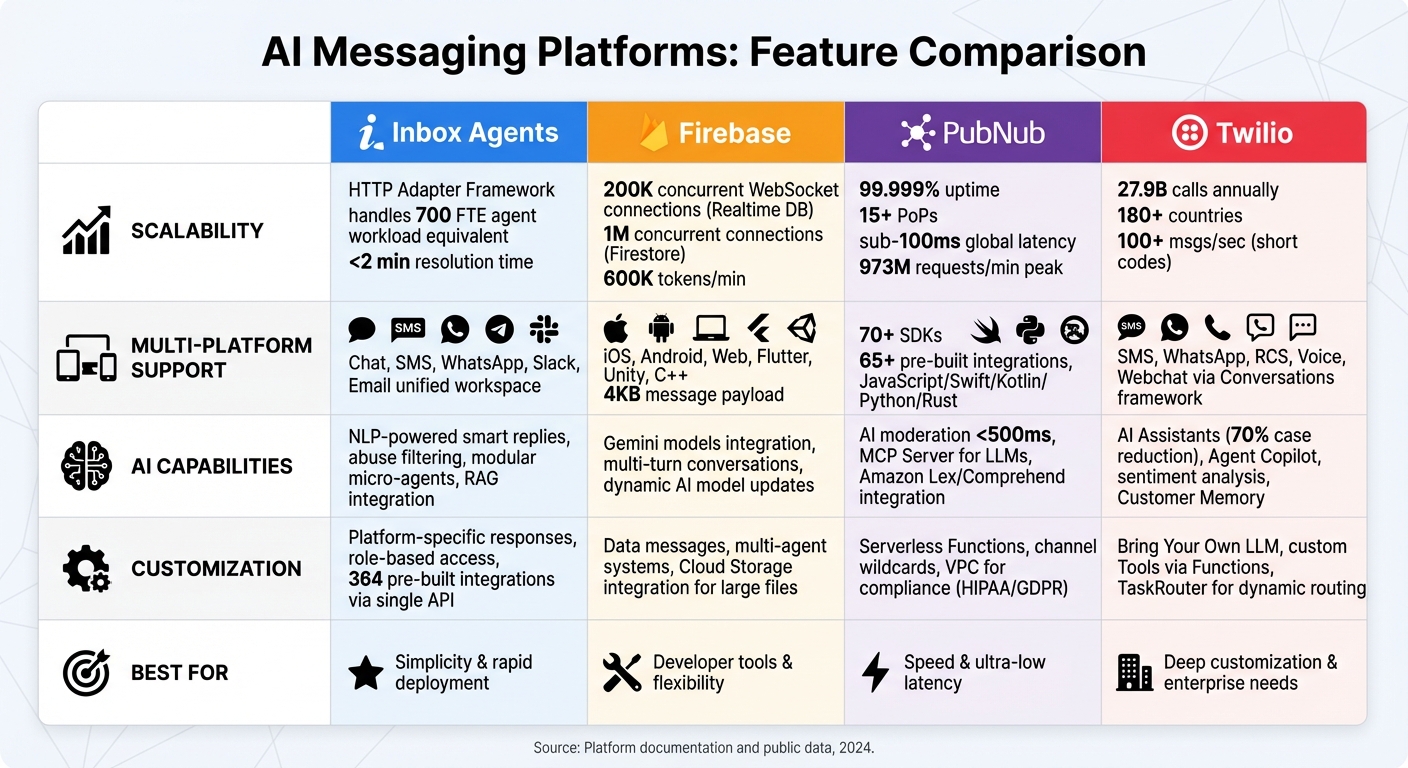
AI Messaging Platforms Comparison: Inbox Agents vs Firebase vs PubNub vs Twilio
1. Inbox Agents
Scalability
Inbox Agents tackles scalability with an HTTP Adapter Framework that uses a standardized PlatformNode interface. This ensures consistent messaging logic across environments like Next.js, Hono, or Express.js. For instance, when Klarna launched an OpenAI-powered assistant in early 2024, it handled the equivalent workload of 700 full-time agents in just one month. This upgrade slashed resolution times from 11 minutes to under 2 minutes and reduced repeat inquiries by 25%.
The system ensures messages are standardized across all channels, meaning an agent trained once can respond consistently everywhere. It also maintains real-time updates and retains conversation context even when users switch platforms - like moving from SMS to web chat mid-conversation. This solid foundation allows Inbox Agents to scale effortlessly while integrating multiple messaging channels into one seamless system.
Multi-Platform Integration
Leveraging its scalable design, Inbox Agents brings together chat, SMS, WhatsApp, Telegram, Slack, and email into a single workspace. This eliminates the inefficiency of switching between tabs and losing context. Why does this matter? Salesforce CEO Marc Benioff highlights that "Service employees waste over 40% of their time on low-value and repetitive tasks", much of which stems from managing disconnected tools.
The integration layer employs Retrieval-Augmented Generation (RAG) to pull relevant data from vector databases, ensuring agents always have access to business-specific knowledge, no matter which platform a customer uses. When combined with Customer Data Platforms like Twilio Segment, agents can identify returning users and recall their history across all touchpoints, making interactions more personalized and efficient.
AI Features
Inbox Agents uses Natural Language Processing (NLP) to power automated summaries (both text and audio), smart replies, and customized responses. It also filters out abuse and spam in real time. For negotiations, the platform adapts to the flow of conversations rather than relying on rigid scripts, offering a more dynamic and human-like experience.
The system’s modular micro-agent architecture breaks down complex workflows into smaller, specialized agents. These micro-agents handle specific tasks like triage, knowledge retrieval, or resolution independently. This approach minimizes errors by restricting each agent’s access to only the tools and context it needs. For sensitive scenarios, a human-in-the-loop configuration ensures that critical actions require explicit approval before proceeding. These AI-driven features allow businesses to manage large volumes of conversations across multiple channels without compromising response quality.
Business Customization
Inbox Agents adjusts to the unique demands of each platform. For example, responses can be tailored to Instagram’s image-heavy format or adapted to Discord’s community-focused environment. Complex cases are routed intelligently to human staff, while role-specific tool access ensures agents only use the data they need. This approach keeps token usage efficient and costs manageable.
The platform’s memory management integrates seamlessly with existing data systems, grounding responses in company-specific knowledge rather than generic training data. Businesses can start with reference designs, such as Telegram integrations, as blueprints for building more advanced connections to platforms like WhatsApp Business API or Slack. This approach allows businesses to expand their channel coverage incrementally, maintaining both scalability and efficiency while delivering personalized service on a large scale.
2. Firebase
Scalability
Firebase Cloud Messaging (FCM) is built to handle an enormous volume of requests - millions per second, to be exact - with two database options to support this load. The Realtime Database can manage up to 200,000 concurrent WebSocket connections, while Cloud Firestore scales even further, supporting approximately 1 million concurrent connections. FCM operates on a quota system, allowing 600,000 tokens per minute through its HTTP v1 API.
However, FCM traffic tends to spike - doubling during the first 30 seconds to 2 minutes of each hour. To avoid issues during these peak times, it's recommended to ramp traffic gradually and use exponential backoff with jittering to prevent retry amplification during outages. These performance features make Firebase a strong option for cross-platform messaging, as we'll explore further.
Multi-Platform Integration
One of Firebase's standout features is its ability to deliver notifications and data messages across multiple platforms, including iOS, Android, Web, Flutter, Unity, and C++ applications. Message payloads for instant messaging are capped at 4,096 bytes. To simplify omnichannel messaging, the Bird extension connects Firestore to external services like WhatsApp, SMS, Facebook Messenger, and Telegram. Developers can trigger messages by simply writing to the database.
For temporary events, such as typing indicators, a dedicated real-time messaging layer is recommended to minimize storage overhead. However, architecting for scalability is critical. As Hussein Nasser points out, "Sharding is a tedious process with the onus of handling almost entirely on the developer". This makes careful planning essential to avoid hitting connection limits prematurely.
AI Features
Firebase doesn't stop at messaging - it also incorporates advanced AI capabilities. Through Firebase AI Logic and Genkit, developers can integrate Gemini models (like Gemini 3 Pro and Flash) directly into their messaging workflows. The AI Logic SDK simplifies managing multi-turn conversations, and the sendMessageStream() function allows partial AI results to display as they are generated, offering faster, more interactive experiences.
Additionally, Firebase Remote Config enables dynamic updates to AI model parameters without requiring a new app release. To ensure security, Firebase App Check should always be implemented in production environments to verify that calls to generative AI models originate from authorized app instances.
Business Customization
Firebase offers flexible targeting options, whether you're messaging a single device, a group, or an entire topic. It also supports "data messages", where client-side code determines how the app should behave. Genkit takes it a step further by enabling multi-agent systems. For example, a triage agent can delegate tasks like handling reservations or complaints to specialized sub-agents. For complex queries that involve large files like images or PDFs, Firebase recommends storing these files in Cloud Storage and passing their URLs in prompts to maintain performance.
However, Firebase isn't without its challenges. Aarathy Sundaresan from CometChat warns that "Defaulting to Firebase for chat products introduces long-term challenges... such as scalability concerns, customization constraints, potential cost escalations, and vendor lock-in". Additionally, transient message syncing can lead to increased data storage costs. These are important considerations for businesses when weighing Firebase as a solution.
3. PubNub
Scalability
PubNub operates on a global infrastructure with over 15 Points of Presence (PoPs) and guarantees 99.999% uptime for all users. Its network delivers impressive speed, achieving sub-100ms global latency and sub-30ms WAN latency, with half of all messages delivered in under 20ms. During a major global sporting event in 2025, PubNub handled a staggering 973 million requests per minute, showcasing its capacity for handling massive traffic.
To manage such high throughput, PubNub employs sharding with dedicated ingress channels and consistent hashing methods like CRC32 and FNV-1a to balance the load efficiently. Kyle Hellert, Chief Product Officer at Live Nation, highlights the platform's reliability:
"We've delivered billions of messages through PubNub - that is something that we've been very proud of. Being able to have that reliability allows us to focus on building a great user experience without having to scale every single part of our infrastructure".
This reliability and scalability have enabled developers to reduce development cycles by 75% compared to building in-house messaging systems. It’s a foundation that supports seamless integration across multiple platforms.
Multi-Platform Integration
PubNub supports over 70 SDKs for a wide range of languages and frameworks, including JavaScript, Swift, Kotlin, Python, Rust, Unity, Flutter, and React. This extensive compatibility ensures real-time messaging works across iOS, Android, Web, and embedded systems without requiring separate integration points. Additionally, the platform offers more than 65 pre-built integrations with third-party services, streamlining the development process.
With PubNub Functions, developers can execute custom JavaScript code at the edge, allowing them to process, route, or transform messages without the need for backend management. This feature simplifies workflows while maintaining flexibility.
AI Features
PubNub integrates advanced AI tools to enhance messaging management. The platform includes native AI chat moderation within its Virtual Private Cloud (VPC), capable of intercepting harmful or inappropriate content in under 500ms. Non-technical teams can activate these moderation features through an intuitive UI in the BizOps Workspace, eliminating the need for coding or external API management.
In 2025, PubNub launched the Model Context Protocol (MCP) Server, which connects large language models like Cursor and Windsurf directly to PubNub SDKs. Stephen Blum, PubNub's CTO, explains:
"The right way to build AI agents leverages function/tool calling for deterministic JSON output format. This is a critical aspect to creating AI coding agents".
Developers can also integrate third-party AI services like Amazon Lex, Amazon Comprehend, and HuggingFace API through PubNub Functions. These integrations enable the creation of intelligent chatbots that maintain conversation context using message history APIs.
Business Customization
PubNub provides businesses with the tools to tailor messaging workflows to their specific needs, improving both scalability and efficiency. Through its serverless Functions environment, businesses can execute custom logic as data flows through the network. For instance, developers can use pubnub.history to supply the last 10–20 messages as context for AI chatbots. Channel wildcards like "chatgpt.*" allow a single logic set to manage multiple one-on-one conversations simultaneously.
The Events & Actions framework enables real-time data transfers to third-party systems based on specific message events. For industries requiring strict compliance, such as healthcare or finance, PubNub's AI moderation can operate entirely within a dedicated VPC, ensuring sensitive data remains secure and compliant with regulations like HIPAA and GDPR.
To help developers get started, PubNub offers a free tier that includes up to 1 million messages per month or 200 Monthly Active Users, making it easy to test and scale features.
4. Twilio
Scalability
Twilio's cloud-based infrastructure is built to handle massive communication demands, processing an impressive 27.9 billion calls annually across more than 180 countries. Its Messaging Services streamline operations by managing various sender types - like short codes, long codes, WhatsApp, and Alpha Sender IDs - under a single SID, paired with intelligent routing. For businesses scaling their messaging capabilities, short codes can deliver over 100 messages per second, while toll-free numbers can be upgraded to handle high-volume application-to-person (A2P) traffic. On the voice side, ConversationRelay costs $0.07 per minute and is designed to manage sudden spikes in call volume effortlessly.
Dean Fox, Director of Transformation at Datacom, highlighted the platform’s flexibility:
"One of the main reasons we picked Twilio was to give our engineering group the flexibility to lean in and deliver the things they are looking for. Now, they have all the tools at their fingertips to build world-class customer experiences in minutes".
This robust infrastructure ensures Twilio's messaging solutions can scale seamlessly while maintaining reliability and performance.
Multi-Platform Integration
Twilio's Conversations framework takes scalability to another level by unifying communication channels like SMS, WhatsApp, RCS, voice, and webchat into a single session. This omnichannel setup eliminates the complexity of managing separate integrations for each platform, making it easier for businesses to handle customer interactions. To enhance functionality, Twilio Functions acts as middleware, bridging AI models with messaging channels. This allows for custom logic, secure data handling, and backend-free operations, simplifying deployment across platforms.
AI Features
Twilio's AI Assistants framework powers autonomous conversational agents capable of handling tasks like booking reservations or placing orders through SMS, WhatsApp, and webchat. These AI agents have proven effective, reducing up to 70% of support cases.
Michael Ko, Head of Product at Driva, shared how Twilio's AI boosted their business:
"Initially, we anticipated the chatbot would reduce phone and email support requests. The primary benefit has been a significant 5% uplift in conversion rates at major friction points, as the solution guides more customers to progress through our sales funnel successfully".
To support human agents, Twilio offers Agent Copilot, which generates summaries, sentiment analysis, and disposition codes, speeding up post-interaction workflows. Conversational Intelligence adds another layer by providing transcription and language analysis to extract intent and sentiment from customer interactions. Automated calls using these tools cost around $0.25 each, a stark contrast to the $6–$20 cost of live-agent calls.
Twilio’s Customer Memory feature, powered by its Segment integration, takes personalization to the next level. By leveraging an AI Personalization Engine, it pulls historical customer data and updates profiles in real-time based on conversation context. This personalized approach has been linked to a 54% increase in customer spending. By combining autonomous AI agents with tools that enhance human support, Twilio delivers a scalable, AI-driven messaging experience.
Business Customization
Twilio offers businesses the freedom to integrate their preferred large language models (LLMs) with its "Bring Your Own LLM" approach. Whether using models from OpenAI, Anthropic, or AWS, companies can avoid vendor lock-in while tailoring AI capabilities to their needs. Developers can further enhance functionality by creating custom "Tools" using Twilio Functions or external APIs. These tools enable agents to perform specific tasks, such as checking order statuses, booking appointments, or querying databases.
The platform's TaskRouter ensures efficient message handling by dynamically assigning conversations to human agents based on skills and priority. Custom escalation paths can also be defined, ensuring smooth transitions from AI to human agents when sentiment analysis detects dissatisfaction or when sensitive issues arise. This flexibility allows businesses to craft tailored solutions that align with their specific operational needs.
sbb-itb-fd3217b
How to Build an Advanced AI SMS Assistant
Advantages and Disadvantages
When it comes to scaling multi-platform messaging integration, both Inbox Agents and Twilio bring their own set of strengths and challenges. Knowing these differences can help businesses make informed decisions based on their unique requirements.
Inbox Agents focuses on streamlining message management by unifying messaging channels. It leverages AI-powered features like smart replies, personalized responses, and summaries to maintain context and deliver a tailored experience. One of its standout features is its ability to handle high volumes of interactions efficiently through AI filtering and prioritization, reducing the need for additional human resources.
On the other hand, Twilio offers a highly customizable approach. With tools like AI Assistants and Customer Memory (integrated through Segment), it allows businesses to fine-tune their messaging systems. Reports suggest that Twilio's AI Assistants can cut workloads by as much as two-thirds. However, this level of customization comes with its own challenges, requiring a hybrid human-AI setup and significant technical expertise to implement effectively.
The key difference lies in their approach: Inbox Agents prioritizes ease of use and efficiency right out of the box, while Twilio provides deeper customization for businesses willing to invest in more complex setups. Each platform offers a distinct way to tackle the challenge of scalable, integrated messaging.
Conclusion
Integrating messaging platforms at scale requires a thoughtful combination of advanced technology and user-friendly design. In this space, Inbox Agents stands out by streamlining customer communication with its unified, all-in-one solution.
What sets Inbox Agents apart is its ability to simplify complex integrations. With 364 pre-built integrations accessible through a single API, it eliminates the need for custom development. As Mike K., Co-founder of Mycroft, puts it:
"This is a truly unified API platform, not a pretty UI passthrough where you'd still end up building the same integrations yourself."
The platform’s AI-first design employs real-time RAG streams and Unified MCP tools in a zero-storage, live pass-through framework. This ensures secure integration access, improves data accuracy, and minimizes compliance risks - key concerns for modern enterprises.
Ultimately, choosing the right tool depends on your organization’s resources and goals. If your team has the bandwidth for extensive customization, traditional tools might offer the flexibility you need. But if your priority is rapid deployment and seamless scaling without the hassle of managing complex integrations, Inbox Agents delivers. Its usage-based pricing model, tied to API volume, provides a clear path for growth while keeping costs predictable. This combination of intelligent automation and scalability reflects how messaging integration is evolving to meet the demands of today’s businesses.
FAQs
How does Inbox Agents simplify multi-platform messaging integration?
Inbox Agents simplifies managing your messages by combining conversations from multiple platforms into one easy-to-use interface. No more hopping between apps - everything you need is in one place.
The tool also comes packed with AI-driven features, including automated inbox summaries, smart replies, and personalized responses. These tools help streamline communication and adapt to your specific business needs. Plus, its flexible setup means it can handle increasing message volumes effortlessly, keeping your workflow smooth and organized.
What AI features does Inbox Agents provide to improve messaging across platforms?
Inbox Agents brings a suite of AI-driven tools designed to simplify and improve messaging processes. Among its standout features are automated inbox summaries, which give users concise overviews of ongoing conversations, and smart replies that make responding faster and easier. The platform also offers automated outreach, personalized responses customized to fit unique business requirements, and advanced tools to manage negotiations effectively.
On top of that, Inbox Agents includes powerful spam and abuse filters to keep messaging clean and secure. These features allow businesses to handle conversations effortlessly across multiple platforms, saving time while boosting the quality of customer communication.
How does Inbox Agents provide scalable messaging while keeping interactions personalized?
Inbox Agents is built on a cloud-native infrastructure that can seamlessly scale to accommodate large volumes of conversations. Thanks to advanced container orchestration and auto-scaling features, the system automatically adjusts to traffic surges, ensuring it can handle thousands of simultaneous interactions with minimal delay - no manual intervention needed.
What sets Inbox Agents apart is its ability to balance this scalability with a personal touch. By utilizing AI-driven tools like real-time inbox summaries and smart-reply engines, it analyzes conversation history, tone, and intent to create responses that feel tailored to the situation. Whether it's managing negotiations or weeding out spam, these tools ensure communication stays relevant and effective. This blend of scalable tech and AI-powered personalization equips businesses to handle increasing communication demands without sacrificing quality or the human touch.