

AI in Multi-Party Negotiation: Key Benefits
AI is reshaping how multi-party negotiations are conducted by simplifying complex processes, reducing costs, and improving outcomes. Here’s why it matters:
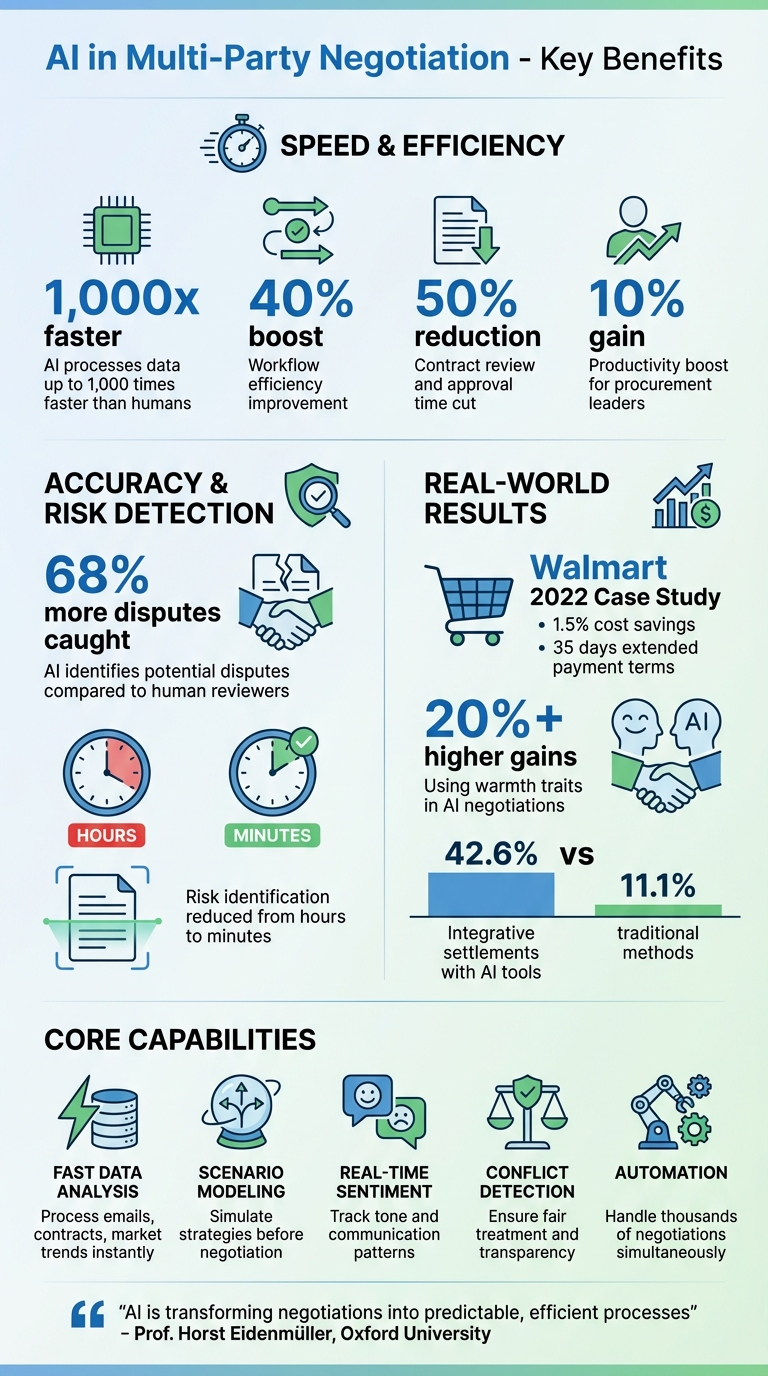
- Faster Data Analysis: AI processes data up to 1,000 times faster than humans, identifying risks and generating insights from emails, contracts, and market trends in minutes.
- Scenario Modeling: Simulations help predict successful strategies, allowing negotiators to prepare for objections and craft effective counteroffers.
- Real-Time Sentiment Analysis: AI tracks tone and communication patterns, alerting negotiators to potential issues and suggesting ways to keep discussions productive.
- Conflict Detection: It ensures all parties are treated consistently by clarifying negotiation ranges and reducing resource-based imbalances.
- Efficiency Gains: Automated workflows save time, enabling organizations to handle thousands of negotiations simultaneously.
AI tools, like those used by Walmart in 2022, have already demonstrated success, saving 1.5% on costs and extending payment terms by 35 days. With platforms like Inbox Agents, businesses can now centralize communications, automate risk assessments, and make informed decisions in real time. As Oxford Professor Horst Eidenmüller notes, AI is transforming negotiations into predictable, efficient processes.
AI in Multi-Party Negotiation: Key Benefits and Impact Statistics
Key Benefits of AI in Multi-Party Negotiations
Fast Data Analysis and Insights
In multi-party negotiations, where priorities often clash, speed can make all the difference. AI tools analyze data at incredible speeds - up to 1,000 times faster than humans. They can process unstructured information from emails, transcripts, and contract drafts, turning it into actionable insights.
One standout feature of AI is its ability to uncover risks instantly. Whether it's identifying non-standard clauses, vague terms, or potential sticking points, AI reduces review times from hours to mere minutes. It also calculates the best timing for offers and concessions based on past successes. Companies using AI-driven negotiation tools have reported a 40% boost in workflow efficiency and can catch 68% more potential disputes compared to human reviewers.
AI's capabilities go beyond document review. It keeps negotiators informed by continuously scanning industry reports, competitor updates, and market trends - delivering insights much faster than manual research. Advanced algorithms can even analyze behavioral cues, like tone or facial expressions, to gauge sincerity in real time. According to Jessica King of ContractPodAI, "AI adoption in legal departments can cut contract review and approval times by up to 50%, while simultaneously improving accuracy and risk management".
Scenario Modeling and Preparation
Walking into a multi-party negotiation without preparation is like playing chess without seeing the board. AI changes the game by running simulations that test different strategies before negotiations even begin. These simulations predict which opening offers, concession patterns, or stakeholder responses are most likely to succeed.
This is particularly helpful when dealing with complex situations, such as supplier networks or internal teams with competing goals. Instead of relying on instinct, negotiators can use AI to simulate scenarios based on historical data. This helps them anticipate objections and craft counteroffers that address multiple parties' concerns at once.
Real-Time Sentiment Analysis
In negotiations where emotions often run high, especially with multiple parties involved, AI's ability to analyze tone and communication patterns in real time becomes invaluable. For instance, a study of 180,000 autonomous negotiations revealed that longer conversations often led to deadlocks, while asking more questions was linked to successful deals. AI monitors these dynamics as they unfold, alerting negotiators to potential impasses and suggesting strategies to re-engage. This real-time insight helps ensure smoother, more balanced interactions.
Conflict Detection and Equal Treatment
AI doesn’t just analyze data - it also promotes fairness. By examining public data and behavioral trends, it reduces information gaps and prevents any one party from gaining an unfair advantage through superior resources. This transparency clarifies the Zone of Possible Agreement (ZOPA), helping everyone involved understand what outcomes are realistically achievable.
Automated playbooks further enhance fairness by standardizing interactions. These tools ensure that all parties are treated consistently, adhering to pre-set corporate standards. This approach minimizes the risk of "outlier" agreements, where one party might secure better terms due to time constraints or inexperience. As a result, negotiations are more balanced and disputes are less likely.
"Increased transparency about the ZOPA and significantly reduced transaction costs could pave the way to speedy and fair agreements."
- Horst Eidenmüller, Statutory Professor for Commercial Law, University of Oxford
Time Savings and Efficiency
Time is a critical factor in multi-party negotiations, and AI excels at saving it. By automating repetitive tasks like purchase order processing and data preparation, AI frees up negotiators to focus on strategic decisions. Procurement leaders have reported up to a 10% productivity boost through generative AI.
AI's scalability is another game-changer, enabling it to manage thousands of negotiations simultaneously - something no human team could handle. This eliminates inefficiencies in contract management, preserving significant value. By removing emotional biases and reducing transaction costs, AI simplifies negotiations, leading to faster and more predictable outcomes.
With these capabilities, AI not only streamlines the negotiation process but also consistently delivers better results for all parties involved.
AI in Negotiation: The Game-Changer You Can’t Ignore
Better Outcomes Through AI-Driven Strategies
AI is reshaping the way negotiations unfold by clarifying the Zone of Possible Agreement (ZOPA). This ensures that decisions are guided by transparent, data-backed insights instead of relying on strategic misrepresentation or guesswork. With this clarity, parties can pinpoint optimal trade-offs and reduce the influence of cognitive biases.
One standout feature of AI is its ability to identify strategic trade-offs. These are opportunities where parties can make concessions on less important issues in exchange for gains on high-priority ones. In multi-party negotiations, where the dynamics can get complicated, AI steps in to analyze the preferences of all stakeholders. It uncovers mutually beneficial solutions that don't just split the pie but make it bigger for everyone involved.
AI also plays a key role in minimizing biases that often derail negotiations. By offering clear, data-driven insights, it helps counter irrational tendencies and promotes what’s known as strategic de-biasing. Studies involving 180,000 AI-led negotiations revealed that incorporating warmth traits - like positivity, gratitude, and asking open-ended questions - can lead to over 20% higher gains.
"AI applications will increase the information level of the parties and drastically reduce transaction costs. A quick and predictable agreement in the middle of a visible bargaining range could become the new normal."
- Horst Eidenmüller, Professor of Commercial Law, University of Oxford
In November 2023, Luminance’s "Autopilot" model made waves by fully automating an NDA negotiation, signaling a shift toward predictable, AI-driven deal-making. These advancements highlight how AI is steering multi-party negotiations toward faster, more efficient, and strategically sound outcomes.
sbb-itb-fd3217b
How Inbox Agents Supports AI-Powered Multi-Party Negotiation
Unified Communication Interface
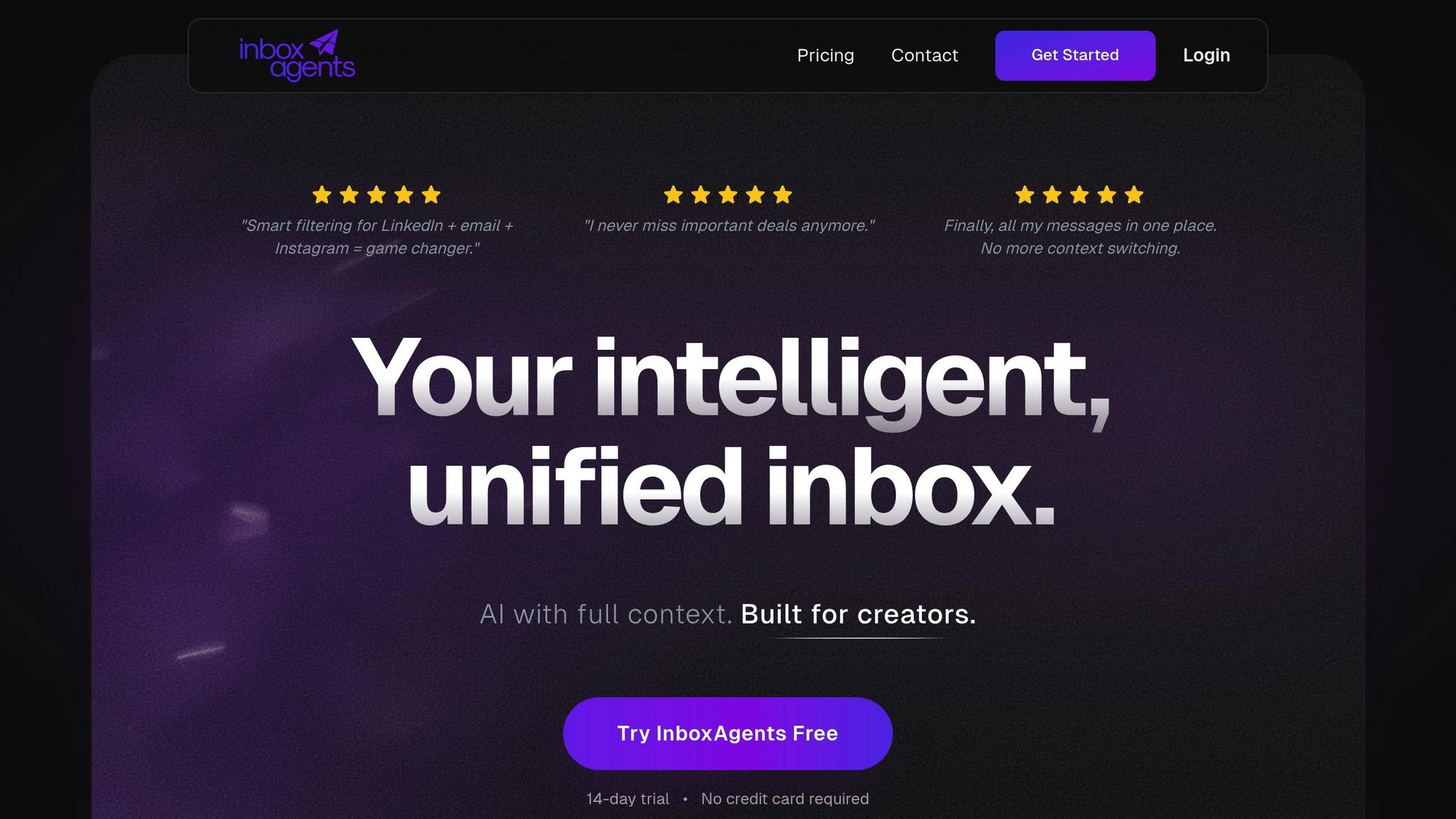
One of the biggest challenges in multi-party negotiations is managing conversations scattered across various platforms like email, chat apps, and document files. Inbox Agents tackles this issue by bringing all communication channels into a single, streamlined interface. This setup not only creates a clear, auditable communication trail but also ensures that stakeholders stay aligned with consistent, real-time updates. When everyone has access to the same updates, milestones, and negotiation statuses in one place, delays caused by miscommunication or fragmented information are minimized. Plus, this centralized communication seamlessly integrates with AI tools, boosting negotiation strategies even further.
AI-Driven Negotiation Tools
Inbox Agents leverages AI to simplify and strengthen the negotiation process. Automated inbox summaries sift through complex, multi-party conversations to pull out key clauses, highlight deviations, and summarize critical points. Features like smart replies and negotiation handling tools offer fallback language suggestions based on company playbooks, ensuring consistency and efficiency. Additionally, the platform assigns risk scores at the clause level, flagging potential issues before they escalate. Studies show that negotiation support systems can significantly improve outcomes - 42.6% of dyads using these tools achieved integrative settlements compared to just 11.1% using traditional methods.
Real-Time Insights for Better Decision-Making
Inbox Agents combines its unified communication interface and AI tools to deliver real-time insights that drive smarter decision-making. It prioritizes negotiation points based on content and sender importance, while also offering AI-powered response suggestions informed by both historical data and live feedback. By analyzing patterns like tone, style, and frequency, the platform helps negotiators adapt their approach to suit each stakeholder's preferences. Real-time dashboards provide visibility into how messages are received and acted upon, offering valuable context for strategic decisions. Procurement leaders using similar AI-driven tools have reported up to 10% gains in productivity, cost savings, and overall effectiveness. These features make it easier to navigate complex negotiations quickly and confidently.
Conclusion
AI has become a game-changer in modern multi-party negotiations, offering clear benefits in data analysis, efficiency, and impartiality. By cutting down the time required and improving outcomes, AI solutions have proven their value. Recent applications highlight reduced costs and streamlined processes. Moreover, AI eliminates emotional bias, ensuring all parties are treated fairly by adhering to standardized protocols that promote consistent results.
Negotiations are moving away from traditional back-and-forth bargaining toward data-driven, more predictable approaches. As Horst Eidenmüller, Statutory Professor for Commercial Law at the University of Oxford, explains:
"AI applications will increase the information level of the parties and drastically reduce transaction costs. A quick and predictable agreement in the middle of a visible bargaining range could become the new normal".
Platforms like Inbox Agents are harnessing these AI-driven advancements to reshape negotiation frameworks. By combining tools like unified communication, automated risk assessment, and real-time strategic insights, they transform complex negotiations into seamless, efficient workflows - all within a single platform.
FAQs
How does AI make multi-party negotiations faster and more effective?
AI is reshaping how multi-party negotiations are handled by taking over tedious tasks and offering precise, data-driven insights. Instead of spending hours - or even days - analyzing documents, market trends, or past offers, AI can process all that information and generate proposals in just seconds. During live discussions, it speeds things up even more by instantly exchanging offers and counteroffers, cutting down on delays and reducing transaction costs.
But it’s not just about speed. AI also helps achieve better results by encouraging fairness and uncovering solutions that benefit everyone involved. By sticking to consistent, rule-based criteria, it minimizes bias and ensures clear, equitable communication. Plus, AI has the ability to adjust its negotiation style - balancing collaboration with assertiveness - to reach agreements that are not only effective but also long-lasting.
Tools like Inbox Agents take this to the next level, allowing U.S. businesses to simplify negotiations with features like automated summaries, smart replies, and optimized trade-off suggestions - all accessible within one streamlined platform.
How does AI help identify and address conflicts during multi-party negotiations?
AI serves as a valuable tool for identifying and managing potential conflicts during multi-party negotiations. By examining participants' tone, language, and shared preferences, AI can pick up on early signs of disagreement, emotional tension, or conflicting objectives. This gives negotiators a chance to resolve issues before they spiral out of control.
With techniques like preference aggregation and sentiment analysis, AI can pinpoint areas of friction and even propose ways to ease tensions. Some systems go a step further, offering real-time feedback to participants. For instance, they can flag when conversations become combative or veer away from collaboration, ensuring discussions stay focused and productive.
How can AI-driven sentiment analysis improve negotiation results?
AI-powered sentiment analysis offers negotiators a real-time understanding of the emotional tone in conversations. By detecting emotions such as frustration, enthusiasm, or uncertainty, it can recommend tone-adjusted responses or alert users to shifts in sentiment. This helps to avoid misunderstandings and ensures that discussions remain respectful and constructive.
Studies highlight that empathy and positive interactions often result in better agreements and increased overall value in negotiations. Sentiment analysis plays a key role by uncovering emotional cues, enabling negotiators to provide reassurance, clarify misunderstandings, or make well-timed concessions. This approach promotes balanced dialogue, minimizes conflict, and paves the way for outcomes that benefit all parties.