

AI in Multi-Party Negotiation: Stakeholder Insights
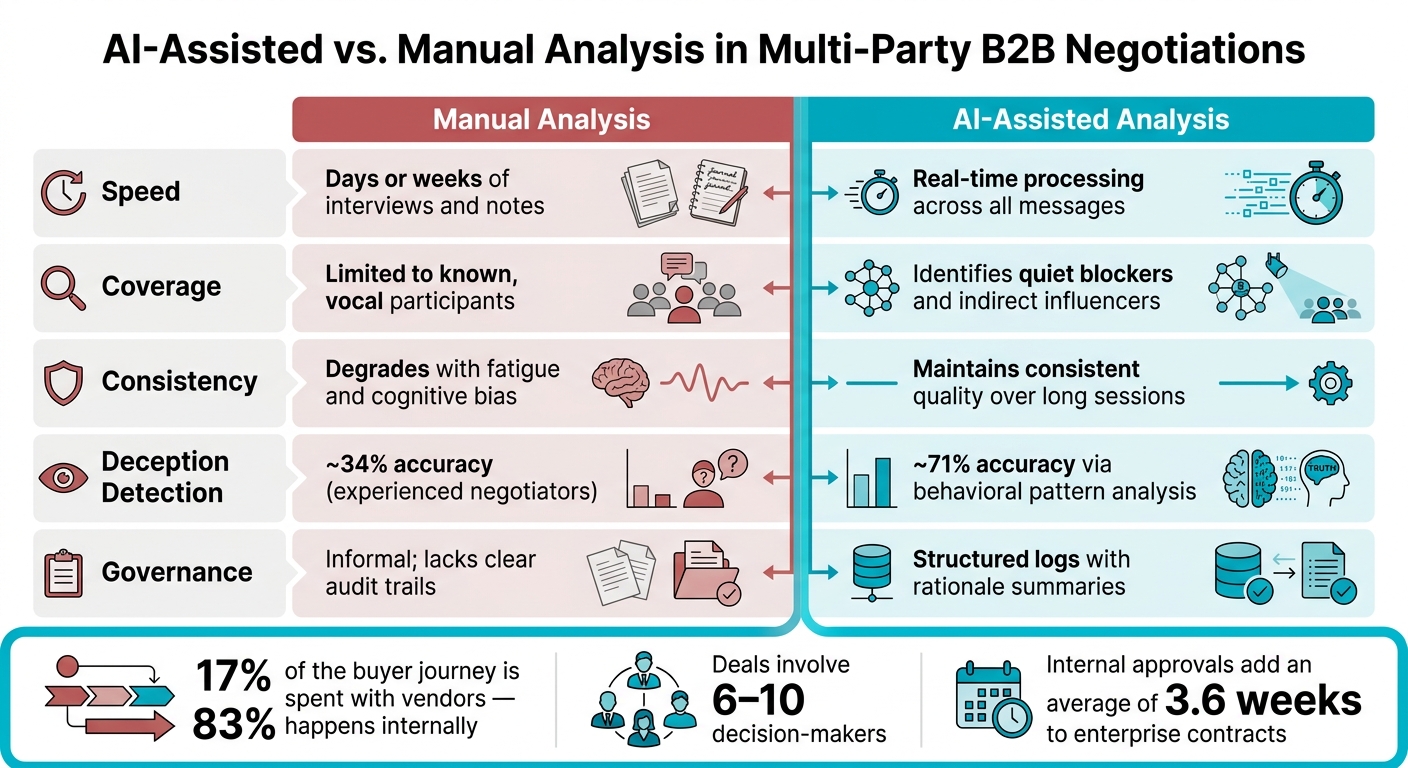
Most B2B negotiations stall because the hard part happens away from the table. Buyers spend only 17% of the journey with vendors, while 83% happens inside the company through debate, approvals, and quiet pushback.
If I were explaining this article in plain English, I’d put it this way: AI helps me track who matters, what each person wants, where deals get stuck, and what needs follow-up next. In group negotiations, that matters because deals often involve 6–10 decision-makers, shifting alliances, and delays like the extra 3.6 weeks that internal approvals add to enterprise contracts.
Here’s the article in one quick view:
- Map stakeholders early by role, influence, constraints, and veto power
- Group people by shared concerns like growth, risk, or cost
- Rank priority using signals such as authority, silence, meeting behavior, and coalition pull
- Plan before the call with target, acceptable, and walk-away points in USD
- Use AI during sessions to track agreement, side threads, and message drift
- Review after sessions to log commitments, flag missing follow-up, and route issues to legal or finance
- Keep humans in control with access rules, logs, and approval steps for high-risk decisions
- Roll out slowly by starting with summaries and tracking in lower-risk workflows
What stood out to me is simple: AI is less about replacing negotiation judgment and more about keeping the full stakeholder picture in view when messages, calls, and internal reviews start piling up.
The SMART Negotiator | How to use AI in Negotiations - Keld Jensen | The Tim Castle
sbb-itb-fd3217b
Stakeholder Mapping and Prioritization with AI
AI vs. Manual Analysis in Multi-Party B2B Negotiations
How to Build a Stakeholder Map Using Roles, Influence, and Interests
Build your stakeholder map around role, influence, and constraints - not just job titles.
In enterprise deals, the groups that usually matter most are legal, finance, operations, and procurement. Each one wants different things. Each one also has its own view of risk.
AI helps by scanning emails, chats, meeting notes, and contract history to pull out recurring concerns, deadlines, and approval paths. The result is a living record of what each party has said, plus how their position has changed over time.
A useful framework to apply early is to group stakeholders into coalition types - Innovation, Risk Management, or Cost Optimization - based on shared concerns. That gives you a better way to shape your value proposition for each cluster instead of sending the same pitch to everyone. It also makes it easier to spot where support is likely to build and where pushback may show up.
Once the map is in place, group stakeholders by coalition so you can see where agreement or resistance is likely to form.
How AI Signals Help You Rank Stakeholder Priority
AI helps rank stakeholders by reading signals across four key dimensions: decision authority, engagement patterns, risk exposure, and coalition influence.
On the authority side, AI can separate the Economic Buyer, who controls the budget; the Technical Buyer, who can veto based on fit; the Champion, who pushes the deal forward inside the company; and Blockers, who can slow or stop progress even if they don't have final sign-off power.
On the engagement side, AI tracks slowing momentum by flagging signals like a key contact going silent for 7+ days, canceling meetings, or stopping message opens. Those are early signs that priorities may have changed.
The Power-Interest Grid is a standard way to turn those signals into a ranked list. AI can fill it in automatically using past data:
| Quadrant | Recommended Action |
|---|---|
| High Power, High Interest | Manage closely; prioritize direct engagement |
| High Power, Low Interest | Keep satisfied. |
| Low Power, High Interest | Keep informed; address concerns proactively |
| Low Power, Low Interest | Monitor. |
AI doesn't stop at initial placement. It can also use Bayesian inference to keep updating its view of each stakeholder's priorities. As Dr. Dorsa Sadigh explains:
"When a party claims issue X is their top priority but repeatedly concedes on X while holding firm on issue Y, the agent updates its model of that party's true priorities."
That kind of pattern reading is tough to do by hand at scale. In a complex negotiation, it's one of the main reasons AI-assisted analysis helps so much.
| Feature | Manual Analysis | AI-Assisted Analysis |
|---|---|---|
| Speed | Days or weeks of interviews and notes | Real-time processing across all messages |
| Coverage | Often limited to known, vocal participants | Identifies quiet blockers and indirect influencers |
| Consistency | Degrades with fatigue and cognitive bias | Maintains consistent quality over long sessions |
| Deception Detection | ~34% accuracy for experienced negotiators | ~71% accuracy via behavioral pattern analysis |
| Governance | Informal; lacks clear audit trails | Structured logs with rationale summaries |
Those rankings show where your team should focus before live negotiation begins.
Where Inbox Agents Fits in Message-Heavy Negotiations
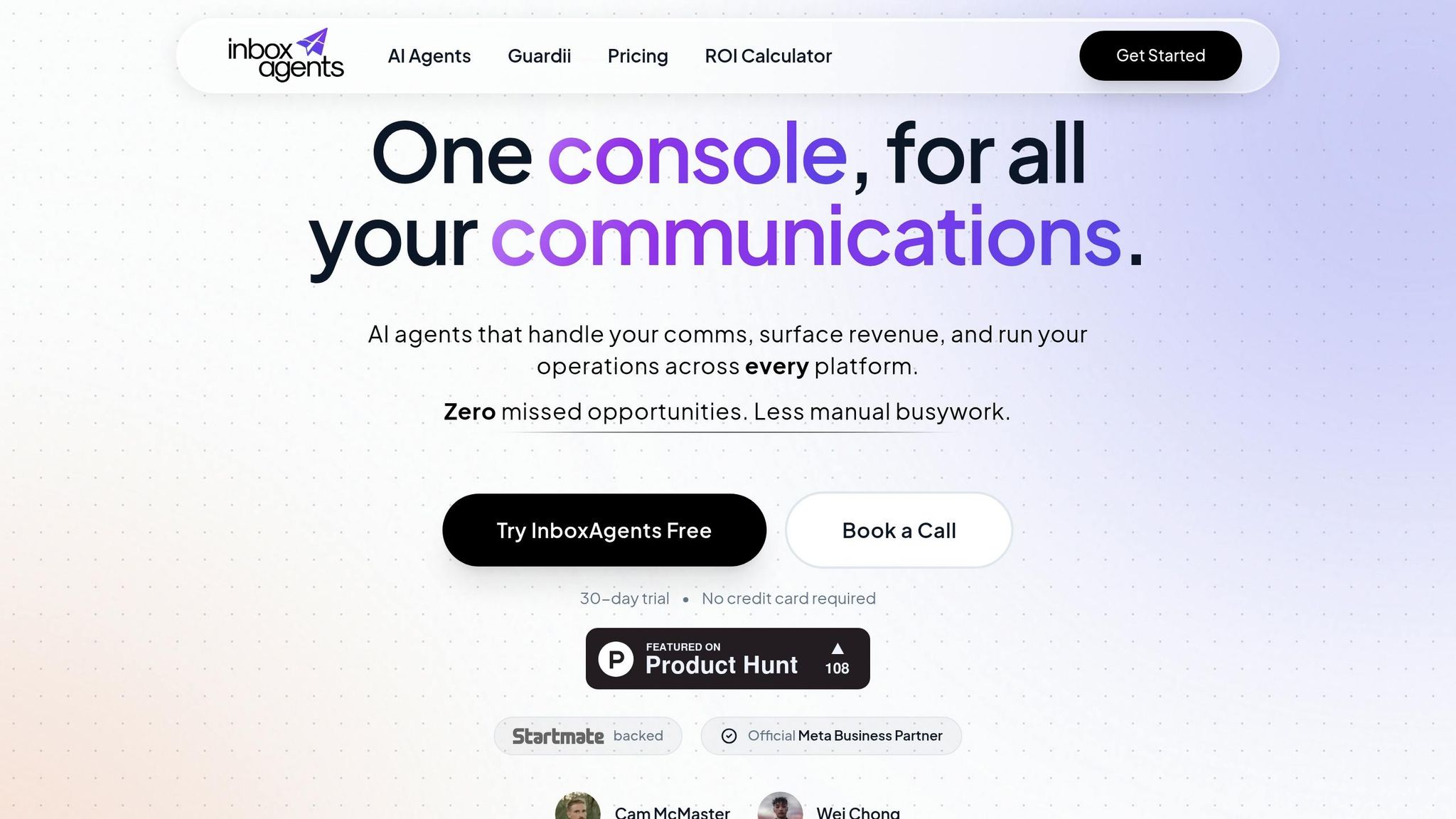
Inbox Agents brings conversations from multiple messaging platforms into one interface, so your team can see everything in one place.
Its inbox summaries highlight key concerns and shifts in position across threads, which helps teams avoid missing details in message-heavy negotiations. Smart replies and negotiation handling features also help your team keep a steady tone and position across outbound messages. That cuts the chance that different team members respond to the same stakeholder with mixed framing.
Those signals help set up scenario planning and coalition analysis before the first call.
That shared view also carries into pre-negotiation scenario planning and live coordination.
AI-Supported Tactics Before, During, and After Negotiation Sessions
Pre-Negotiation Planning: Scenarios and Coalition Analysis
Before the call, AI can turn your stakeholder map into a priority matrix and show where coalitions are likely to hold together or fall apart. That gives you a clearer read on where support may come from - and where it may slip.
A good place to start is with three financial thresholds in USD before any session: your target (best realistic outcome), your acceptable point (sign now), and your walk-away point - the moment your BATNA is the better move. AI can keep those thresholds front and center as offers move in real time and your BATNA shifts.
You can also run scenario models against different coalition mixes and compare them to those three thresholds. That helps you pressure-test your plan before anyone joins the call.
One problem to watch for: leaning too hard on one coalition - like the Innovation Coalition - and losing trust with the Risk Management Coalition. AI can spot that drift early, which gives you time to rebalance your message before support starts to fade. That same priority view can guide your moves during the session too.
Live Coordination Across Calls, Messages, and Side Conversations
During the call, those priorities help you decide who to engage, when to step in, and which side threads need attention. AI tracks the pattern so your team can stay focused on the room instead of juggling signals by hand.
It can monitor consensus trends across topics, calculate agreement scores in real time, and suggest when to intervene if the discussion stalls. The best setup combines human judgment with AI analysis as the session unfolds.
Inbox Agents keeps bilateral threads in sync with the main negotiation through smart replies, negotiation handling, and personalized responses. That matters more than it may seem. If one stakeholder hears one message and another hears something slightly different, alignment can crack fast. This setup helps keep parallel conversations from drifting into conflict.
Post-Session Analysis and Next-Step Tracking
After the session, the same signals should help lock in commitments and drive follow-up. At that point, the risk often shifts away from the table and into the gap between what was said and what gets done.
Verbal commitments may never make it into writing. Open issues can get buried. A stakeholder who looked aligned in the meeting may suddenly go quiet.
AI helps by transcribing conversations and parsing email threads to pull out key positions, while flagging commitments or concessions that still haven't been captured in formal writing. It can also watch follow-up signals, like missed meetings, and alert your team when a once-active stakeholder has gone dark.
Internal routing is another spot where AI cuts drag. Non-standard requests, such as custom SLAs, can be flagged and sent to internal legal or finance teams automatically, with follow-up timers to keep things moving. That follow-up data then feeds back into the same priority map used before the call, so your stakeholder view stays current as the deal moves ahead.
AI speeds up follow-up analysis, but a human still needs to review external summaries.
The table below shows where AI helps most after the session.
| Feature | Human-Only | AI-Augmented |
|---|---|---|
| Documentation | Manual notes; prone to bias and memory gaps | Real-time transcription with automated commitment extraction |
| Stakeholder Insight | Relies on intuition and reading the room | Sentiment analysis and agreement score tracking per stakeholder |
| Follow-Up | Manual CRM entry and email reminders | Automated follow-up signal monitoring and risk alerts |
| Internal Routing | Sequential emails and manual handoffs | Automatic routing to internal legal or finance teams with follow-up timers |
| Limitations | Cognitive load, emotional fatigue, and ego | Risk of hallucinations; requires human-in-the-loop verification |
Governance, Trust, and Implementation in U.S. Organizations
Data Controls, Human Review, and Explainable AI Recommendations
After analysis comes control. The same stakeholder signals need access rules, logs, and human approval before they influence commitments. In negotiation, AI is a trust issue as much as a technical one. You need to spell out who can view what, what gets logged, and when a human has to approve an action.
Role-based access is the starting point. Access controls protect the accuracy of the stakeholder map and priority rankings. If the wrong people can view or change those signals, the analysis falls apart. Keep private reservation values - like your maximum willingness to pay or minimum acceptable price - in a private prompt, not in shared threads.
Each recommendation should tie back to the clauses, messages, or market signals behind it. Signed, append-only logs that connect each recommendation to its source give outside auditors a clear path from individual messages to collective commitments.
For regulated deals, keep human veto authority in place along with clear halting protocols. That way, the AI stops and escalates to a human governance officer when it runs into unresolved conflicts, budget exhaustion, or high-risk exceptions.
A Phased Rollout from Lower-Risk to High-Stakes Negotiations
Once access and logging are set, begin with lower-risk workflows. Don’t jump straight into high-stakes deals. If teams don’t yet know how the system behaves, trust can disappear fast.
Start with meeting summaries, sentiment tracking, and routine RFP management. These are jobs where mistakes are lower-cost and easier to spot. Run the system in shadow mode for 4–6 weeks before using outputs live. That period helps teams spot blind spots without putting active deals at risk. Lower-risk use cases should show that the AI can keep stakeholder signals steady before it touches binding negotiations.
When the team starts to trust the outputs, move into more strategic negotiation support. But keep human review in the loop for anything that faces external parties.
The table below shows the main metrics to track at each stage of rollout.
| Metric | What It Measures | Target Outcome |
|---|---|---|
| Time-to-Agreement | Total cycle time from first offer to signed contract | 40–60% reduction in routine cycles |
| Escalation Rate | % of AI-led sessions requiring human intervention | Varies by risk tier |
| Post-Agreement Compliance | Adherence to negotiated clauses and SLAs | Improved through structured data capture |
One practical step is easy to miss: document your playbooks before rollout. Write down your must-have positions (non-negotiable), standard positions (preferred), and fallback positions (approved fallbacks) so the AI has clear boundaries to work within. Those limits help keep stakeholder insight dependable as negotiations become more complex.
Conclusion: Building Better Stakeholder Insight Over Time
Multi-party negotiations are messy. AI helps teams spot stakeholder signals sooner and respond with more speed. This is often achieved through real-time inbox monitoring to capture every communication shift.
The edge comes from organizational memory. Every negotiation adds to a record your team can use again: past concessions, blockers, coalition shifts, and outcome patterns. Over time, that record makes the next stakeholder map sharper. And the payoff grows when teams bring the same discipline to every deal.
Key Points to Carry Forward
Map stakeholders early. Update priorities as leverage shifts. Use AI in both planning and follow-up. And keep human review in place for high-stakes decisions.
That learning curve shows up in the numbers. Reps using AI intelligence briefs are 2.3x more likely to move a deal to the next stage, and enterprise deals backed by AI have seen win rates rise from 18–22% to 28–35%.
The aim isn't automation for the sake of it. It's using each stakeholder signal and each deal outcome to make the next round of priority decisions faster and the follow-up clearer for every stakeholder.
FAQs
How does AI find hidden stakeholders?
AI can spot hidden stakeholders and masked interests by watching behavior patterns in real time. It checks what people say they want against the concessions they actually make. When those two things don’t line up, that gap can point to hidden agendas or deceptive behavior.
It can also use inference models to assess communication and separate surface-level claims from the goals underneath. Inbox Agents helps here by bringing communications into one place, which makes it easier to follow engagement and notice shifts in position during negotiations.
What should humans still handle in negotiations?
AI is strong at processing data, weighing trade-offs, and staying consistent from a strategy standpoint. But people still matter a lot when it comes to building rapport, earning trust, and picking up on emotional nuance, especially in the early stages of a negotiation.
Humans also do a better job of reading intent, understanding social context, and judging long-term outcomes. In high-stakes, strategic, or regulated deals, human oversight is still needed for nuanced decisions and ethical accountability.
How do you start using AI without adding risk?
Use AI in multi-party negotiations as a prep tool and strategic co-pilot, not as a stand-in for human judgment. It can help you map out your thinking on BATNA, ZOPA, and concession strategy. Then you can test those ideas against actual data, deal limits, and what’s happening on the ground.
Keep human oversight in place, with clear veto authority over decisions, especially in high-stakes or heavily regulated contracts. That way, you get AI’s analytical support without giving up control of risk.