

How AI Scores Buyer Intent in Negotiations
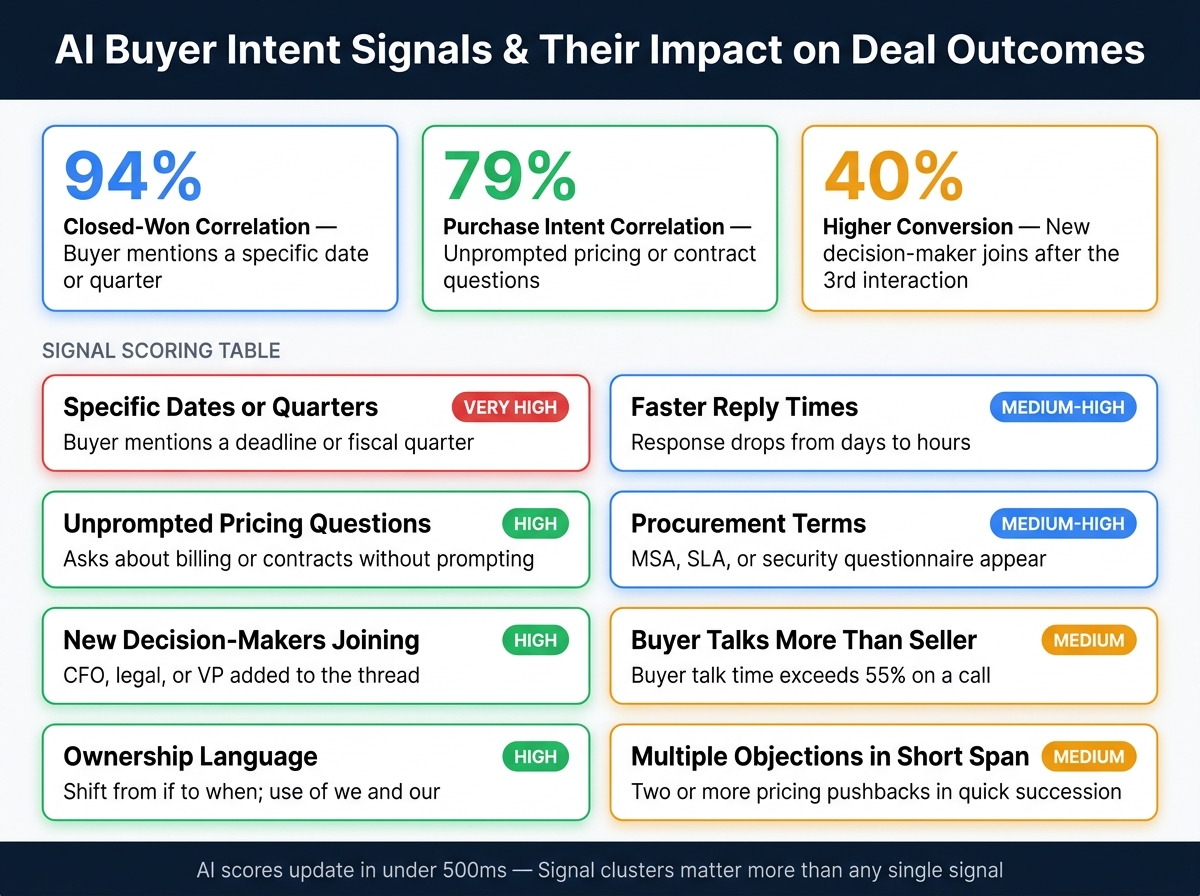
AI can tell when a deal is moving now - not just who looks like a good lead. In live negotiations, it watches what buyers say, how fast they reply, who joins the thread, and whether the talk shifts to pricing, legal, security, or rollout. Some signals stand out: specific dates tie to a 94% closed-won correlation, unprompted pricing questions tie to 79% purchase intent, and new decision-makers joining after the third touch links to 40% higher conversion.
If I had to sum it up in plain English, it works like this:
- Lead scoring asks: who should I talk to?
- Intent scoring asks: who is moving toward a decision right now?
- It uses first-party conversation data from email, chat, SMS, meetings, CRM notes, and document views
- It looks for signal clusters, not one message in isolation
- It turns those signals into a 0–100 score, low/med/high tier, or red/yellow/green flag
- It helps reps decide who to answer first, when to follow up, when to switch channels, and how firm to be on price
- It still needs human review, because bad data, bias, and missed nuance can distort the score
Here’s the short version of what matters most:
- Language shifts: from “we’re looking” to “if we onboard in Q3”
- Ownership words: “we,” “our,” and “when” often point to internal support
- Reply speed: hours instead of days can mean the deal moved up in priority
- Deal-shape changes: pricing, billing, contracts, API setup, and legal steps
- Stakeholder movement: CFO, legal, or VP added to the thread
- Call behavior: buyer talk time, silence, and objection clusters
A score by itself means little. What you do next is the point. If intent jumps, I’d move fast. If intent drops, I’d check for a stalled approval, a hidden objection, or a lost champion. That’s the core idea behind the article.
HubSpot's Lead Scores Are Guesses. AI Makes Them Real. | CRM Experts Online
sbb-itb-fd3217b
What signals AI uses to score buyer intent
AI Buyer Intent Scoring: Key Signals & Their Impact on Deal Outcomes
Language, tone, and timing signals
The clearest intent signals show up when a buyer stops speaking in broad terms and starts sounding like someone getting ready to buy. AI looks for that move from vague language to specific language. For example, a shift from "we're exploring options" to "if we onboarded in Q3" points to movement from early research toward commitment.
Ownership language also matters a lot. When a buyer starts saying "we" and "our" instead of "if this were adopted," AI treats that as a sign that someone inside the account is backing the deal. And when terms like "MSA", "security questionnaire," or "legal review" show up in the conversation, that usually means the deal has moved into a formal approval stage.
Timing adds another layer. If a buyer had been replying every two days and then suddenly answers within two hours, that's a strong sign of urgency. AI picks this up through message timestamp metadata. Intent scores often decay after 48 hours, while signals that arrive within six hours get more weight in the model.
Language tells part of the story. The structure of the deal often says even more.
Behavioral and deal-structure signals
AI also watches for changes in how the deal is taking shape. One of the strongest signals is a buyer mentioning a specific date or quarter. That has a 94% correlation with closed-won outcomes. Unprompted questions about pricing, annual billing, or contract setup are close behind, with a 79% correlation to purchase intent.
Another strong clue is when new decision-makers join the thread on their own. If a CFO, VP, or legal counsel gets added without the seller asking, it usually means the deal cleared an internal checkpoint. Deals where a new decision-maker joins after the third interaction convert 40% more often.
Questions about onboarding timelines, API integrations, or CRM setup matter too. Those questions suggest the buyer is thinking through implementation, not just looking around.
What matters most isn't one signal by itself. AI gives the most weight to signal clusters.
Comparison table: signal types, detection method, and score impact
When signals show up across channels, AI scores them as part of one conversation instead of treating them like separate events. Here's the short version of the main signals, how AI spots them, and how much they should shift the score.
| Signal Type | What It Is | How AI Detects It | Score Impact |
|---|---|---|---|
| Specific Dates or Quarters | Buyer mentions a specific date, deadline, or fiscal quarter | Date and phrase detection | Very High - 94% correlation to closed-won |
| Unprompted Pricing Questions | Buyer asks about contract terms, billing, or invoicing without being prompted | Keyword and context analysis across messages | High - 79% correlation to purchase intent |
| New Decision-Makers Joining the Thread | CFO, legal, or VP added to the conversation | CRM and email participant tracking | High - 40% higher conversion when it occurs after interaction 3 |
| Ownership Language | Shift from "if" to "when"; use of "we" and "our" | Language and pronoun analysis | High - Signals internal champion and commitment |
| Faster Reply Times | Reply speed drops from days to hours | Metadata timestamp analysis | Medium-High - Indicates rising deal priority |
| Procurement Terms | Terms like "MSA", "SLA", or "security questionnaire" appear | Keyword and contextual clustering | Medium-High - Late-stage readiness marker |
| The Buyer Talks More Than the Seller | Buyer talks more than 55% in the back half of a call | Speaker separation and talk-time analysis | Medium - Correlates with 2.4x higher close rate |
| Multiple Objections in a Short Span | Two or more pricing objections within a short window | Semantic clustering of pushback patterns | Medium - Signals active negotiation, not dismissal |
How AI turns negotiation signals into a score
Feature weighting and model training
After AI spots intent signals, it gives each one a weight based on how well it predicts the outcome. In plain English, the model turns language, tone, and behavior into features, then checks those features against what happened in past deals.
One framework assigns 30% of the weight to the volume of positive signals within a 14-day window. Direction of change and stakeholder engagement get 25% each, while match to past wins gets 20%. As new deals close, the model recalibrates those weights. That weighting is what shapes the final score the system shows.
Common scoring formats and live updates
Once the model processes the signals, it produces a score. Teams often show that score as a 0–100 number, as intent tiers like low, medium, and high, or as a traffic-light status: red, yellow, green.
During live negotiations, scores can refresh in under 500 ms. That means the score can change almost as soon as new data comes in. A medium score might move up when reply speed improves, more stakeholders enter the discussion, or the buyer starts asking about budget, technical validation, or security review.
The same score can appear in different formats based on how the team works. A sales leader doing forecast reviews may want precision. A rep in the middle of a call may just need a fast visual cue. But here's the catch: if the team doesn't have a clear playbook for what to do next, even a smart risk score won't shift deal outcomes.
Comparison table: numeric scores vs. intent tiers vs. traffic-light status
Each format does a different job. Some help with forecasting. Others help teams move fast day to day or react in the moment during a live conversation.
| Scoring Format | Speed of Interpretation | Best Use Case | Strengths | Limits |
|---|---|---|---|---|
| Numeric Score (0–100) | Requires context | Pipeline reviews and automated forecasting | High precision; easy to sort and aggregate across large pipelines | Can feel arbitrary without an explanation of why it changed |
| Intent Tiers (Low/Med/High) | Very fast | Daily inbox triage and lead prioritization | Clear, immediate direction on where to focus | Lacks nuance for subtle shifts in deal health |
| Traffic-Light Status (Red/Yellow/Green) | Instant | Real-time coaching during live calls or chats | Quickly flags deals needing urgent attention | Can oversimplify complex negotiations |
Many teams use both a CRM numeric score and a traffic-light live view. That combo gives managers detail and gives reps speed. The best format is the one that fits how the team uses the signal in day-to-day work.
How buyer intent scores change negotiation decisions
Once AI turns a pile of signals into a score, the next question is simple: what should the rep do next? A score only matters if it changes that next move. Intent scores are decision inputs, not just a nice-looking readout.
Prioritization, follow-up timing, and channel choice
Use the score to decide whether to respond right away, escalate, or wait. If the score jumps, move that thread to the top of the queue. If intent looks low, the thread can sit a bit longer or get handled async.
Timeline anchoring matters here. When a buyer says something like "We need this live before Q3", that should trigger immediate human follow-up. In many cases, that means moving from email to a live technical call or demo with that specific decision-maker.
Pricing stance, concessions, and risk detection
Intent scores also shape pricing moves. If a buyer shows strong intent and has few outside options, there’s less reason to discount. AI can calculate the acceptable price range so reps don’t slip into discount panic.
If intent is weaker or less clear, discounts should come with something in return, like a longer term, a higher tier, or another firm commitment. That helps protect margin while still keeping the deal moving.
The score can also flag risk. A sudden drop is often a warning. If a buyer shifts from "when we implement" to "if we adopt", or replies from stakeholders start slowing down, that can point to a stalled internal approval or a new objection that no one has said out loud yet. Spotting that change early gives the team time to find a new champion or step back in before the deal goes cold.
Manual inbox triage vs. AI-assisted decision-making
The same score also changes how teams deal with volume. Most teams still sort by last reply or unread count. That works for a while. Then the inbox gets crowded, and a high-intent thread disappears under routine follow-ups. Human reps miss at least one significant buying signal in 67% of calls where a signal is present, mostly because of cognitive load.
AI-assisted triage changes that workflow. Higher intent should lead to faster, more direct handling. Instead of reading every thread just to figure out what’s urgent, the system surfaces the conversations that matter most based on intent tier. Inbox Agents can sort conversations by intent, summarize negotiations, and draft replies.
| Feature | Manual Inbox Triage | AI-Assisted Decision-Making |
|---|---|---|
| Speed | Hours to days; limited by rep review cycles | Real-time; near-instant in-call cues |
| Consistency | Subjective; prone to gut feel and discount panic | Objective; based on historical win/loss patterns |
| Context Coverage | Single-thread focus; misses cross-call patterns | Multi-threaded; tracks sentiment shifts across all stakeholders |
| Escalation Risk | High; missed signals lead to stalled deals | Low; automated alerts for stalled approvals and competitive mentions |
| Practical Workflow | Sorting by last reply or unread volume | Sorting by intent tier with suggested smart replies |
Sales teams using AI-powered signal detection report 25% faster sales cycles and a 51% increase in lead-to-deal conversion. That’s a big shift for teams buried in busy inboxes. But none of these decisions hold up unless the score itself can be trusted.
Limits, best practices, and conclusion
Bias, data quality, and explainability
Once intent starts shaping priorities and trade-offs, one issue moves to the front: can you trust the score?
If negotiation history is scattered across disconnected tools, the model is learning from gaps. And those gaps can affect follow-up timing, pricing moves, and escalation decisions.
AI can miss nuance, inherit historical bias, and misread culturally different communication styles. That’s why reason codes matter. When a score shifts, the system should show rationale summaries and trace logs so teams can see what changed and check whether the update holds up.
In plain English, governance belongs inside the scoring system itself. It can’t be bolted on later.
Privacy, governance, and operational checks
In regulated sectors, intent scoring should be paired with bias audits, explainability logs, and legal checks before teams log those scores or act on them. A black-box score isn’t enough. Teams need traceable reasons for every change.
The day-to-day checks are pretty simple:
- Review AI scores against actual close outcomes on a regular schedule
- Tune the thresholds that mark a buyer as high intent
- Audit edge cases where the model got the call wrong
It also helps to track whether engagement is speeding up or slowing down, and to watch for buying-committee expansion or contraction. Both signals tell you more than a single score snapshot.
For high-stakes or complex deals, human veto authority should stay in place so AI can speed up the workflow without making the final call.
Conclusion: Key takeaways on AI intent scoring
With the limits out in the open, the working rule is simple: use the score to focus attention, not replace judgment.
AI scores buyer intent by pulling together language patterns, behavioral signals, and deal-structure cues into one updated read on where a buyer stands. The biggest day-to-day use is prioritization and timing: knowing which conversation needs a response now, when to follow up, and when a deal is quietly losing steam.
A unified inbox setup makes that context easier to keep in view. Inbox Agents can keep those signals visible in one place. The score narrows the field and improves timing. The rep makes the final call.
FAQs
How is intent scoring different from lead scoring?
Traditional lead scoring ranks prospects with fixed demographic and firmographic data, like job title or company size.
Intent scoring looks at real-time behavior and context. It ranks prospects based on what they’re saying and doing right now. Unlike older scoring models, intent scores change as buyer behavior shifts. Inbox Agents supports this by analyzing message content to surface active opportunities.
What signals raise a buyer intent score the most?
The strongest signals point to active commitment and a clear need to move soon.
The clearest one is timeline anchoring. That’s when a buyer shares a specific implementation date or deadline. At that point, they’re not just browsing - they’re trying to line things up.
Other high-impact signals include:
- Unprompted pricing questions
- Requests for technical validation or integration details
- Involvement from multiple stakeholders
Each of these shows the conversation is getting more serious. The buyer is starting to think through cost, fit, and internal buy-in - not just surface-level interest.
Can reps trust AI intent scores on their own?
Yes - but only if the scoring is transparent.
Reps can miss intent signals for a few simple reasons: cognitive overload, a one-call view of the deal, and plain old confirmation bias. But that doesn’t mean they should hand judgment over to a black-box system.
AI people can trust shows why a score was assigned. It surfaces the signals behind the score, like pricing questions, timeline shifts, or multi-threading. That gives reps a way to check the score against what they already know about the deal.