

How Predictive Analytics Scores Buyer Intent
Buyer intent scoring tells me who is most likely to buy soon, so I can act fast instead of treating every lead the same. In plain terms, it works by combining behavior, fit, timing, and past win/loss data into a score that shows who needs outreach now, who needs nurture, and who should stay in a low-touch path.
Here’s the short version:
- The model looks for buying signals, not just interest. Pricing-page visits, demo requests, trial signups, and product use matter more than a blog view.
- Recent action matters more than old activity. A burst of activity this week says more than light engagement over months.
- Fit data matters too. Industry, role, company size, and tech stack help me separate interest from actual buying chance.
- The score must be tied to action. High scores should trigger fast outreach. Medium scores should trigger nurture. Low scores should stay in long-term follow-up.
- The data has to be connected. Website events, CRM records, product usage, and inbox conversations need to sit in one record or the score will miss part of the story.
- The model needs testing and regular retraining. Good scoring is not just ranking leads. The score should line up with actual conversion rates.
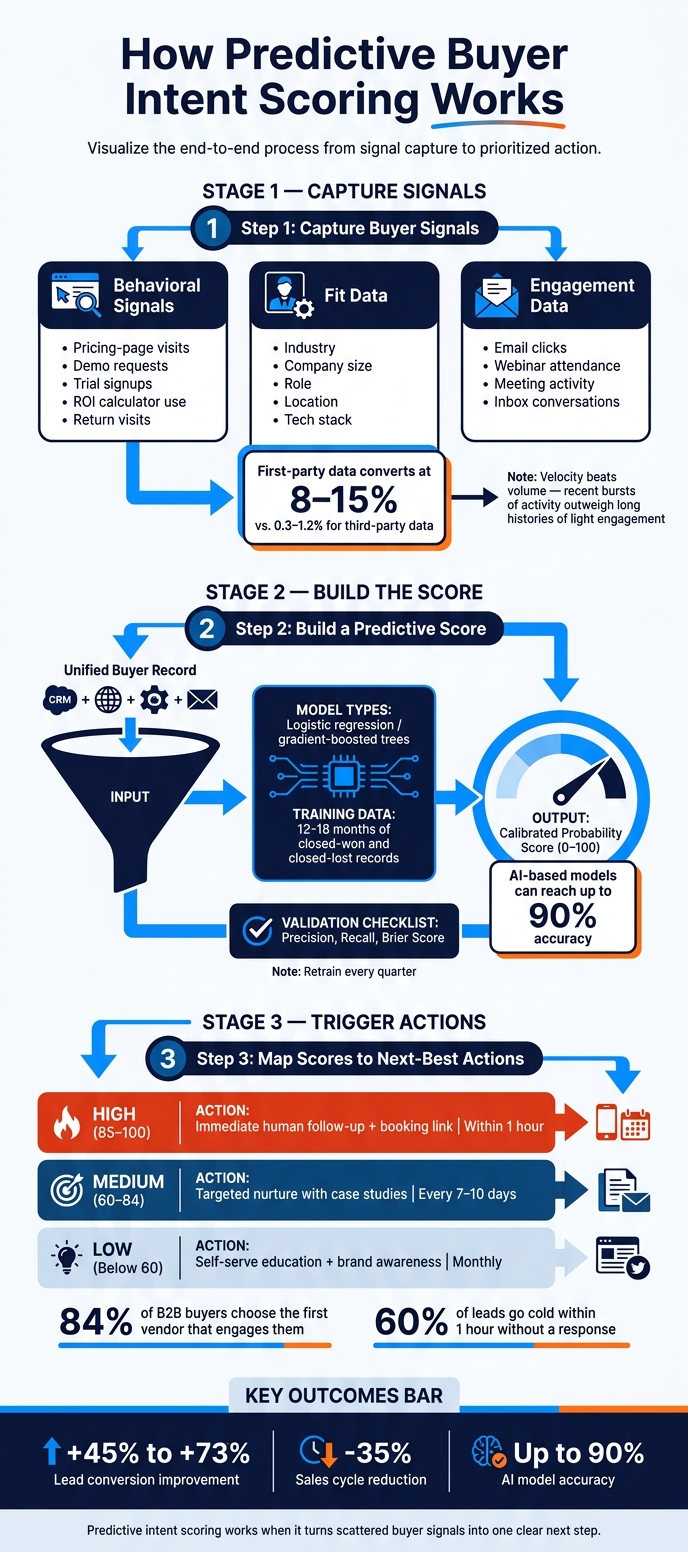
A few numbers show why teams use this approach: AI-based models can hit up to 90% accuracy, lead conversion can improve by 45% to 73%, and sales cycles can shrink by 35%. On top of that, 84% of B2B buyers go with the first vendor that engages them, and 60% of leads cool off after one hour without a response.
So if I had to sum it up in one line: predictive intent scoring works when it turns scattered buyer signals into one clear next step.
How Predictive Buyer Intent Scoring Works: Signals to Action
Intent Data vs Real Buyer Signals – What Marketers Should Trust
Step 1: Capture the Signals That Predict Purchase Intent
A predictive model is only as good as the signals feeding it. If the data is messy, split across tools, or missing key moments, the score will be messy too. Teams need clean, connected data from the first visit all the way to the sales conversation.
Track First-Party Behavior Across the Journey
Start by tracking page- and event-level actions that often point to buying intent. That includes pricing-page visits, competitor comparison pages, ROI calculator use, and demo requests. These aren't just traffic patterns. They're individual signals that can say a lot on their own.
For SaaS teams, product-led signals matter just as much as website activity. Trial creation, inviting a teammate within 24 hours of signup, and active use of core features are strong signs that a prospect is getting closer to a purchase decision. Recent return visits and direct replies to sales emails also matter.
One detail stands out here: velocity beats volume. A burst of recent activity tells you more than a long history of light engagement. Intent fades fast, so newer actions should carry more weight than older ones.
Add Context from Fit and Engagement Data
Behavior alone doesn't tell the whole story. Someone can look interested and still be a poor fit because of industry, company size, or lack of buying power. That's why fit data needs to sit next to intent data in the scoring model.
Useful fit signals include:
- Industry
- Company size
- Role
- Location
- Current tech stack
Technographic data is especially useful when you're going after accounts that may be ready to switch tools. Then add engagement data like email clicks, webinar attendance, and meeting activity. Put together, these signals help the model sort out who is both interested and likely to buy.
Give first-party data the most weight. It converts to meetings at 8% to 15%, compared with 0.3% to 1.2% for third-party publisher data. That's a big gap. Signals from your own website, product, and email interactions usually beat outside sources, especially when you can tie them back to the same account and journey.
Connect Systems So the Full Journey Is Visible
When tools don't talk to each other, the model sees only pieces of the story. Marketing automation may show campaign activity. The CRM may show pipeline data. Product analytics may show usage. Messaging tools may hold key buying conversations. If those systems stay siloed, the score is built on fragments.
Use a unified data pipeline to pull those pieces into one buyer record. In practice, that means:
- Linking website behavior to CRM records
- Syncing product usage events
- Pulling in conversation and inbox data
This makes it easier to track the full path from first touch to purchase - or drop-off. Messaging data matters here too. It can surface high-intent conversations that would otherwise sit buried in inbox threads.
Inbox Agents unifies messaging channels in a single interface, which makes conversation-level data easier to collect and sort before it disappears into the cracks.
Once the full signal set is connected, the next step is turning it into a calibrated purchase score.
Step 2: Build a Predictive Model That Turns Signals Into Scores
Once your signals feed into one buyer record, the next move is to train a model that turns those signals into a probability score. The goal is simple: a steady score your team can trust for routing and follow-up.
Define the Outcome and Prepare Historical Data
Before you touch model code, get clear on the outcome you want to predict. Common targets include likelihood to close or probability to book a demo.
Your training set should include closed-won and closed-lost records, with event timestamps attached. That way, the model learns the actual sequence of events instead of a scrambled snapshot. Pull in 12 to 18 months of labeled history so seasonality shows up in the data. If demo requests jump every January, the model needs to see that pattern.
Negative examples matter too. Don’t train only on conversions. Closed-lost records, unsubscribes, and stalled leads show the model what disqualification looks like.
Use Models That Estimate Purchase Probability
Use logistic regression or gradient-boosted trees to estimate purchase probability. In plain English, these models learn which mixes of actions, timing, and customer traits tend to appear before a purchase.
A pricing-page visit from yesterday should carry more weight than one from a month ago. And a chain of related actions can tell you more than any single signal by itself. That’s where a lot of the value comes from.
The big idea here is calibration, not just ranking. It’s not enough for the model to say who looks more likely to buy. The score also needs to mean something in practice.
Validate Scores Before Using Them in Workflows
Before you put the model into production, set aside part of your historical data. The model should never see this slice during training. Then check whether high-scoring leads convert at much higher rates than low-scoring leads.
Track:
- Precision: the share of high-score leads that actually converted
- Recall: the share of total wins the model flagged
- Brier score: how closely predicted probabilities line up with actual outcomes
Here’s the gut-check: a 0.8 score should line up with about an 80% conversion rate across similar leads if the model is calibrated well.
Retrain the model every quarter and bring in feedback from sales and customer success. Buyer behavior shifts, and the score has to stay in step with what’s happening now.
Once the score is validated, it can drive actions across the journey.
sbb-itb-fd3217b
Step 3: Use Buyer Intent Scores to Optimize the Customer Journey
A validated score in your CRM matters only if it leads to a clear next move. That's where the score starts doing its job.
The goal is simple: connect each score to one default action. Once that's in place, the score can guide routing, nurture, and inbox triage inside the tools your team already uses every day.
Map Score Ranges to Next-Best Actions
The easiest way to put scores to work is to group contacts into three tiers and assign each one a default next step.
| Intent Level | Next-Best Action | Response Window |
|---|---|---|
| High (85–100) | Immediate human follow-up + booking links | Within 1 hour |
| Medium (60–84) | Targeted nurture with case studies | Every 7–10 days |
| Low (Below 60) | Self-serve education + brand awareness content | Monthly / long-term |
This matters because 84% of B2B buyers choose the first seller they engage with, and 60% of leads go cold within 1 hour if no one responds. For high-intent inbound leads, a reply within 1 hour should be the bar.
Beekeeper did exactly that. It flagged any lead who watched its product demo tour video for immediate SDR outreach, as long as the lead matched its Ideal Customer Profile.
Replace Static Journeys with Score-Based Decision Points
Static drip sequences lump very different leads into the same path. A cold lead gets the same treatment as someone who's close to booking a call. That's where score-based branching helps.
When a contact crosses a score threshold, the system should react. Pause nurture. Route the account to a senior rep. Queue up a personal follow-up. Simple, but powerful.
This connects straight to your CRM. Clear score cutoffs make the workflow easier to run:
- A score of 60 moves a contact into marketing-qualified nurture
- A score of 85+ marks them for sales review
- Negative actions like unsubscribes, inactivity, or a switch to a non-target role should lower the score
That last part matters more than people think. If you don't subtract points, reps can end up chasing leads that looked hot two weeks ago but have cooled off since.
And these thresholds shouldn't live only inside automation. They should shape human replies too.
Use Intent Scoring for Retention and Churn Prevention
Buyer intent scoring doesn't stop once a deal closes. The same model can help spot renewal risk in your current customer base.
For example, predictive models can pick up signs that an account is checking out competitors on review sites like G2 or TrustRadius. That gives account teams a chance to step in early with active account management before renewal is in danger.
Totango used renewal risk signals from TrustRadius to spot customers who were actively looking at a competing platform. It won the deal with targeted messaging and case studies.
The same setup can also surface high-intent conversations for immediate follow-up. And that same score logic should help sort replies inside the inbox, where speed often makes the difference.
Apply Intent Scores Inside Inbox and Conversation Workflows
Once scores start shaping routing, the inbox needs to follow that same playbook. CRM scores should flow straight into the inbox, where buyer questions show up in real time. A lot of teams still sort messages by timestamp or channel. That sounds simple, but it creates a mismatch fast. A high-intent buyer asking about pricing can end up sitting right next to a basic FAQ, even though the scoring model says those two conversations should not get the same level of attention.
Prioritize High-Intent Conversations in a Unified Inbox
When AI reviews incoming messages in real time, it can spot high-intent keywords like "pricing", "demo", or "upgrade." It can also read sentiment and flag those conversations right away. The result is an inbox ranked by intent instead of timestamp.
That matters even more in a unified inbox. When email, WhatsApp, and web chat all feed into one view, and AI-generated intent tags are applied to each thread, agents can see the hottest conversations no matter where they came from. Inbox Agents supports this setup with automated inbox summaries and AI-powered prioritization across messaging channels.
Treat message content as a live signal that updates intent, not as a separate workflow.
Adjust Reply Strategy by Score and Journey Stage
A high-intent signal doesn't always mean the same reply. The right response should change based on two things: the score and where the contact is in the journey.
High-intent contacts need fast answers and help with negotiation. Medium-intent contacts in early evaluation need useful content that builds trust over time. Inbox Agents helps teams manage this with AI summaries, routing, and smart replies that keep hot threads at the top.
Score-Based Message Handling by Intent Level
Use these thresholds to keep reply routing consistent.
| Intent Score Range | Inbox Priority | Recommended Response | Best Channel | Expected Outcome |
|---|---|---|---|---|
| High (85–100) | Urgent / Top of Inbox | Direct answer + booking link or negotiation support | WhatsApp / email | Meeting booked / Demo scheduled |
| Medium (60–84) | Standard | Educational content, case studies, or ROI calculators | Email / LinkedIn | Nurture toward high intent |
| Low (Below 60) | Low / Automated nurture | Soft-touch brand awareness or newsletter opt-in; protects rep time | Social media / Automated email | Long-term brand recall |
Conclusion: Turn Buyer Intent Scores Into Better Decisions
When signals, scoring, and workflows work together, intent scoring becomes a decision system. Predictive analytics pulls in behavioral data, fit data, and win/loss data to produce a buyer intent score. But the score means nothing on its own. It has to lead to action.
If your data is disconnected or out of date, the score turns into a guess. That’s why teams need to treat it like an operating rule, not just another number on a dashboard. The teams that do this well treat intent scoring as a living system. They retrain it on a regular basis, watch for drift, and connect each score band to one clear next step. A score matters only when it changes what happens next.
As Koala CEO Tido Carriero puts it, "Intent data needs to be actioned the same day to make the most use of it. Intent loses a lot of value a week later and is almost worthless a few weeks later." That urgency matters at every stage - whether you're routing a high-intent conversation, starting a nurture sequence, or flagging a retention risk before it turns into a lost account.
The same discipline should shape inbox triage, sales routing, and retention outreach. Predictive buyer intent scores create value only when they trigger the right action at the right time.
FAQs
What data do I need to score buyer intent accurately?
Use a unified mix of first-party, second-party, and third-party data. In most cases, the strongest signals come from your own website analytics, CRM interactions, and product usage data.
Then layer in review platform insights, content consumption patterns, job postings, search trends, plus firmographic and technographic data. That gives you a clearer read on research activity and helps you prioritize accounts that match your ideal customer profile.
How often should a buyer intent model be retrained?
Buyer intent models need regular monitoring and fresh data to avoid model drift and keep accuracy in the 85%–90% range.
Buyer behavior doesn't stay still. It shifts over time, often in small ways that add up. That's why it helps to refine the model after each interaction or campaign result, so it stays aligned with what people are actually doing. Inbox Agents helps with this by bringing messaging and automated outreach into one interface.
How do I turn intent scores into sales actions?
Turn intent scores into sales actions by linking them to your CRM and sales tools. That way, signals can trigger pre-approved next steps in real time instead of just sitting on a dashboard.
- High-intent: trigger personalized outreach within one hour
- Medium-intent: route leads into long-term nurture tracks with case studies
- Low-intent: monitor for future activity spikes