

How to Segment Campaign Messages by Intent
Segmenting campaign messages by intent means grouping your audience based on their behavior and predicted actions rather than static traits like location or job title. This approach uses AI to analyze real-time signals such as website visits, email engagement, or content downloads to identify where someone is in their buying journey.
Here’s the process in a nutshell:
- Set Clear Goals: Define specific objectives like boosting conversions or reducing churn.
- Centralize Data: Combine data from all platforms (CRM, email, social media) into one place.
- Identify Intent Signals: Use AI to detect high, medium, and low intent behaviors (e.g., frequent pricing page visits = high intent).
- Build Segments: Create static groups for one-off campaigns or dynamic segments that update automatically based on behavior.
- Personalize Messages: Tailor content to each intent level (e.g., discounts for high intent, educational content for medium intent).
- Automate and Track: Deploy campaigns using automation tools and monitor performance to refine your strategy.
Brands using intent-based segmentation see up to 82% higher conversion rates and 760% revenue growth with AI-driven campaigns. Tools like Inbox Agents streamline this process, enabling smarter, more effective outreach.
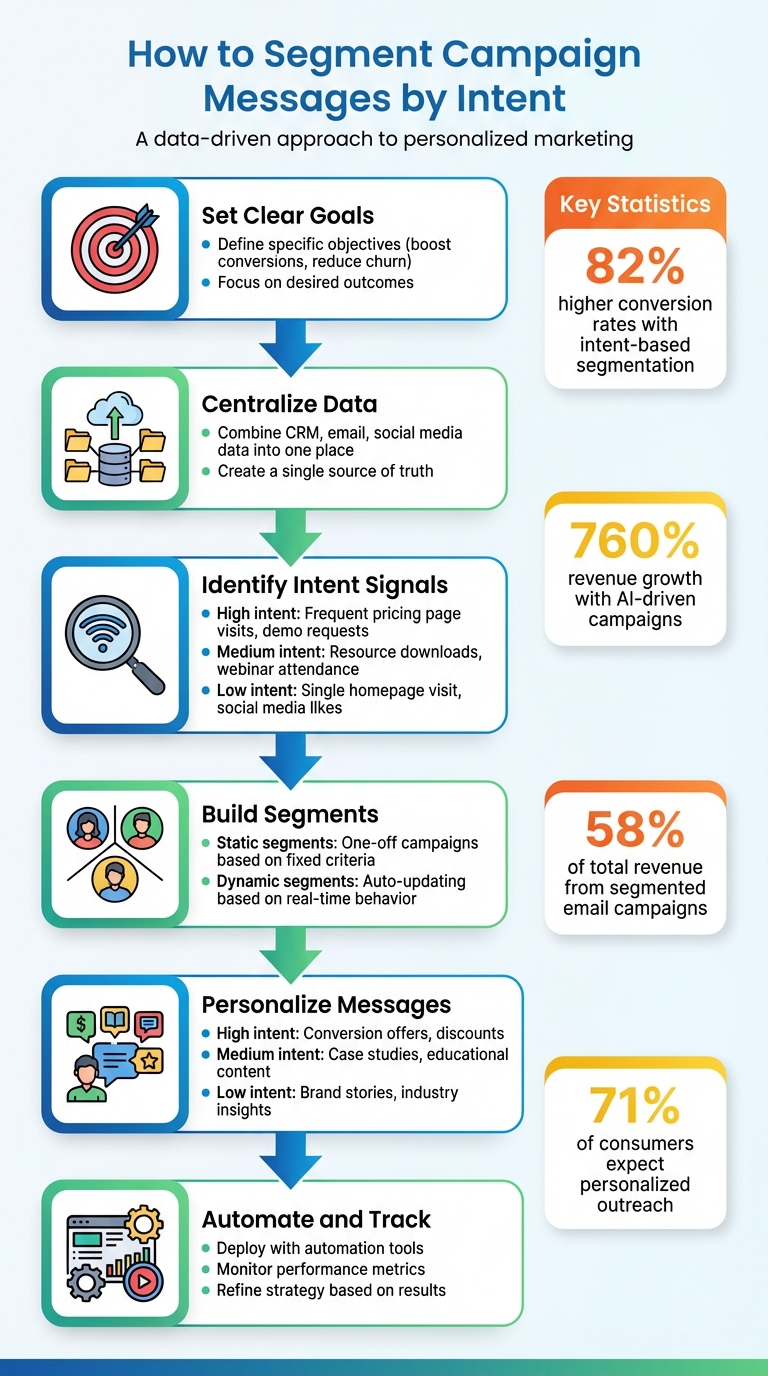
6-Step Process for Segmenting Campaign Messages by Intent
Step 1: Set Goals and Collect Data
Define Measurable Goals
Before diving into data collection, it’s crucial to establish clear, measurable goals. Vague aspirations like "improve engagement" won’t cut it - specificity is key. For instance, you might aim to increase your lead-to-sale conversion rate or decrease customer churn by implementing targeted re-engagement campaigns. These well-defined objectives not only guide your data collection but also help you avoid being overwhelmed by irrelevant information or poorly segmented data.
When segmentation goals are tied directly to revenue metrics, the results can be game-changing. Consider this: segmented email campaigns account for 58% of total revenue, and AI-enhanced campaigns have been shown to boost revenue by as much as 760%.
Centralize Your Data
With your goals in place, the next step is to gather all your data into a single, centralized location. Pull information from your CRM, analytics tools, email platforms, messaging apps, and any other interaction channels. Tools like Inbox Agents simplify this process by consolidating emails, SMS, and social media feeds into one dashboard, giving you a comprehensive view of customer behavior.
This centralization creates what Customer.io refers to as a "single source of truth". Instead of juggling multiple data streams, you’ll have one unified customer profile that powers your segmentation efforts. To ensure this system runs smoothly, connect your tools using APIs or native integrations, and conduct regular audits to weed out duplicate or outdated records.
Step 2: Identify Intent Signals Using AI
Understand Key Intent Signals
Customer behavior often reveals their intent. For instance, if someone visits your pricing page three times in two days, they're likely showing strong interest. High-intent signals include actions like frequent visits to pricing or demo pages, requests for proposals, detailed inquiries about integrations or competitors, and active participation in product trials. These behaviors suggest that a prospect is actively evaluating solutions.
On the other hand, medium-intent signals show interest but lack immediate urgency. Examples include repeat visits to the website, downloading resources like whitepapers or case studies, attending webinars, or subscribing to newsletters. These prospects typically need nurturing through helpful, value-driven content. Low-intent signals, such as a single visit to the homepage, reading one blog post, or liking a social media post, indicate curiosity but not readiness to buy. These individuals are best approached with subtle retargeting and long-term educational content rather than direct sales efforts.
AI also tracks external intent signals, often referred to as "digital breadcrumbs" by Eugene Suslov from Reply.io. These include activities like funding announcements, spikes in hiring at target companies, changes to their tech stack, or engagement with competitor profiles on LinkedIn. Such signals can reveal interest before a prospect even reaches out. In fact, 93% of marketers say leveraging intent data improves conversion rates, while 82% report it helps sales teams close deals faster.
The next step is using AI to analyze these signals in real time.
Use AI for Real-Time Analysis
AI excels at uncovering patterns that might escape human detection. It tracks behaviors like clicks, scrolling activity, session depth, and feature usage to find meaningful correlations. For example, users who consume specific combinations of content may be five times more likely to convert. Sentiment analysis takes this further by examining chat logs, emails, and calls to gauge urgency, hesitation, or enthusiasm. Meanwhile, predictive modeling compares current behavior to historical trends to estimate the likelihood of a purchase or the risk of churn.
AI also connects the dots across platforms. It can detect when multiple stakeholders from the same company are researching similar topics on different channels. This level of account-based insight is especially valuable in B2B sales, where buying decisions often involve committees. As Eugene Suslov puts it:
"The sales team that wins isn't the one sending the most outreach, it's the one spotting intent first".
For high-intent actions like demo requests, timing is critical. Responding within the hour can make all the difference - 71% of consumers expect personalized outreach, and 76% feel frustrated when it doesn’t happen.
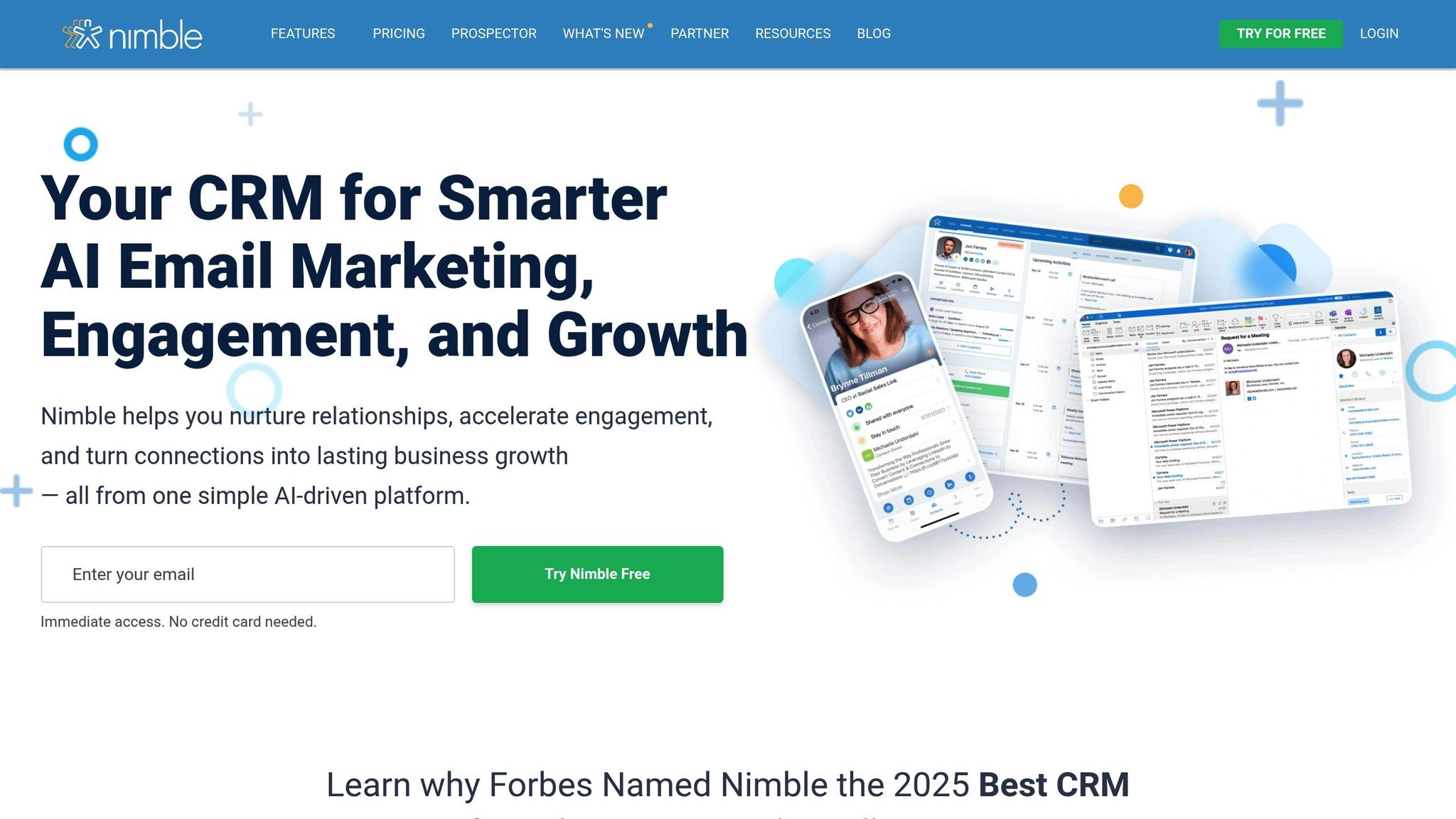
AI-Powered Email Writing in Nimble | Create Emails Faster with Intent-Based Messaging
Step 3: Build Intent Segments in Inbox Agents
To make your outreach more effective, it's essential to organize contacts into segments based on their intent signals. By using the insights from Step 2, you can create segments that adapt to your customers' changing behavior. This process lays the groundwork for more precise and impactful communication.
Inbox Agents provides two main ways to segment your contacts: static segments and dynamic segments. Each serves a distinct purpose, and knowing when to use them can help keep your campaigns relevant and effective.
Static vs. Dynamic Segments
Static segments are like creating a fixed list - you decide who belongs in the group, and it stays that way until you manually update it. These are perfect for one-off communications, such as sending company announcements, policy updates, or post-event follow-ups. However, the downside is that static segments require regular maintenance and can quickly become outdated if left unchecked.
Dynamic segments, on the other hand, update themselves automatically based on predefined criteria. For instance, if someone frequently visits your pricing page, they can be tagged as high intent. Similarly, if engagement drops, they might be moved into a re-engagement group. This type of segment is ideal for campaigns like lead nurturing or abandoned cart recovery. While dynamic segments are more powerful, they do require a well-integrated CRM system and accurate data to function seamlessly.
"Segmentation alone boosted our average open rate by 12% year-over-year" - Briana Torres, Senior Email Marketing Strategist at Injectco
Here’s a quick comparison of the two approaches:
| Feature | Static Segments | Dynamic Segments |
|---|---|---|
| Update Frequency | Manual; remains unchanged until updated | Automatic; refreshes in real time |
| Messaging | Uniform, one-size-fits-all | Personalized; adapts based on current behavior and intent |
| Setup Complexity | Low; requires minimal technical effort | High; dependent on CRM integration and data mapping |
| Best Use Case | Fixed campaigns like newsletters or policy updates | Lead nurturing, abandoned carts, and intent-based outreach |
| Scalability | Limited without ongoing updates | Highly scalable with adaptable, AI-driven templates |
Use Inbox Agents' AI Tools
Once your segments are defined, Inbox Agents' AI tools take over to simplify the process further. These tools automatically categorize and score leads, saving you time and effort. For example, Smart Folders group messages into categories like Revenue Opportunities, Investor Updates, and Partnership Leads. The system pulls data from platforms like Gmail, Outlook, LinkedIn, Slack, Discord, Instagram, WhatsApp, and Twitter DMs, analyzing behavior across all channels in real time.
Other features help fine-tune your segmentation even more. The Dollarbox identifies messages with high revenue potential, while the Qualification Agent ranks leads as high, medium, or low priority based on their fit and activity. Additionally, the Lifecycle Agent tracks metrics like recency, frequency, and monetary value to automatically move contacts between segments like "Champions" and "At-Risk" without you lifting a finger.
The AI typically becomes highly accurate within one to two weeks of regular use. To speed up this learning curve, you can provide feedback through the priority training feature. Reviewing your Daily Briefings also ensures the system correctly distinguishes between urgent and routine messages, keeping your workflow smooth and efficient.
sbb-itb-fd3217b
Step 4: Personalize Campaign Messages
Create messages that resonate with each contact's stage in the buying journey. Research shows that 71% of consumers expect personalized interactions, and 76% feel frustrated when they don’t get them. When done right, personalization can yield impressive results, delivering 5 to 8 times the ROI on marketing spend and increasing sales by 10% or more.
Tailor Messages by Intent Level
The type of message you send should match the intent level of your audience. Here’s how to approach it:
- High-intent contacts: These are your most engaged prospects. Reach out within 24 hours with conversion-focused offers like discounts, free shipping, or VIP access. The goal is to close the deal quickly.
- Mid-intent contacts: These individuals need more information to make a decision. Share educational content such as customer success stories, product comparisons, or ROI case studies (especially for B2B). For example, Andie Swim, a swimwear brand, generated over $70,000 in extra revenue in eight months by using a tiered engagement strategy that delivered tailored content to active subscribers.
- Low-intent contacts: Focus on building trust with this group. Send them industry insights, brand stories, or quizzes to learn more about their preferences. If someone hasn’t engaged in nine months, consider a "sunset flow" with three messages asking if they’d like to stay subscribed, offering a final incentive before removing them from your list.
| Intent Level | Message Type | Send Frequency | Primary Goal |
|---|---|---|---|
| High | Scarcity offers, cart discounts, VIP perks | Daily or 3x/week | Drive immediate conversion |
| Medium | Product recommendations, case studies, social proof | 2-3x/week | Build consideration and trust |
| Low | Educational guides, brand stories, preference surveys | Weekly or less | Engagement and data collection |
| Lapsed | Win-back incentives, "We miss you" offers | One-time series | Re-activation |
This table provides a quick reference for message types, frequency, and goals based on intent levels. Once your content is customized, you can use AI to refine and scale your efforts.
Use AI for Personalization
AI tools can take your tailored content to the next level. Inbox Agents’ features are designed to make personalization seamless and effective:
- Personalized Responses: This tool analyzes contact history across platforms like Gmail, LinkedIn, Slack, and WhatsApp to craft replies that feel authentic. It adjusts tone and content based on factors like role, company size, and recent interactions, avoiding generic templates.
- Negotiation Handling: For high-intent prospects, this tool is a game changer. If someone requests a discount or pushes back on pricing, the AI uses predictive models to suggest the smallest incentive needed to close the deal. For example, a North American retailer improved its annualized margins by 3% by using AI to assess "promotion propensity" and reduce unnecessary discounts.
- Automated Outreach: Deploy multiple message variations and let the AI learn from engagement metrics like clicks, opens, and replies. In 2025, a European telecom tested 2,000 different actions using generative AI to tailor text messages based on customer data, achieving a 10% boost in engagement compared to non-personalized campaigns.
"Tailored messaging makes a big difference, especially when aligned with user lifecycle stages. This segmentation approach boosts our open rates by at least 20% compared to batch-and-blast campaigns." - Adrian Nikolov, MobiSystems, Inc.
Step 5: Automate Campaign Deployment and Track Performance
Once your messages are tailored to your audience, the next step is to roll them out efficiently and monitor what works. Managing campaigns manually can lead to errors, but automation ensures your messages reach the right audience at the perfect time. Plus, real-time tracking lets you fine-tune your strategy based on actual results. This combination of automation and tracking lays the groundwork for smooth and effective campaign execution.
Automate Outreach with Inbox Agents
Using AI-powered audience segments and personalized messages, automation allows for real-time adjustments that drive ongoing success. Tools like Inbox Agents bring multiple communication channels together, so you’re not constantly switching between platforms. This makes it easy to deploy campaigns across various channels. The Automated Outreach feature lets you create multiple message variations and target them based on intent. For instance:
- High-intent contacts can immediately receive conversion-focused offers.
- Mid-intent prospects might get educational content on a staggered schedule.
AI takes care of tracking email opens, clicks, and replies in real time, which helps refine message variations for better results. You can start with a "human-in-the-loop" approach, where the AI drafts responses that you review before moving to full autopilot mode. If you’re running large-scale campaigns, consider using secondary domains to protect the reputation of your primary domain - this is particularly helpful for maintaining deliverability at scale.
Monitor and Optimize Campaigns
After launching your campaigns, ongoing monitoring is key to keeping engagement levels high. Automation becomes even more valuable when you’re tracking performance metrics. With Inbox Agents, you get a centralized dashboard that provides a complete view of your campaign's health across all channels. Use automated A/B testing to experiment with variables like subject lines or calls-to-action (CTAs). For reliable results, test each variation with at least 200 contacts.
Here’s a real-world example: In May 2025, British retailer HMV used AI-driven AutoSegments to refine its campaigns, leading to a 14% boost in revenue, a 34% increase in impressions, and a staggering 425% rise in landing page views.
You can also use AI-powered Send Time Optimization to schedule messages when recipients are most likely to engage. This approach alone can improve open rates by 20–30%. Keep a close eye on engagement patterns - send regular campaigns only to subscribers who have interacted (opened or clicked) within the past 60 days. For those who haven’t engaged in nine months, trigger a re-engagement flow or remove them from your list entirely.
AI tools can even predict when subscribers are at risk of fatigue or churn, giving you the chance to act before they unsubscribe. For example, United Fashion Group used AI to adapt customer journeys on the fly, resulting in a 43.75% increase in conversion rates and a 57.31% jump in Average Order Value.
To maintain a strong sender reputation, keep your bounce rate below 1%. This involves strict list management - automatically suppress hard bounces, spam complaints, and unsubscribes.
"The biggest competitive advantage in the inbox is predictive relevance." - Gila, Founder, Ageless Revenue
Conclusion
Segmenting campaign messages based on intent transforms marketing into a precise, data-driven approach. By understanding where each contact is in their buying journey, you can deliver messages that feel timely and relevant. And the results speak for themselves - brands using segmentation experience 101% higher click-through rates.
Inbox Agents simplifies this process by bringing all your messaging channels together in one platform. Its AI-powered tools handle everything from analyzing intent signals in real time to automating personalized outreach across multiple channels. This not only saves hours of manual effort but also allows your campaigns to adapt instantly to audience behavior.
The move from reactive to proactive marketing is no longer just a nice-to-have - it's essential. With AI managing segmentation, personalization, and optimization, you can focus on crafting your strategy while ensuring every message reaches the right person at the perfect time.
Set clear goals, centralize your data, and let AI pinpoint the intent signals that matter most. Then, rely on Inbox Agents to turn those insights into campaigns that engage, convert, and grow - all with less manual effort.
FAQs
How does AI identify intent signals for segmenting campaigns?
AI determines intent signals by analyzing a prospect's online activities and assigning an intent score based on their level of engagement. This process involves examining first-party data, such as visits to specific website pages (like pricing or product details), email interactions, click-through rates, and chat conversations. Additionally, third-party data - like activity on review platforms or LinkedIn - is incorporated to develop a more complete profile. These signals are then evaluated using factors such as recency, frequency, and relevance, helping to classify prospects into high, medium, or low intent categories.
With these intent scores in hand, campaigns can be designed to align with each prospect's level of interest. For instance, high-intent prospects might receive personalized outreach or immediate follow-ups, while medium-intent leads are nurtured with content aimed at building trust. Meanwhile, low-intent prospects are typically included in broader awareness campaigns. This strategy ensures that messaging is both timely and relevant, leading to better conversions and more efficient use of resources.
What’s the difference between static and dynamic audience segments?
Static segments consist of fixed groups defined by unchanging attributes, such as gender or date of birth. Since these attributes remain constant, any updates to these segments need to be done manually to keep them relevant.
Dynamic segments, however, are much more flexible. They automatically update in real time based on factors like user behavior, engagement patterns, or other criteria. This means the audience list stays up-to-date without manual intervention, making dynamic segments perfect for targeting customers based on their current actions or intent.
How can I tailor messages to match different buyer intent levels?
You can tailor your messages to match buyer intent by using AI to categorize prospects into different groups and crafting specific communication strategies for each. Start by employing AI tools to examine behaviors such as website visits, email interactions, or chat tone. Assign each prospect an intent score (e.g., 0–100), then divide these scores into three categories: high intent (ready to buy), medium intent (actively researching), and low intent (just browsing).
For high-intent prospects, focus on straightforward offers and compelling calls-to-action, like “Buy now” or limited-time deals (e.g., Save $50 today). Medium-intent prospects are more likely to engage with educational materials or product comparisons, while low-intent audiences respond well to brand-building content and engaging stories. AI tools like smart replies and personalized responses can enhance your messages by automatically including details like the prospect's name or recent activity, making the communication feel more relevant.
It's also important to choose the right communication channel for each group. High-intent buyers often prefer live chat or phone calls for quick assistance, while medium- and low-intent prospects are better reached through email or SMS. Keep an eye on key metrics like open rates and conversion rates to fine-tune your approach and ensure your messages connect effectively with each audience segment.