

Symmetric and Asymmetric Encryption: Best Practices
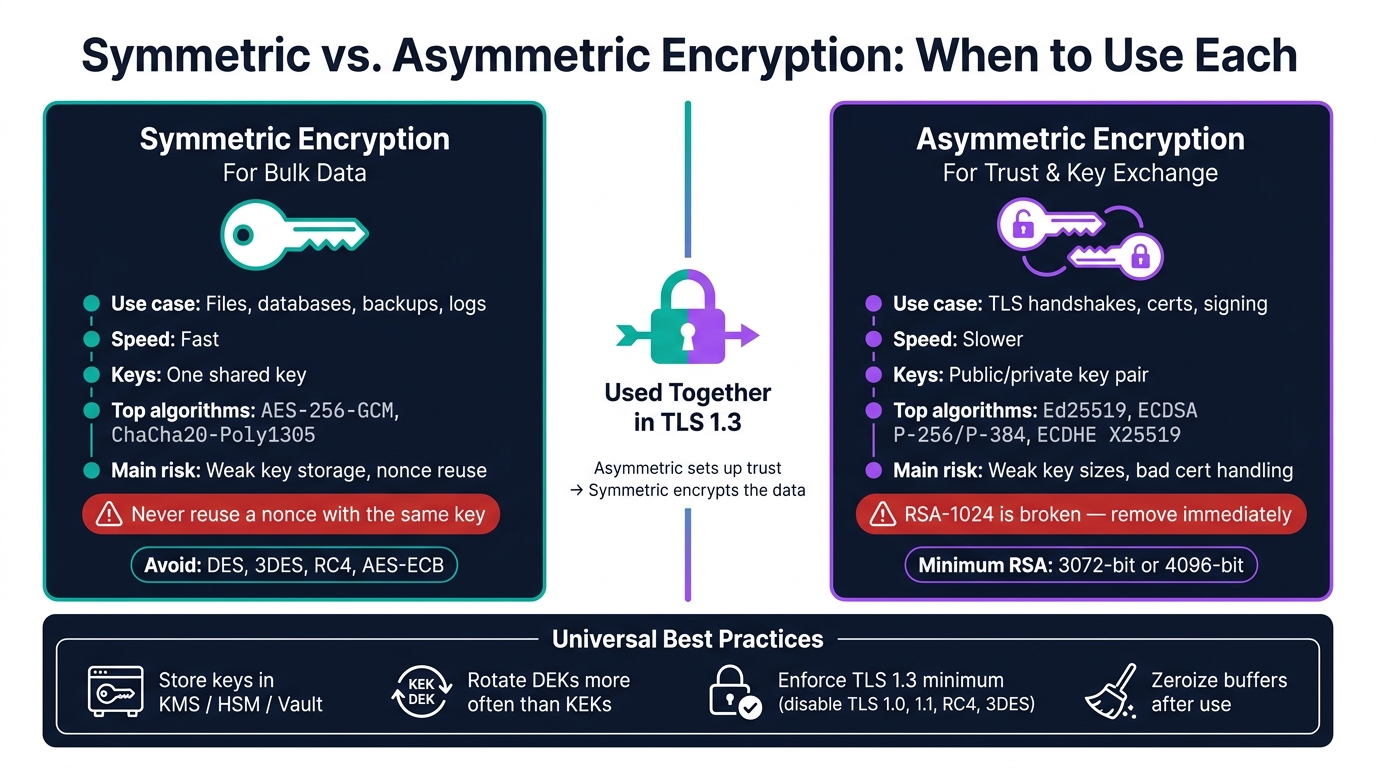
If I had to boil this down to one rule, it’s this: use asymmetric encryption to set up trust, then use symmetric encryption for the data itself.
That’s how most modern systems work, including TLS 1.3. In plain English: one method solves the key-sharing problem, and the other handles large volumes of data without the heavy compute cost of public-key crypto.
Here’s the short version:
- Use symmetric encryption for bulk data
- Pick AES-256-GCM for most new systems
- Use ChaCha20-Poly1305 when AES hardware support is weak
- Never reuse a nonce with the same key
- Use asymmetric encryption for trust
- Use Ed25519 for new signatures where FIPS is not required
- Use ECDSA P-256/P-384 for FIPS-aligned signing
- Use ECDHE with X25519 or P-256 for forward secrecy
- Protect keys like production assets
- Store them in KMS, HSM, or a vault
- Rotate DEKs more often than KEKs
- Use envelope encryption
- Lock down transport
- Set TLS 1.3 as the minimum
- Disable TLS 1.0, TLS 1.1, RC4, and 3DES
- Use mTLS for service-to-service traffic
- Reduce plaintext exposure
- Decrypt only where needed
- Keep plaintext in memory for the shortest time possible
- Zeroize buffers after use
A few hard facts stand out. RSA-1024 is broken and should be removed. RSA-2048 still appears in legacy setups, but RSA-3072 or RSA-4096 is the better target when RSA is still required. And for web traffic, TLS 1.3 with ephemeral key exchange helps keep past sessions safe even if a long-term private key is exposed later.
Symmetric vs Asymmetric Encryption: Key Differences & Best Practices
Encryption Explained: Symmetric vs Asymmetric Algorithms for Network Security
sbb-itb-fd3217b
Quick Comparison
| Topic | Symmetric Encryption | Asymmetric Encryption |
|---|---|---|
| Main use | Bulk data protection | Key exchange, identity, signatures |
| Keys used | One shared key | Public/private key pair |
| Common choices | AES-256-GCM, ChaCha20-Poly1305 | Ed25519, ECDSA, RSA-OAEP, ECDHE |
| Speed | Fast | Slower |
| Best fit | Files, databases, backups, logs | TLS handshakes, certs, signing |
| Main risk | Weak key storage, nonce reuse | Weak key sizes, bad cert handling |
If I’m setting up encryption in a SaaS app, inbox tool, API, or internal service mesh, this is the checklist I’d keep: modern algorithms, strict key storage, short plaintext windows, and strong TLS settings from day one.
Checklist: Symmetric Encryption Best Practices
This checklist covers the controls that make symmetric encryption safe in production.
Choose Approved Algorithms and Secure Modes
Use AES-256-GCM for most new application encryption. For new deployments, pick AES-256 over AES-128. If you need a software-friendly option for mobile devices or platforms without hardware-accelerated AES, use ChaCha20-Poly1305.
Both are AEAD modes, which means they protect confidentiality and integrity in one step.
Stay away from DES, 3DES, RC4, and AES-ECB. ECB is a bad fit because identical plaintext blocks turn into identical ciphertext blocks, which leaks data patterns. If you're stuck with CBC or CTR for legacy reasons, pair them with a MAC and use the Encrypt-then-MAC approach.
Never reuse a nonce with the same key in GCM or ChaCha20-Poly1305. That mistake can wreck the security of the whole scheme.
Generate, Store, and Rotate Keys Safely
Generate keys inside a FIPS 140-2/140-3 validated module with a CSPRNG. Do not use noncryptographic RNGs.
Keep keys in a dedicated KMS, HSM, or secret-management vault like AWS KMS, Azure Key Vault, or HashiCorp Vault. Do not store keys in plaintext, source code, configuration files, or environment variables.
Set a rotation schedule. Rotate data keys more often than master keys.
Use envelope encryption: encrypt data with a Data Encryption Key (DEK), then encrypt the DEK with a Key Encryption Key (KEK). That setup lets you rotate the KEK without re-encrypting your entire dataset.
Encrypt Data at Rest with Clear Key Boundaries
Use separate keys for each workload instead of one key across the whole platform. In multi-tenant SaaS platforms, per-tenant or per-user key scoping helps keep one compromise from exposing everyone else’s data. Apply that same boundary to databases, object storage, backups, and logs.
Store keys separately from the data they protect. In cloud environments, key destruction - destroying the key - is the reliable way to make encrypted backups, snapshots, and replicas unrecoverable.
Use asymmetric cryptography for key exchange, identity, and certificate trust.
Checklist: Asymmetric Encryption and Certificate Best Practices
This checklist covers key types, certificates, and private-key handling in production.
Use Modern Key Types and Minimum Key Sizes
For new signing work, use Ed25519 (EdDSA). If you need FIPS compliance, use ECDSA P-256 or P-384. If RSA is still required for legacy compatibility, go with RSA-3072 or RSA-4096. RSA-2048 is still an acceptable legacy minimum, but it shouldn't be your target for new deployments. RSA-1024 is broken and should be removed from active configurations.
If you're using RSA for encryption, always use OAEP padding. For RSA signatures, use PSS. Never use PKCS#1 v1.5 for encryption.
| Purpose | Recommended | Acceptable (Legacy) | Remove Now |
|---|---|---|---|
| Digital Signatures | Ed25519, ECDSA P-384 | RSA-2048 (PSS), ECDSA P-256 | RSA-1024, MD5, SHA-1 |
| Key Exchange | ECDHE (X25519) | RSA-3072 (OAEP) | RSA-1024, Static DH |
| RSA Key Size | 3,072-bit or 4,096-bit | 2,048-bit | 1,024-bit or smaller |
Key choice is only part of the job. Certificates and private keys also need to stay valid, available, and locked down.
Manage Certificates and Private Keys as Production Assets
Treat certificates like production assets, not paperwork you deal with once and forget.
Automate issuance and renewal with the ACME protocol, tools like cert-manager for Kubernetes, or managed services like AWS ACM or Google Managed SSL. Renew certificates 30 to 60 days before expiration, and alert on 30-day expiry.
Before connecting, verify the trust chain, hostname, validity window, and revocation status through CRL or OCSP. Turn on OCSP stapling to cut revocation-check delay and help protect client privacy.
Private keys deserve the same level of protection as your most sensitive credentials. Store production private keys in an HSM or a managed KMS such as AWS KMS or Azure Key Vault. If certificate pinning is needed for a high-security mobile app, pin the Subject Public Key Info (SPKI) hash instead of the certificate itself. That gives you room to rotate certificates without breaking the client.
Once certificate operations are automated, use asymmetric crypto only where trust boundaries call for it.
Use Asymmetric Cryptography for Trust, Not Bulk Encryption
Use asymmetric cryptography for trust, not bulk encryption. It fits authentication, digital signatures, and key exchange. For bulk data, use AES-256-GCM and other symmetric keys.
Use forward secrecy in TLS. Use ECDHE with X25519 or P-256 for key exchange. Ephemeral keys are created per session and destroyed afterward, which means a future compromise of a server's long-term private key can't be used to decrypt past recorded sessions.
Use mTLS between internal services that process inbox data, and automate certificate rotation through your service mesh.
Checklist: Key Management, Encryption in Transit, and SaaS Operations
Once you’ve picked your algorithms and certificate formats, the next place things can go wrong is operations. Keys can be mishandled. Traffic can slip through weak transport settings. Plaintext can hang around in memory longer than it should.
This checklist focuses on the day-to-day controls that keep encryption working in production.
Define a Full Key Lifecycle and Access Policy
Give every key a clear owner and a set rotation schedule. Start with a full inventory of every component that generates, stores, or uses a key, then assign a named person who is accountable for each one.
For access control, use least privilege and RBAC. For your most sensitive keys, require dual control with M-of-N authorization so one person can’t export or misuse a key on their own. Log every admin action tied to keys, and keep those records in a tamper-proof audit trail such as AWS CloudTrail where it fits.
Rotation isn’t optional. Set rotation intervals based on how sensitive the data is, and automate rotation through your KMS. When a key is no longer needed, destroy it so any data encrypted under that key becomes permanently unrecoverable, including backups and snapshots. Most cloud providers apply a 7- to 30-day waiting period before permanent deletion, so your retention policy needs to account for that window.
Enforce Strong Encryption in Transit Across Web, API, and Messaging Flows
Use TLS 1.3 as the minimum for all external and internal traffic. Disable TLS 1.0, TLS 1.1, RC4, and 3DES in your server and load balancer settings. For service-to-service traffic, use mTLS.
Add HSTS headers so browsers are forced to use HTTPS for at least one year. Enforce HTTPS redirects at the infrastructure layer, not only in application code.
Protect Sensitive AI Inbox Data During Processing
For inbox workloads, the main control is simple: keep the plaintext window as small as possible. Platforms that process message data across many channels - like Inbox Agents, which unifies email, chat, and other messaging sources into a single interface - deal with sensitive content such as message bodies, attachments, user identifiers, metadata, and AI-generated summaries. Classify each data type before you decide how to protect it.
Message data, summaries, metadata, and attachments should be decrypted only for the exact step that needs them. Limit decryption to the active component, so an AI summarization service gets only the plaintext needed for a given task. Keep plaintext in memory only for as long as needed. Zeroize buffers that hold key material or decrypted content right after use.
Conclusion: The Encryption Checklist to Keep
Good encryption comes down to two things: the algorithm you pick and how you use it.
Use symmetric encryption for bulk data, databases, and disk encryption. Use asymmetric cryptography for trust, authentication, digital signatures, and key exchange. The checklist above turns that divide into practical controls.
Most problems don't start with the math. They start in day-to-day operations. That's where teams slip up.
Use this checklist to keep encryption secure in production. Keep it current, and verify it in production.
FAQs
When should I use symmetric vs. asymmetric encryption?
Symmetric encryption uses one shared key. That makes it much faster, which is why it’s a good fit for high-volume data like disk encryption, database protection, and streaming data.
Asymmetric encryption uses a public-private key pair. It’s used for key exchange and identity authentication, but it takes more computing power and isn’t a good fit for large payloads.
In most production systems, the two work together: asymmetric encryption handles key exchange or signatures, and symmetric encryption handles bulk data.
Why is nonce reuse so dangerous?
Nonce reuse is a catastrophic failure in symmetric cryptography. With modes like GCM and ChaCha20-Poly1305, you must use a different nonce every time you encrypt with the same key.
If you reuse a nonce with that key, things can fall apart fast. An attacker may learn how two plaintexts are related, and they may also be able to forge valid messages.
The rule is simple: for any given key, every nonce must be used only once.
How often should encryption keys rotate?
Encryption keys should rotate on a regular schedule to lower the chance of unauthorized access. How often that happens depends on the key type, the system it lives in, and how sensitive the data is.
A common best practice is to automate rotation every 12 months or sooner, especially in high-risk environments or when rules like PCI DSS v4.0 apply. DEKs often have shorter lifespans, while KEKs usually stay in place longer.