


AI Scenario Simulation for Teams
AI scenario simulation is changing how teams plan and make decisions. Instead of relying on slow, static methods, it uses autonomous agents to model dynamic business behaviors in real time. This allows teams to test multiple "what-if" scenarios quickly and adjust strategies as new data emerges. Here's what you need to know:
- Faster Results: AI can update scenarios daily, compared to the months manual methods often require.
- Improved Precision: AI simulations replicate human behavior with up to 85% accuracy and uncover insights traditional methods often miss.
- Scalable Solutions: AI handles thousands of scenarios simultaneously, making it easier to manage complex challenges.
- Cost Savings: AI-driven tools are more affordable than traditional platforms, starting at $19 per user per month.
While AI excels in speed and scale, human expertise is still vital for interpreting results and addressing nuanced factors like political or reputational dynamics. The best approach combines AI's efficiency with human judgment to improve decision-making and prepare for unexpected challenges.
1. AI Scenario Simulation
Speed
AI scenario simulations operate at a pace that manual methods simply can't match. With AI, scenarios can be run and updated weekly - or even daily - thanks to frameworks capable of executing multiple "what-if" scenarios all at once.
The results speak for themselves. For example, global logistics operations have seen efficiency in response processes improve by 30% to 50%. Similarly, automated anomaly resolution powered by supervisor agents has boosted processing speeds by over 50%. In another case, a telecommunications company using AI-driven assistants managed to increase digital sales by a staggering fivefold.
This incredible speed lays the groundwork for simulations that are not only fast but also highly detailed - something the Accuracy section will dive into next.
Accuracy
When it comes to accuracy, AI simulations excel by capturing real human behaviors and business contexts with impressive precision. By combining qualitative data with advanced algorithms, AI agents can replicate survey responses with 85% accuracy. For instance, in a study involving 1,052 individuals representative of the U.S. population, generative agents accurately predicted personality traits and experimental outcomes based on two-hour interview transcripts.
"The quality of simulation depends on the sharpness of inquiry. If you ask lazy questions... you'll get shallow scenarios." – Auxiliobits
Creating high-fidelity simulations requires what experts call a "context fabric." This involves clearly defined goals, access to proprietary data, decision-making logic, and adherence to regulatory constraints. Unlike static models, which rely on fixed logic, AI agents can simulate behavioral dynamics in real-time. This dynamic approach, often involving human oversight, uncovers edge cases that more generic models might overlook.
Scalability
Scalability is another standout strength of AI simulations. While human teams often struggle to process large datasets, AI tools can handle vast amounts of information and simulate thousands of scenarios simultaneously. This capability allows teams to respond to communications 12 hours faster on average, with productivity increasing by 66%.
AI-powered simulations are also highly accessible, enabling organizations to scale their efforts across teams and locations without the need for in-person workshops. Using generative AI, these simulations can provide real-time, unscripted dialogues that adapt to user inputs, mimicking the complexity of real-world workplace challenges. Additionally, integration with Learning Management Systems ensures consistent training and feedback for large, distributed teams. Today, 35% of organizations are already leveraging agentic AI, with another 44% planning to implement it soon.
Adaptability
What sets AI simulation apart even further is its adaptability. Unlike manual models, which often require a complete overhaul when conditions change, AI agents can instantly update scenarios in response to new data - whether it's a shipping delay, a regulatory update, or a competitor's move. Natural language interfaces also make it easier for non-technical users to adjust simulation parameters.
AI systems are designed to "remember" multi-step workflows and use advanced reasoning to tackle complex goals. Many organizations are adopting a "graduated autonomy" approach, starting with agents in "Shadow Mode." In this mode, agents assist without taking direct action, gradually transitioning to full autonomy once their performance is validated. This step-by-step approach builds trust while ensuring simulations remain grounded in real-world scenarios.
2. Manual Methods
Speed
When it comes to speed, manual scenario planning falls far behind AI-driven alternatives. For many organizations, it’s treated as a routine exercise, often resulting in static presentations that lose relevance within just a couple of months. Traditional simulation systems, on the other hand, can take six months or more to produce actionable insights - far too slow for today’s rapidly shifting business landscape.
"Scenario planning... as practiced in the past few decades, it can be too time- and resource-intensive to meet today's need for fast insights." – MIT Sloan Management Review
Adding to the delay are technical hurdles. These manual tools demand a high level of expertise to set up and interpret. When quick decisions are needed, this complexity becomes a bottleneck. The slow pace doesn’t just waste time - it also compromises accuracy, as manual methods struggle to keep up with real-time complexities.
Accuracy
Manual methods often miss the mark on accuracy because they rely on simplified assumptions that remain static, failing to reflect dynamic conditions. Researchers must manually define rules, which often fall short in capturing the nuances of human behavior or unique situational factors.
"Models are frozen logic. They hold assumptions still, so we can look at them. Agents move inside that logic, push against it, and see what breaks." – Auxiliobits
Another challenge lies in configuring abstract parameters. For example, assigning a score to something like "digital savviness" on a scale of 1 to 10 can be highly subjective and prone to errors. A single year-long simulation, with hourly intervals, can produce tens of thousands of data points - far more than humans can realistically analyze. Traditional market entry models, often limited to around 30 assumptions, may miss critical variables altogether. Beyond speed and accuracy, manual methods struggle even more when scaling to complex scenarios.
Scalability
Scalability is another major limitation of manual approaches. These methods tend to address problems in isolation, rather than taking a systemic view, making it nearly impossible to evaluate multiple divergent scenarios at once. In highly complex environments, like multi-domain military operations, the coordination required has reached a point where it’s described as "humanly impossible".
"Integration and synchronization of all activities associated with operations is becoming increasingly difficult to the point of humanly impossible." – Sue E. Kase et al., Frontiers in Psychology
Resource limitations exacerbate the issue. With leaner organizational structures, personnel are often stretched thin, driving up the cost of traditional planning methods. For instance, legal teams might spend 40% of their time manually reviewing contracts, which drains productivity. On top of that, businesses can lose up to 30% of a contract’s value due to poor visibility and manual tracking. These factors make it even harder for manual methods to keep up with today’s demands.
Adaptability
Flexibility is where manual methods falter the most. They generate one-time forecasts based on fixed assumptions, which quickly become outdated as market conditions evolve. When new data - like a regulatory change, competitor move, or shipping delay - comes into play, these models often require a complete rebuild. This process can take weeks, if not months, causing significant delays .
Manual methods also rely on researcher-defined rules, which limit their ability to adapt to varying contexts. In volatile situations, where executives need to explore multiple "what-if" scenarios on short notice, these methods simply can’t deliver the speed or flexibility needed to provide actionable insights.
In-Ear Insights: Rapid Scenario Planning with Generative AI
sbb-itb-fd3217b
Pros and Cons
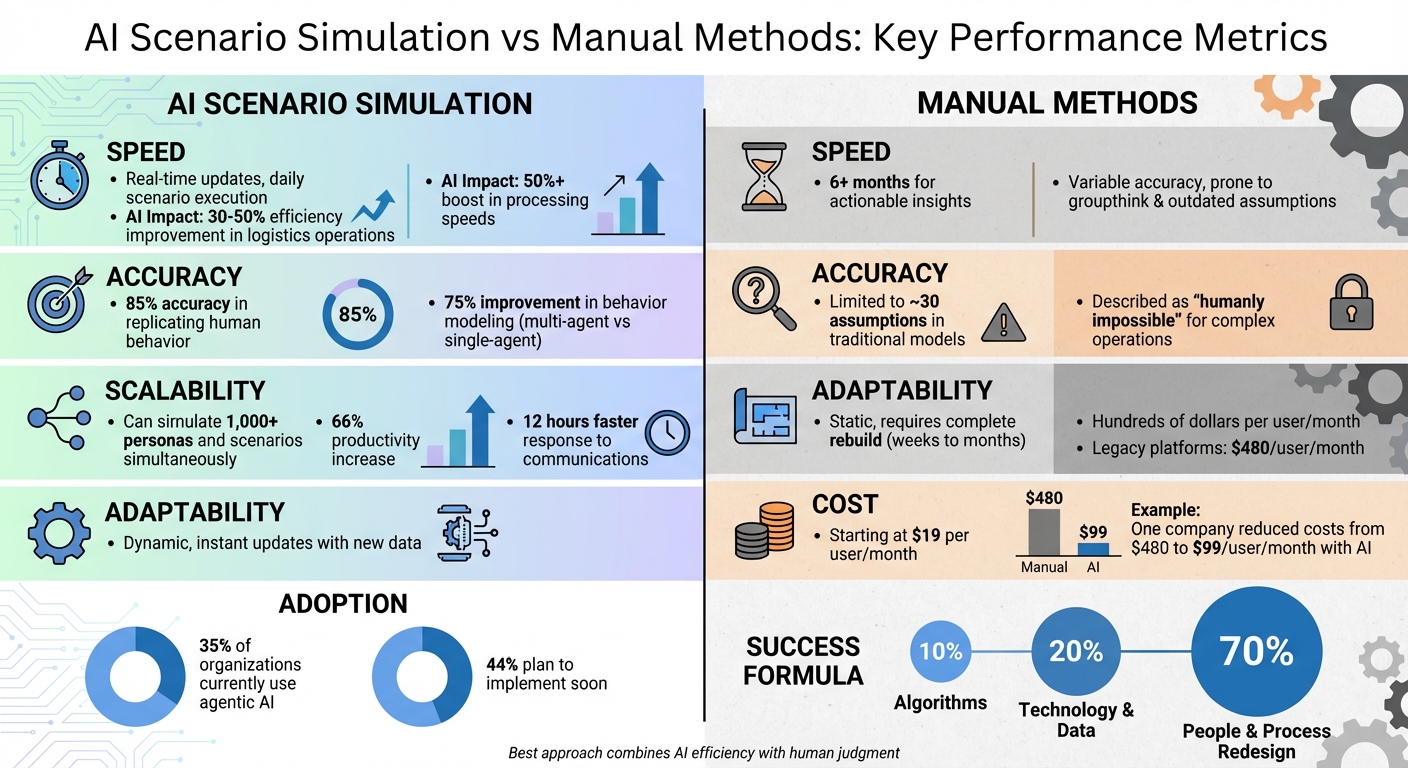
AI vs Manual Scenario Simulation: Speed, Accuracy, Scalability & Cost Comparison
When comparing AI scenario simulation to manual methods, it's clear that both come with their own sets of benefits and challenges. AI shines in speed and scale, offering capabilities that manual methods simply can't rival. For example, teams can simulate multiple "what-if" scenarios in real time rather than waiting months for results. Some global logistics firms have even reported efficiency gains of 30% to 50% in their response processes thanks to AI-driven automation. This speed advantage also lays the groundwork for the accuracy benefits that follow.
Speaking of accuracy, AI has a noticeable edge. Multi-agent large language model (LLM) simulations can boost the precision of human behavior modeling by about 75% compared to single-agent methods. However, AI has its limitations. It often struggles with understanding nuances like political dynamics, internal morale, or reputational subtleties - areas where human strategists excel. As one analysis points out, AI agents can't interpret a regulator's body language or sense the unspoken tension in a boardroom.
On the flip side, manual methods offer strong contextual judgment but lack flexibility. Traditional models are static and can quickly become outdated. For instance, a tariff change or supply chain disruption often requires a complete rebuild of manual models. AI, on the other hand, can instantly update scenarios without starting over. That said, the "black box" nature of AI remains a concern. Without clear explanations for its recommendations, executives may hesitate to trust AI-driven strategies.
Here’s a side-by-side comparison of key factors:
| Criterion | AI Scenario Simulation | Manual Methods |
|---|---|---|
| Speed | Real-time updates; enables quick decisions | Slow; actionable insights can take 6+ months |
| Accuracy | 85% accuracy in modeling human behavior; reduces bias | Variable; prone to groupthink and outdated assumptions |
| Scalability | Can simulate 1,000+ personas and scenarios | Limited by analyst capacity and workshop costs |
| Adaptability | Dynamic; updates instantly with new data | Static; requires rebuilding when conditions change |
| Transparency | Low to medium; needs explainability layers | High; rules are easy to interpret |
| Contextual Nuance | Low; misses political and reputational subtleties | High; relies on human intuition and judgment |
The cost factor also weighs in favor of AI. Traditional scenario planning can be expensive, requiring significant executive time and costing hundreds of dollars per user each month when using legacy platforms. In contrast, AI-based solutions are far more affordable, starting at just $19 per user per month. One sales operations leader even replaced a $480-per-user-per-month tool stack with a $99-per-user-per-month AI platform, achieving better functionality at a fraction of the cost. However, achieving success with AI requires a thoughtful balance - 10% algorithm, 20% technology and data, and 70% people and process redesign. These trade-offs highlight the strategic choices teams must consider, which will be explored further in the conclusion.
Conclusion
AI scenario simulation has reshaped planning by turning it into a dynamic, real-time rehearsal. Unlike traditional manual methods, AI offers real-time processing, dynamic behavior modeling, and the ability to scale massively. This means organizations can instantly test thousands of "what-if" scenarios, providing a new level of strategic agility.
"AI agents turn strategy into a live rehearsal, not a static forecast" – Auxiliobits
However, while AI enhances simulation capabilities, it doesn't replace the need for human judgment. Its rapid insights and ability to uncover hidden connections are invaluable, but experienced leaders are critical for interpreting these findings in context. For instance, understanding the significance of a 2% shift in gross margin requires a blend of AI-driven data and human expertise.
The cost-benefit analysis clearly supports adopting AI, but achieving meaningful change demands more than just technology. It requires the right balance: 10% algorithms, 20% technology and data, and 70% people and process redesign.
The best way to start? Focus on workflows where speed and scalability are crucial. As teams see the value of AI insights, confidence in its role will naturally grow.
"The role of AI agents isn't to decide. It's to stretch the imagination responsibly" – Auxiliobits
FAQs
How does AI scenario simulation help teams make decisions faster than manual methods?
AI-powered scenario simulations are a game-changer for decision-making, cutting through time-consuming tasks like data collection and complex "what-if" analyses. Instead of spending weeks sifting through data and evaluating outcomes manually, AI can process massive datasets, explore multiple scenarios, and identify the best options - all within minutes.
By providing quick, actionable insights, teams can test strategies on the fly and respond more effectively to shifting circumstances. This approach can shorten decision-making cycles by up to 40%, turning processes that once dragged on for weeks into just a few days. The outcome? Faster, smarter, and more efficient decisions that help teams stay ahead in fast-moving environments.
What are the challenges of using AI scenario simulations to account for human behavior?
AI scenario simulations offer a useful way to examine team dynamics, but they come with their own set of challenges. While they can mimic many behavioral patterns, they often fall short when it comes to capturing the finer details of human behavior - like emotions, cultural subtleties, or spur-of-the-moment creativity - that play a big role in decision-making. Plus, the quality and biases in their training data can impact how accurate they are, especially in situations that require sensitivity to context.
That's why human oversight is essential. People are needed to ask the right questions, interpret the results meaningfully, and address ethical issues, such as maintaining privacy and securing consent when personal data is involved. Simulations also tend to overlook non-verbal communication and the gradual development of trust within teams, making regular human input crucial for improving and validating their findings. Even with these limitations, AI can still be a helpful tool - especially when paired with human insight and expertise.
How can teams combine AI scenario simulations with human expertise for better decision-making?
To make the most of AI scenario simulations, it's crucial to see AI as a partner rather than a standalone solution. While AI can rapidly generate potential outcomes and highlight trade-offs, human expertise is indispensable for defining the problem, choosing relevant variables, and interpreting the results. This collaboration ensures that simulations align with real-world contexts and strategic objectives.
Building trust in AI starts with transparency. Teams need to understand how AI arrives at its recommendations, including the reasoning, assumptions, and limitations involved. By incorporating structured feedback loops, organizations can validate AI outputs, address biases, and fine-tune future simulations, leading to more accurate and meaningful results.
Integrating AI insights into daily workflows becomes even smoother with tools like Inbox Agents, which consolidate team communications into a single interface. These platforms allow teams to review AI-generated scenarios, discuss them in real time, and use features like automated summaries or smart replies to simplify decision-making. This approach minimizes the need for constant context-switching, speeds up collaboration, and embeds scenario planning into the natural flow of daily operations.