

How AI Matches Brand Voice in Replies
AI helps businesses maintain a consistent brand voice across emails, chats, and social media, even at scale. By analyzing past communications, it learns your tone, vocabulary, and style. It adjusts responses based on context, like softening replies for frustrated customers or mirroring excitement for happy ones. Tools like Inbox Agents centralize messaging channels, ensuring every interaction reflects your brand's personality. Regular feedback, clear guidelines, and integration with CRM systems refine AI's performance, making it a reliable extension of your team. With 71% of customers expecting personalization, AI bridges the gap between speed and tailored communication.
How to Keep AI True to Your Brand Voice
sbb-itb-fd3217b
How AI Learns Your Brand Voice
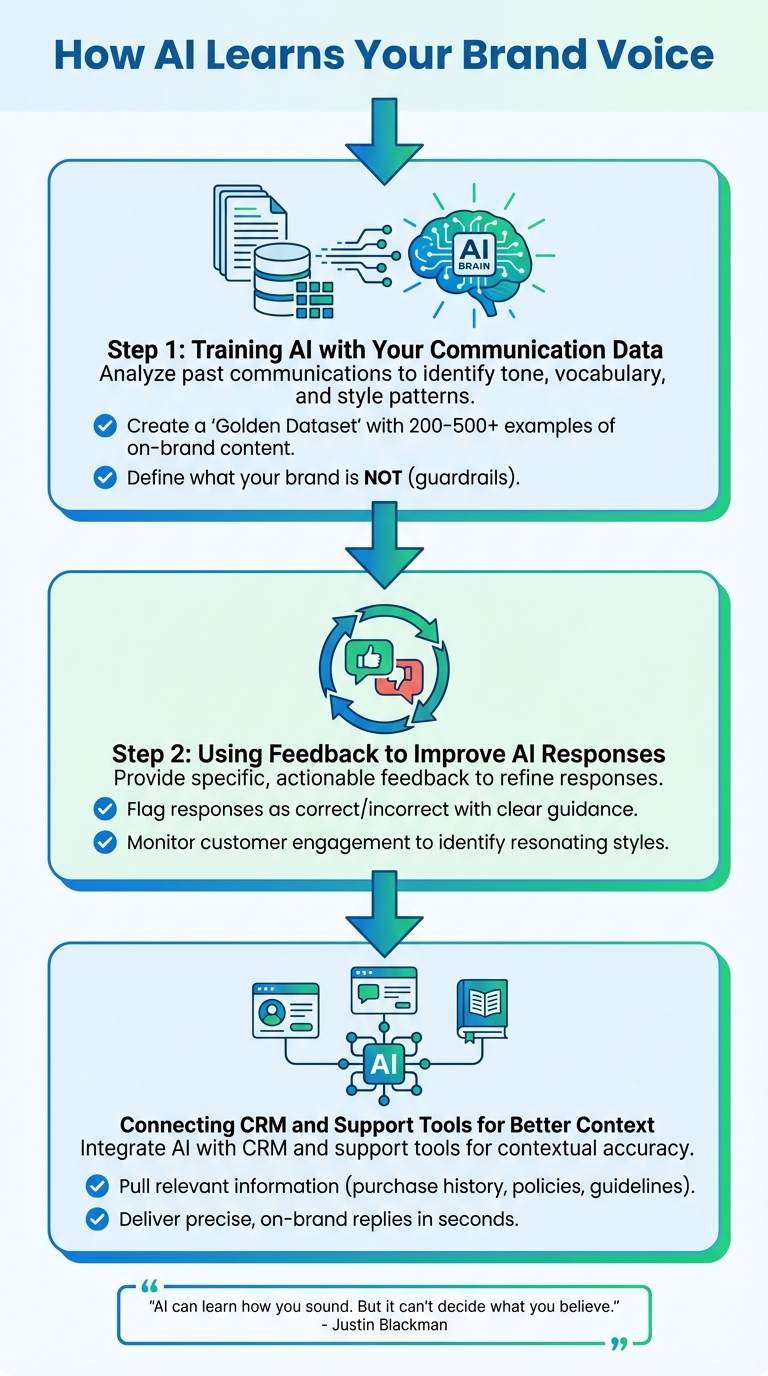
3-Step Process for Training AI to Match Your Brand Voice
AI doesn’t automatically know how to speak like your brand - it has to be taught. The journey begins with analyzing your existing communication style. Here's how AI evolves from a generic tool into a seamless extension of your brand identity.
Training AI with Your Communication Data
To learn your brand voice, AI studies your past communications, identifying patterns in tone, structure, vocabulary, and punctuation. By reviewing key pieces of content - like your "About Us" page, homepage copy, and high-performing emails - AI develops a detailed profile of how your brand communicates.
Large language models pick up on the nuances that define your tone. Are you witty or straightforward? Playful or professional? Brief or conversational? The AI organizes this understanding into prompt-and-response pairs, training itself to respond in your style across various scenarios.
Brand voice strategist Justin Blackman emphasizes this point:
"AI can learn how you sound. But it can't decide what you believe. You still have to teach it your perspective, your values, and your take on what matters most." – Justin Blackman, Brand Voice Strategist
A proven way to train AI is by creating a "Golden Dataset" with 200 to 500+ examples of on-brand content. These can come from support chats, sales emails, or social media replies. It’s also critical to define what your brand is not. For instance, if your brand avoids sarcasm or overly corporate language, those guardrails help the AI avoid off-brand responses.
Once the foundational voice profile is set, it’s refined further through ongoing feedback.
Using Feedback to Improve AI Responses
AI’s understanding of your brand voice improves with consistent coaching. Many platforms make this easy by offering feedback tools that let team members flag responses as correct or incorrect.
Specific feedback is key. Instead of saying, "This feels off", offer actionable input like, "This sentence is too long", or "It needs a sharper tone." Amy Marino from HubSpot explains the importance of clear guidance:
"Embrace iterative collaboration: Be specific about what's working and what's not. Direct feedback like 'X doesn't make sense because Y' or 'too run-on, not sharp enough' helped AI course-correct quickly." – Amy Marino, HubSpot
Customer reactions also provide valuable insights. By monitoring engagement, you can identify which styles resonate and tweak the AI accordingly. If the AI misses emotional or contextual cues, adding specific "say this, not that" rules can help close those gaps.
These refinements become even more effective when AI systems integrate with your existing tools.
Connecting CRM and Support Tools for Better Context
Training and feedback are essential, but contextual integration ensures AI responses stay accurate and aligned with your brand. By connecting the AI to your CRM and support tools, it can pull in relevant information - like help documents, macros, or internal guidelines - to craft precise, on-brand replies.
For example, if a customer asks about their order status, the AI can instantly check their purchase history, reference your shipping policies, and respond in your brand’s tone - all within seconds. Tools like Inbox Agents simplify this process by unifying messaging channels and integrating with your systems, ensuring every response is informed and consistent with your brand voice.
Steps to Help AI Match Your Brand Voice
Once you’ve got a handle on how AI powers real-time inbox monitoring, it’s time to put that knowledge to work. Teaching AI to reflect your brand voice takes careful planning and a structured approach.
Document Your Brand Voice Guidelines
AI can only mimic what it’s taught, so start by laying out clear, detailed rules for your brand’s personality. Is your tone formal or casual? Are you more empathetic or direct? Playful or serious? These traits should be translated into specific, actionable guidelines.
For example, create a chart with side-by-side comparisons of acceptable and unacceptable language. If your brand values approachability, you might include: “Use simple, empathetic phrases like ‘We’re here to help you figure this out,’” and contrast that with: “Avoid slang or overly casual expressions like ‘No worries, dude.’” These clear boundaries help the AI understand what aligns with your voice and what doesn’t.
Be explicit about mechanical details, too. If your company always refers to itself as “Acme Labs™” instead of just “Acme,” spell that out. Define preferences for punctuation, capitalization, greetings, sign-offs, and even sentence length. For instance, if you prefer short, engaging questions to connect with readers, make that clear.
Next, build a voice corpus - a collection of 200 to 500+ high-quality examples of your brand’s writing. Pull these from your “About Us” page, top-performing emails, website copy, and approved marketing materials. Don’t forget to include some negative examples - content that might seem close to your brand voice but misses the mark. This helps the AI learn what to avoid. Consistency like this can deliver measurable benefits, with some studies showing revenue gains of 23% to 33% when a unified voice is maintained across channels.
Test and Adjust AI Responses
Even the best documentation won’t guarantee perfect results right away. Testing is key. Create a “Golden Set” of 10 to 20 standard prompts that reflect common customer interactions, like welcome emails, complaint responses, or order confirmations. Use these prompts to evaluate how well the AI sticks to your brand guidelines with each update.
Treat AI outputs as drafts, not finished products. Have editors review them for style consistency, factual accuracy, and emotional tone. Keep an eye on the human edit rate - the percentage of AI-generated content that requires manual corrections - and aim to reduce it over time.
Set up feedback loops to refine the system. If the AI uses banned phrases or misses the tone, flag those issues and revise your instructions. Blind reviews, where team members compare AI-generated content with human-written examples without knowing which is which, can also help gauge authenticity. If the AI feels off, tweak your instructions by breaking down complex rules into simple, focused steps.
Adapt AI for Regional Differences
If you’re reaching customers across different regions, your AI needs to do more than just translate text - it has to reflect cultural nuances. A phrase that resonates in New York might fall flat in London or confuse someone in Sydney. Tailor idioms, references, and formality levels to suit each audience while staying true to your brand’s core identity.
To help the AI capture regional expressions accurately, upload native language examples. For instance, 3M operates in 70 countries with over 60,000 products. By training their AI with brand-specific data and localized translations, they reduced cases by 90% and SLA times by 75%, all while maintaining a consistent voice globally.
Generational preferences also matter. Millennials often respond well to short, conversational messaging, while Baby Boomers may prefer a more formal tone. Gen Z tends to favor empowering, self-service communication, while Gen X appreciates practical, incentive-driven messages. Fine-tune your AI to pick up on these differences without losing the essence of your brand.
Keeping Brand Voice Consistent Across Channels
Today’s customers expect a seamless experience, whether they’re interacting via messaging, email, or chat. In fact, 71% of customers expect personalization, and 76% feel frustrated when they receive inconsistent messages. AI plays a key role in meeting these expectations by ensuring your brand voice remains consistent across every interaction. This consistency becomes even more effective when paired with unified messaging platforms that streamline communication.
Using Unified Messaging Platforms
Handling conversations across email, SMS, WhatsApp, and social media through separate dashboards can quickly turn into a logistical nightmare. Each platform comes with its own inbox, history, and rules, making it incredibly challenging to maintain a consistent brand voice. That’s where unified messaging platforms step in to simplify the process.
Take Inbox Agents (https://inboxagents.ai), for example. This platform gathers all messaging channels into one interface, providing your AI with a single, cohesive framework for communication. You can define one AI persona with specific traits, behaviors, and a consistent communication style that’s applied across all channels. Whether a customer contacts you via email or social media, the AI draws from the same brand guidelines, ensuring a uniform tone without requiring constant manual adjustments.
This centralized approach eliminates "tone drift", ensuring that your brand personality shines through on every platform. And with 90% of customers valuing an "immediate" response, and 60% defining "immediate" as 10 minutes or less, a unified system allows your AI to respond quickly while maintaining quality. Once a centralized platform is in place, the next step is fine-tuning the AI’s tone for each specific channel.
Matching Tone Across All Platforms
Consistency doesn’t mean rigidity. While your AI should stay true to your brand’s core personality, it also needs to adapt to the unique norms of each platform. For instance, social media responses should be short and engaging, while emails can afford to be more detailed and professional. Despite these differences, both should still reflect the same brand identity.
AI achieves this through channel-specific adaptation, tweaking its tone, length, and formality based on the platform. For example, Wildride automated 33% of their email responses, and their AI was so well-aligned with their natural communication style that an influencer assumed they were speaking with a real team member. Similarly, Emily McEnany, Senior CX Manager at Dr. Bronner’s, shared that customers often mistake their AI for a human team member due to its well-calibrated tone.
Here’s the kicker: people can only identify AI-generated content 46.9% of the time. But this level of seamlessness is only achievable when the AI is thoroughly trained on your brand voice and equipped with tools to adapt across platforms. By operating from a unified platform with clear guidelines, your AI can effortlessly adjust its tone while keeping your brand recognizable on every channel.
Measuring How Well AI Matches Your Brand Voice
Keeping your brand voice consistent is no small task, especially when AI is involved. That’s why measuring performance is key. Regular evaluations help ensure your AI doesn’t stray from your brand’s identity.
Gathering Customer Feedback
One of the best ways to check how well your AI is performing is through direct customer feedback. Simple tools like thumbs-up or thumbs-down icons let users quickly flag responses that feel off-brand.
Blind reviews are another great method. Have your team compare AI-generated responses with human-written ones - without knowing which is which. If they can’t tell the difference, you’re on the right track. Tosha Moyer, Senior Customer Experience Manager at Psycho Bunny, summed it up perfectly:
"The overall tone is good, and its responses are really excellent".
A/B testing is also incredibly useful. For instance, you can test AI-generated email subject lines or social media posts against human-written ones. Metrics like open rates, click-through rates, and reply rates will show you what resonates most with your audience. These insights not only validate your AI’s tone but also feed into broader quality metrics to maintain brand consistency.
Tracking Quality Metrics
Once you’ve gathered feedback, it’s time to dig into the numbers. Start with Customer Satisfaction Scores (CSAT) to measure how happy people are after interacting with your AI. Pair that with response accuracy - how often the AI answers questions correctly without needing human help - and track how frequently team members have to edit AI drafts.
Brand alignment reviews are another critical step. Use scored rubrics to see if AI outputs match your style guide. Check for proper vocabulary, the right level of formality, and whether banned phrases are avoided. Monitoring your “voice violation rate” gives you a clear picture of how often the AI misses the mark. Many teams also use a “golden set” of 10–20 standard customer inquiries to test each AI update, ensuring the tone stays consistent over time.
Here’s a quick snapshot of what to measure and why it matters:
| Metric Category | What to Measure | Why It Matters |
|---|---|---|
| Customer Sentiment | CSAT, engagement rates, reply sentiment | Reflects if customers feel heard and valued |
| Brand Alignment | Tone consistency score, policy adherence | Ensures the AI stays true to your brand guidelines |
| Operational Efficiency | First response time, resolution rate | Confirms AI delivers speed without losing quality |
| Technical Accuracy | Response accuracy, human edit rate | Tracks how often the AI needs corrections |
These metrics work together to ensure your AI consistently represents your brand across all channels.
Building Stronger Customer Relationships
Robust metrics and feedback don’t just measure performance - they help strengthen customer loyalty. When your AI consistently delivers on-brand responses, it builds trust. And trust is the foundation of loyalty. Research backs this up: 64% of customers prefer buying from companies that tailor experiences to their needs. A well-tuned AI can deliver that personalization at scale.
Amber van den Berg, Head of Customer Experience at Wildride, shared a memorable story:
"An influencer emailed us saying, 'I really love you guys,' and our AI Agent replied, 'Love you too,' with heart emojis… It was just like an email from me and my other team members".
These authentic interactions don’t just make customers happy - they deepen their loyalty.
And the benefits go even further. When your AI maintains a consistent voice across thousands of interactions, it builds a reputation for reliability. Customers know what to expect, and that predictability becomes a competitive edge. With 90% of customers saying an "immediate" response is important and 60% defining "immediate" as 10 minutes or less, having an AI that’s both quick and authentic is a game-changer.
Conclusion
A consistent brand voice is key to building trust and loyalty on a large scale. AI can take your unique style and seamlessly apply it across email, chat, social media, and other communication channels. Considering that 71% of people expect personalized interactions and 90% want immediate responses, AI helps bridge the gap between speed and genuine connection.
Think of AI as an extension of your team, not a replacement for human judgment. By training AI with your style guides, providing real-world examples, and setting clear boundaries, you can create a system capable of managing thousands of conversations while maintaining a human touch. Research even shows that people can only identify AI-generated content 46.9% of the time, proving that well-trained AI can deliver responses that customers trust.
Inbox Agents takes this a step further by bringing all your messaging platforms into one easy-to-use interface. Its AI tools learn your brand's personality and apply it consistently across channels - whether you're calming an upset customer on Instagram or connecting with a loyal buyer through email. With features like smart replies and personalized responses, the platform adapts to each situation while staying true to your brand voice, ensuring every interaction feels genuine.
FAQs
How does AI maintain a consistent brand voice across all communication channels?
AI plays a key role in maintaining a consistent brand voice by learning and applying a company's distinct tone, style, and terminology across various platforms like email, social media, chat, and SMS. It all starts with crafting a detailed brand voice guide. This guide outlines the brand’s personality, preferred language, and even what to steer clear of, serving as the foundation for training AI models to replicate the brand’s communication style with precision.
The AI tailors messages to fit the platform - keeping it brief for SMS or more detailed for email - while ensuring the brand’s voice remains intact. To keep everything on track, real-time monitoring and human oversight are used to catch any deviations and review sensitive communications for accuracy. Tools like Inbox Agents simplify this process by centralizing messaging and using AI to deliver consistent, on-brand responses across all customer interactions.
How does AI learn to match a brand's tone and style in responses?
AI learns to embody a brand's tone by first grasping the essence of its unique voice. This begins with defining key personality traits - whether the brand is approachable, formal, or playful - and translating these traits into clear guidelines. These guidelines cover everything from word choice and phrasing to sentence structure and even the use of emojis. A collection of past content, like emails or social media posts, serves as a reference point, helping the AI recognize patterns it can mimic.
The next step involves training the AI with carefully selected examples that highlight both the dos and don’ts of the brand's style. Fine-tuning techniques, such as prompt engineering, ensure the AI stays aligned with the brand's tone. Human feedback during testing helps polish responses, ensuring they remain consistent and natural. To keep the AI on track, the training materials are regularly updated, preventing any drift from the brand's established voice.
Ongoing monitoring is key to ensuring the AI consistently delivers accurate and on-brand responses. Tools like Inbox Agents streamline this process, enabling AI-driven replies that reflect your brand's tone while offering the option for human oversight when necessary.
How does customer feedback help AI improve brand voice in responses?
Customer feedback plays a critical role in shaping AI-generated responses to align with your brand's unique tone and personality. When users highlight replies as being too formal, off-brand, or unclear, this feedback allows the AI to adjust its language, tone, and level of empathy to better reflect your brand's identity.
By integrating this feedback into its training process, the AI can refine its responses and prevent "style drift" - a gradual shift away from your brand's voice. Tools like Inbox Agents simplify this process by pinpointing flagged messages, updating smart-reply suggestions, and applying updated voice guidelines to future interactions. While human oversight remains a key factor, this feedback loop ensures your AI consistently delivers responses that feel genuine and aligned with your brand.